
Learning how to memorize faster is one of the most valuable skills a student can develop. Whether you are preparing for an exam, learning a new language, studying scientific terminology, reviewing historical dates, or trying to remember a long presentation, the ability to retain information efficiently can save hours of study time.
However, memorizing faster does not mean simply reading information repeatedly or trying to force more facts into your brain in a short period. Effective memorization depends on how information is encoded, connected, retrieved, and reviewed.
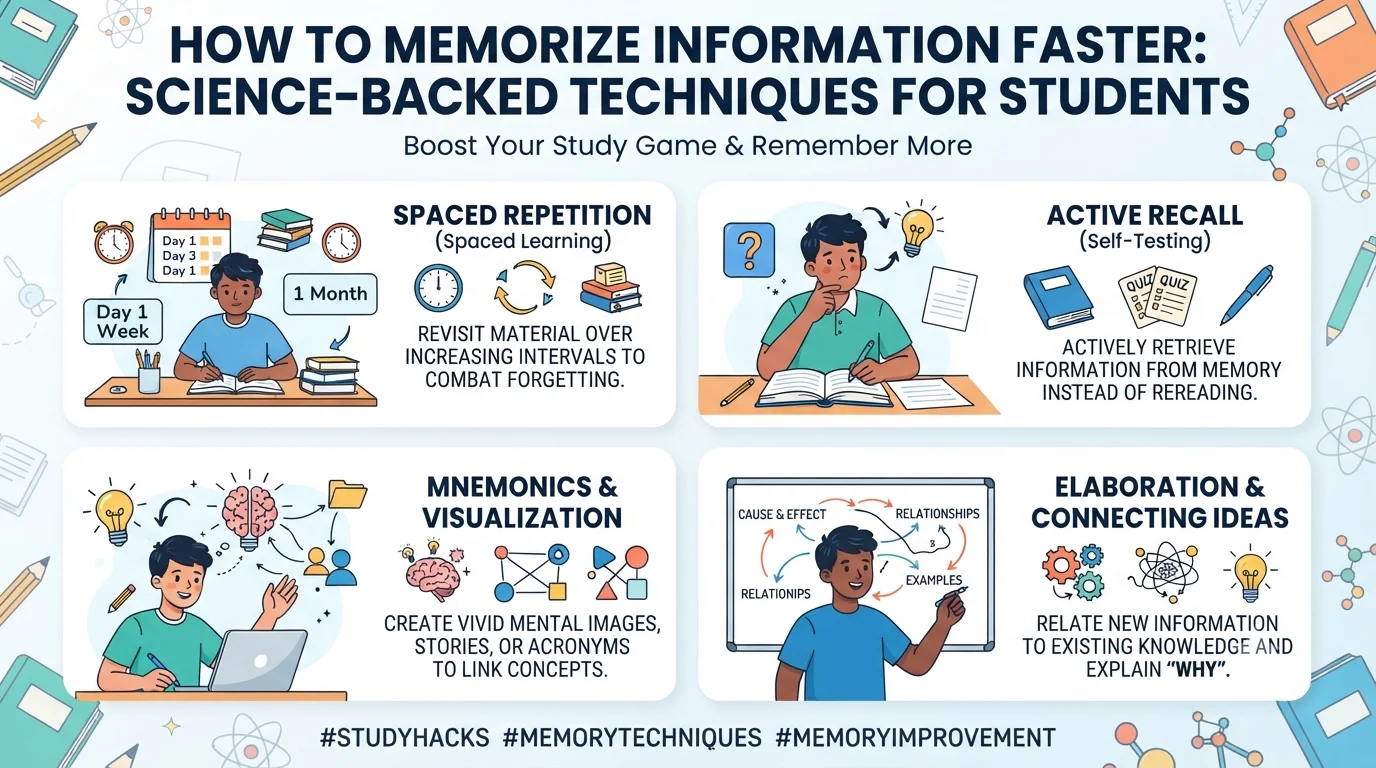
The strongest approach combines several evidence-based learning strategies rather than relying on a single trick.
Students who understand how memory works can make studying more efficient without necessarily studying for longer hours. Techniques such as active recall, spaced repetition, elaboration, chunking, dual coding, mnemonic devices, interleaving, and practice testing can help transform passive studying into active learning.
This guide explains practical memory techniques that students can use immediately. It also explores common study mistakes, how sleep and exercise affect learning, how to create a memorization schedule, and how to adapt techniques to different subjects.
read more about study planner app
Why Memorization Is More Than Repetition
The Brain Does Not Store Information Like a Computer
It is tempting to think of memory as a storage system where information is placed into a mental folder.
Human memory is more complicated.
When you study something, your brain needs to process the information before it becomes easier to retrieve later. Attention, prior knowledge, emotional state, sleep, and the way information is practiced can all influence learning.
Simply looking at a textbook page many times does not necessarily mean that the information has been learned.
You may recognize a sentence when you see it but still be unable to explain it without looking at the page.
This distinction is extremely important.
Recognition is not the same as recall.
Memorization Depends on Retrieval
One of the most useful principles for students is that remembering becomes stronger when you practice retrieving information.
Instead of repeatedly asking:
“Have I seen this before?”
Ask:
“Can I produce the answer without looking?”
That small change can completely transform a study session.
How to Memorize Faster: The Core Principles
1. Understand Before You Memorize
Trying to memorize information that you do not understand is often inefficient.
Suppose you need to memorize a scientific process.
You could repeat the names of the stages dozens of times.
Or you could first understand what happens during each stage and why the stages occur in that order.
Once the concept makes sense, the terminology becomes easier to attach to the underlying idea.
Understanding creates mental connections.
Those connections give your brain more ways to retrieve the information later.
2. Break Information Into Smaller Units
Large amounts of information can feel overwhelming.
Instead of trying to memorize an entire chapter at once, divide it into manageable units.
For example:
Chapter.
Section.
Concept.
Definition.
Example.
Application.
This technique is known as chunking.
3. Retrieve Instead of Re-Reading
One of the most important study hacks is replacing excessive rereading with active recall.
After studying a section, close the book.
Then ask yourself:
What were the main ideas?
What terms did I learn?
Can I explain the process?
What examples were given?
What would the teacher probably ask on the exam?
Try answering without looking.
The effort involved in retrieval is part of the learning process.
4. Review Information Over Time
Spaced repetition is another powerful method.
Instead of studying the same material for several hours in one day, distribute review sessions over multiple days.
A simple schedule might look like:
First review: same day.
Second review: next day.
Third review: three days later.
Fourth review: one week later.
Fifth review: two weeks later.
The exact schedule can vary, but the general principle is consistent: revisit information over time rather than relying entirely on one intensive session.
read more about brain foods for studying
Active Recall: One of the Most Powerful Memory Techniques
What Is Active Recall?
Active recall means deliberately trying to retrieve information from memory.
You are not simply looking at information.
You are generating it.
Examples include:
Answering practice questions.
Using flashcards.
Explaining a topic from memory.
Writing everything you remember on a blank page.
Taking practice tests.
Creating questions and answering them later.
Why Active Recall Works
When you retrieve information, you practice the same basic process you will need during an exam.
This makes active recall particularly useful for students.
Imagine studying a biology chapter.
A passive approach would involve reading the chapter repeatedly.
An active approach would involve closing the book and answering questions such as:
What is the function of this structure?
What happens next?
Why does this process occur?
What is the difference between these two concepts?
The second method gives your memory a workout.
How to Use Active Recall During a Normal Study Session
Start by studying one small section.
Close your notes.
Write down everything you can remember.
Open your notes.
Compare your answer with the original material.
Identify missing information.
Repeat the process later.
The goal is not to remember everything perfectly during the first attempt.
The goal is to identify what your memory can and cannot currently retrieve.
Spaced Repetition for Long-Term Memory
What Is Spaced Repetition?
Spaced repetition is a study strategy where reviews are separated by increasing periods of time.
Instead of reviewing the same information repeatedly in one sitting, you return to it after a delay.
For example:
Day 1: Learn.
Day 2: Review.
Day 4: Review.
Day 7: Review.
Day 14: Review.
Day 30: Review.
This approach is particularly useful for:
Vocabulary.
Definitions.
Formulas.
Medical terminology.
Historical facts.
Foreign-language learning.
Professional certifications.
Why Cramming Feels Effective
Cramming can create a temporary feeling of familiarity.
After reading the same material for several hours, the information may feel extremely familiar.
But familiarity can be misleading.
You might recognize the material while looking at it but struggle to retrieve it independently several days later.
Spaced practice helps reveal whether knowledge is actually becoming durable.
How Students Can Build a Spaced Repetition System
Create a list of information that must be memorized.
Turn each item into a question.
For example:
Question: What is the definition of opportunity cost?
Answer: The value of the next-best alternative that is given up when a choice is made.
Review the question later without looking at the answer.
If you remember it easily, increase the interval.
If you struggle, review it sooner.
Flashcards: How to Use Them Correctly
Flashcards Are Tools, Not Magic
Flashcards can be extremely effective, but only when used actively.
Reading the answer before attempting to remember it turns the activity into recognition.
Instead:
Read the question.
Hide the answer.
Answer aloud or mentally.
Then check the answer.
Keep Flashcards Simple
Avoid putting an entire paragraph on one card.
A better card asks one focused question.
Instead of:
“Explain everything about the human circulatory system.”
Use:
“What is the main function of red blood cells?”
Then create separate cards for other concepts.
Use Both Directions When Appropriate
For language learning, for example, students may need to practice:
English → native language.
Native language → English.
Word → definition.
Definition → word.
The correct direction depends on what you need to perform later.
The Feynman Technique
Explain the Topic in Simple Language
The Feynman technique is a popular learning strategy based on explaining a concept as simply as possible.
Choose a topic.
Pretend you are explaining it to someone who knows nothing about it.
Use simple language.
Avoid unnecessary jargon.
When you become stuck, return to your notes.
Then try again.
Why Explanation Helps Memory
Explaining requires retrieval, organization, and understanding.
It also exposes gaps in your knowledge.
If you cannot explain an idea without reading your notes, you may not understand it as well as you thought.
Use Real Examples
Suppose you are learning supply and demand.
Instead of memorizing a definition alone, explain it using a real-world example.
Imagine a popular product suddenly becomes difficult to obtain.
Ask:
What happens to supply?
What happens to price?
What happens to consumer behavior?
Connecting concepts to examples makes abstract information easier to work with.
read more about stay focused while studying
Chunking: Memorize More by Organizing Information
What Is Chunking?
Chunking means grouping smaller pieces of information into meaningful units.
A common everyday example is telephone numbers.
Instead of remembering a long sequence of individual digits, people often group digits into smaller sections.
Students can apply the same principle.
Chunking Vocabulary
Instead of memorizing twenty unrelated words, group them by category.
For example:
Travel.
Transportation.
Accommodation.
Food.
Directions.
This creates structure.
Chunking Historical Information
Dates can be grouped by:
Century.
Political period.
War.
Leader.
Scientific development.
This gives isolated facts a larger framework.
Chunking Scientific Information
A long biological process can be divided into:
Input.
Stage one.
Stage two.
Stage three.
Output.
Once the structure is remembered, individual details have a place to attach.
Mnemonic Devices
What Are Mnemonics?
Mnemonic devices are memory aids that help connect difficult information to something easier to remember.
They can involve:
Acronyms.
Rhymes.
Stories.
Images.
Locations.
Associations.
Acronyms
If several items must be remembered in a particular order, an acronym may help.
Create a memorable word using the first letters of the items.
The best acronym is one that is easy to pronounce and visually distinctive.
Acrostics
An acrostic uses the first letter of each item to create a sentence.
This can be useful for ordered lists.
The sentence does not have to be logically perfect.
It simply needs to be memorable.
Rhymes
Rhymes can help with sequences, rules, or short facts.
Rhythm gives information an additional pattern.
Stories
Creating a strange story that connects unrelated pieces of information can be surprisingly effective.
Imagine you need to remember:
A key.
A book.
A bicycle.
A lemon.
A clock.
Instead of repeating the list, imagine a giant lemon riding a bicycle while carrying a book and unlocking a clock with a key.
The more unusual the story, the easier it may be to visualize.
The Method of Loci
What Is the Method of Loci?
The method of loci, sometimes called a memory palace, involves associating information with familiar physical locations.
Choose a familiar place.
It could be:
Your home.
Your route to school.
Your classroom.
A familiar building.
Imagine walking through the location.
Assign information to specific places.
Example of a Memory Palace
Suppose you need to remember five presentation points.
Place the first point at the front door.
Place the second point on the sofa.
Place the third point in the kitchen.
Place the fourth point in the bedroom.
Place the fifth point near the window.
During recall, mentally walk through the location.
Each position acts as a retrieval cue.
Make the Images Unusual
Ordinary images may be easy to forget.
Strange, exaggerated, humorous, or emotionally distinctive images can create stronger associations.
If you need to remember the word “elephant,” do not imagine an ordinary elephant.
Imagine an elephant sitting on your desk wearing sunglasses.
The unusual image gives your brain something distinctive to retrieve.
Dual Coding
Combine Words and Visual Information
Dual coding involves using both verbal and visual representations when appropriate.
Instead of reading a description of a process only, create a diagram.
Instead of memorizing a list of components, draw them.
Instead of studying a geographical concept entirely through text, use a map.
Examples for Students
Biology:
Diagram the body system.
History:
Create a timeline.
Chemistry:
Draw molecular structures.
Geography:
Use maps.
Mathematics:
Graph relationships.
Business:
Create process diagrams.
Visual representations can provide additional retrieval cues.
Elaborative Learning
Ask Why and How
Elaboration means connecting new information to existing knowledge.
Instead of asking only:
“What is this?”
Ask:
Why does it happen?
How does it work?
What causes it?
What is an example?
How is it different from another concept?
Where would I use it?
These questions force deeper processing.
Connect New Information to What You Already Know
Suppose you learn about a new economic concept.
Ask how it relates to:
Supply.
Demand.
Pricing.
Consumers.
Businesses.
Government policy.
The more connections you create, the more pathways you may have for retrieval.
Interleaving Different Topics
What Is Interleaving?
Interleaving means mixing related topics or problem types rather than practicing one type continuously.
For example, instead of solving twenty identical mathematics problems, you might practice:
Algebra.
Geometry.
Probability.
Algebra.
Geometry.
Probability.
This forces you to identify which strategy is appropriate.
Why Interleaving Can Feel Hard
Interleaving may feel less comfortable than repetitive practice.
When every problem looks the same, you know exactly what method to use.
With mixed practice, you have to decide.
That additional decision-making can make practice feel harder.
But difficulty during practice does not automatically mean poor learning.
Practice Testing
Turn Studying Into a Test
Practice tests are valuable because they combine retrieval with realistic performance.
Do not wait until the night before an exam.
Use practice questions throughout the learning process.
Create Your Own Questions
After each chapter, write questions that a teacher could ask.
Include:
Definitions.
Comparisons.
Applications.
Problem-solving questions.
“Why” questions.
“Explain” questions.
Then answer them without your notes.
Correct Mistakes Immediately
When you make a mistake, identify why.
Did you:
Forget the information?
Misunderstand the concept?
Misread the question?
Use the wrong formula?
Confuse two similar ideas?
The answer determines what you should review.
The Importance of Sleep for Memory
Studying More Is Not Always Better
Students often sacrifice sleep to gain additional study hours.
That strategy can backfire.
Sleep is closely connected to learning and memory processes.
A tired student may have more difficulty:
Concentrating.
Encoding new information.
Retrieving knowledge.
Maintaining attention.
Making decisions.
Therefore, improving study efficiency can be more valuable than simply extending study time.
Avoid Making All-Nighters Your Main Strategy
An occasional late study session may happen, but relying on all-nighters is generally a poor long-term learning strategy.
A better approach is:
Study earlier.
Use spaced repetition.
Take breaks.
Sleep adequately.
Review later.
This distributes the learning process instead of forcing everything into one night.
read more about study tools
Exercise and Memory
Movement Supports Overall Brain Health
Regular physical activity is associated with many aspects of physical and mental well-being.
For students, movement can also provide a useful break from prolonged sitting.
You do not necessarily need an elaborate workout.
Walking, cycling, recreational sports, or other forms of regular activity can be practical options.
Use Movement as a Study Break
Instead of scrolling through social media during every break, consider walking for a few minutes.
The goal is to return to studying refreshed rather than mentally overloaded.
Nutrition and Hydration
Avoid Studying While Dehydrated
Hydration supports normal physical and cognitive functioning.
Keep water nearby during long study sessions.
Eat Balanced Meals
Students do not need a magical “memory food.”
A generally balanced diet provides the nutrients needed for overall health.
Focus on regular meals and varied foods rather than relying on supplements or extreme dietary strategies.
Managing Distractions
Attention Comes Before Memorization
If your attention is divided, information may not be encoded effectively in the first place.
A student who studies for two hours while constantly checking notifications may accomplish less than someone who studies with full concentration for a shorter period.
Create a Distraction-Free Environment
Before studying:
Put your phone away.
Turn off unnecessary notifications.
Close unrelated browser tabs.
Prepare the materials you need.
Choose a quiet location.
Tell others when you need uninterrupted time.
Reducing distractions can improve the quality of each study session.
The Pomodoro Technique and Memory
Study in Focused Intervals
A simple approach is to study for a focused period followed by a short break.
For example:
25 minutes studying.
5 minutes break.
25 minutes studying.
5 minutes break.
After several cycles, take a longer break.
However, the exact timing is not sacred.
Some students work better with 40-minute or 50-minute periods.
The important principle is maintaining focused attention while avoiding excessive fatigue.
How to Memorize Faster Before an Exam
Start by Identifying High-Priority Material
Do not treat every fact as equally important.
Review:
Learning objectives.
Past exam questions.
Teacher emphasis.
Major concepts.
Frequently tested material.
Core definitions.
Important formulas.
Then organize the material by priority.
Create a One-Page Summary
After studying a chapter, create a compact summary.
Include:
Key concepts.
Essential definitions.
Important formulas.
Major relationships.
Common mistakes.
This summary becomes a useful review tool.
Use Retrieval Before Reading the Summary
Instead of immediately reading your summary, try to reconstruct it from memory.
Then compare your version with the actual summary.
This transforms the summary into an active recall exercise.
A 30-Minute Memorization Session
Minutes 1–5: Preview
Identify exactly what you need to learn.
Minutes 6–15: Learn
Study the material carefully.
Focus on understanding.
Minutes 16–20: Close the Notes
Retrieve the information from memory.
Minutes 21–25: Check
Compare your recall with the original material.
Minutes 26–30: Practice
Answer questions or explain the material aloud.
Repeat the process later using spaced repetition.
A One-Week Memorization Plan
Day 1
Learn the material.
Create questions.
Build initial flashcards.
Day 2
Use active recall.
Correct mistakes.
Day 3
Practice again.
Mix old and new material.
Day 4
Test yourself without notes.
Day 5
Focus on weak areas.
Day 6
Complete a practice test.
Day 7
Perform a final retrieval session.
This approach is generally more useful than trying to memorize everything the night before.
How to Memorize Vocabulary Faster
Group Words by Meaning
Organize vocabulary into categories.
For example:
Travel.
Work.
Education.
Food.
Emotions.
Daily activities.
Use Words in Sentences
Do not memorize a translation alone.
Create a sentence using the word.
This helps connect the word to context.
Retrieve Before Looking
See the foreign word and produce the meaning.
Then reverse the process if you need to speak or write the foreign language.
Use Images
Connect concrete vocabulary with mental images.
For abstract words, create an example or situation that represents the meaning.
How to Memorize Definitions
Convert Definitions Into Questions
Instead of reading:
“Photosynthesis is…”
Create:
“What process allows plants to convert light energy into chemical energy?”
Then retrieve the answer.
Compare Similar Definitions
When two concepts are easy to confuse, study them together.
Create a comparison table.
Ask:
How are they similar?
How are they different?
When would I use each one?
This reduces confusion.
How to Memorize Formulas
Understand What the Formula Represents
Do not memorize symbols without understanding them.
Identify:
What each variable means.
What units are involved.
What relationship the formula describes.
Practice From Memory
Write the formula without looking.
Then solve a problem using it.
Finally, explain why the formula makes sense.
Connect Formulas to Visuals
Graphs and diagrams can help you understand relationships between variables.
This is particularly useful in mathematics and science.
How to Memorize Long Lists
Organize the List
Divide it into groups.
Create Associations
Connect each item to the next.
Use a Story
Turn the sequence into a memorable narrative.
Use a Memory Palace
Place each item in a familiar location.
Retrieve the Entire Sequence
Practice reproducing the list without looking.
Why Some Study Hacks Do Not Work as Well as Expected
Highlighting Everything
Highlighting can help identify important information, but highlighting an entire page does not force meaningful retrieval.
Passive Rereading
Rereading can create familiarity without guaranteeing durable recall.
Copying Notes Repeatedly
Writing information can be useful, but copying text word-for-word is often less effective than generating your own explanation.
Studying Only What You Already Know
Students naturally prefer familiar material because it feels comfortable.
But learning requires attention to weak areas too.
Multitasking
Watching videos, checking messages, and studying simultaneously divides attention.
Focused study is usually more efficient.
How to Measure Whether You Actually Memorized Something
Use the Blank Page Test
Take a blank sheet.
Write everything you remember.
Then compare it with your notes.
This reveals gaps quickly.
Teach Someone Else
Explain the topic without looking at your materials.
If your explanation is clear and complete, your understanding is likely stronger.
Take a Practice Test
A practice test provides a more realistic measure of retrieval.
Wait Before Testing Again
Do not test yourself immediately after reading and assume success.
Test later.
If you can still retrieve the information after a delay, that is stronger evidence of learning.
The Best Memorization Strategy Is a Combination
There is no single magic technique that makes every subject easy.
The most effective approach is usually a combination of strategies.
For example:
Understand the concept.
Break it into chunks.
Create questions.
Practice active recall.
Use spaced repetition.
Add mnemonics when appropriate.
Use diagrams.
Practice with questions.
Sleep adequately.
Review weak areas.
This creates a complete learning system rather than relying on one study trick.
read more about online learning vs traditional learning
Learning how to memorize faster is not about forcing your brain to absorb information at maximum speed.
It is about studying in a way that makes information easier to retrieve later.
The most useful memory techniques are generally those that require active participation.
Instead of repeatedly reading a chapter, test yourself.
Instead of memorizing disconnected facts, organize them.
Instead of cramming everything into one evening, space your reviews.
Instead of memorizing a definition without context, explain it in your own words.
Instead of studying until exhaustion, use focused sessions and protect your sleep.
For students, the goal should not simply be to remember information until the exam is over. The goal should be to build knowledge that remains accessible when it is needed.
A strong study system therefore looks like this:
Understand.
Organize.
Retrieve.
Correct.
Space.
Repeat.
Test.
That cycle can make studying more efficient while also improving confidence.
The most important change may be surprisingly simple: stop measuring a study session by how many pages you have read and start measuring it by how much you can remember without looking.
When you can close the book and explain the material clearly, answer questions, solve problems, and connect ideas from memory, you are no longer simply looking at information.
You are learning it.