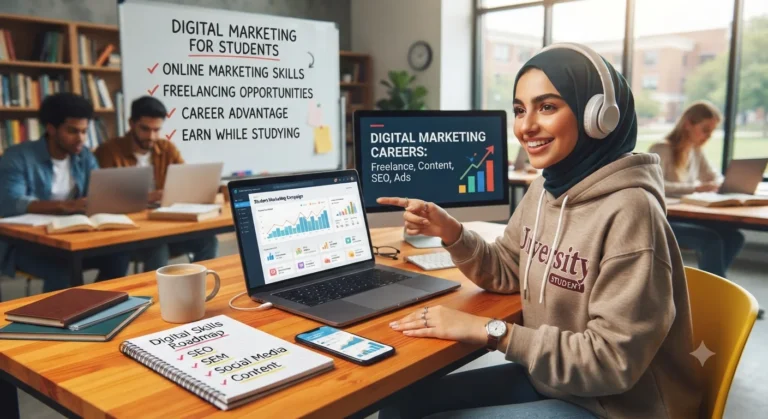

The way businesses attract customers, communicate with audiences, and generate sales has changed dramatically. Traditional advertising still has a place in the market, but digital platforms now influence almost every stage of the customer journey. People discover products through search engines, social media, videos, online reviews, websites, email campaigns, influencers, and digital advertisements.
This shift has created a growing demand for people who understand how digital channels work. For students, learning digital marketing skills is no longer simply an optional advantage. It can become a practical career skill that opens doors to employment, freelancing, entrepreneurship, and an online business.
Digital marketing combines creativity, communication, technology, business strategy, psychology, and data analysis. This makes it particularly valuable for students because the skills can be applied across industries rather than being limited to one specific profession.
A student who understands how to create content, analyze an audience, optimize a website, manage social media, understand advertising campaigns, and interpret marketing data can bring measurable value to almost any modern organization.
read more about career courses
Digital marketing is more than posting on social media
One common misunderstanding is that digital marketing simply means creating Instagram posts or publishing content on social media. Social media is only one part of a much larger field.
Digital marketing can include:
- Search engine optimization
- Social media marketing
- Content marketing
- Email marketing
- Paid advertising
- Search engine marketing
- Marketing analytics
- Conversion rate optimization
- Influencer marketing
- Affiliate marketing
- E-commerce marketing
- Brand management
- Customer relationship management
- Marketing automation
The ability to understand how these areas work together can give students a significant advantage when entering the professional world.
What Are Digital Marketing Skills?
The core skills every student should understand
Digital marketing skills are the practical abilities required to promote products, services, brands, or organizations through digital channels.
Some skills are technical, while others depend heavily on creativity and communication.
Important digital marketing skills include:
Content creation: Understanding how to develop useful and engaging written, visual, and video content.
SEO: Knowing how search engines work and how websites can improve their visibility in organic search results.
Social media marketing: Understanding how different social platforms attract different audiences and how content strategies should be adapted accordingly.
Paid advertising: Learning how online advertising campaigns work, including targeting, budgeting, creative testing, and performance measurement.
Analytics: Being able to interpret data and determine whether marketing activities are producing meaningful results.
Copywriting: Writing persuasive headlines, advertisements, product descriptions, landing pages, emails, and social media content.
Audience research: Understanding customer needs, motivations, problems, interests, and purchasing behavior.
Email marketing: Building communication strategies that nurture potential customers and encourage repeat purchases.
Conversion optimization: Understanding how to turn website visitors, followers, or leads into customers.
A student does not need to master every skill immediately. Developing a strong foundation and gradually specializing in one or two areas can be a highly effective approach.
Why Students Should Learn Digital Marketing
It creates career opportunities
One of the strongest reasons students should develop digital marketing skills is the variety of career opportunities available.
Companies across different industries need professionals who can help them attract customers and generate revenue online. This includes technology companies, retail businesses, financial organizations, educational institutions, healthcare businesses, hospitality companies, startups, agencies, and e-commerce brands.
Students can eventually pursue roles such as:
- Digital Marketing Specialist
- SEO Specialist
- Social Media Specialist
- Content Marketer
- Performance Marketing Specialist
- Paid Media Specialist
- Email Marketing Specialist
- Copywriter
- Marketing Analyst
- E-commerce Specialist
- Marketing Coordinator
- Growth Marketing Specialist
This variety allows students to explore different career paths before deciding where they want to specialize.
It complements almost every university major
Digital marketing is particularly valuable because it does not belong exclusively to marketing students.
A business student can use digital marketing to understand customer acquisition and sales.
A computer science student can combine technical knowledge with SEO, analytics, automation, or digital products.
A design student can use marketing knowledge to understand how visual content contributes to conversions and brand recognition.
A communications student can apply storytelling and communication skills to content marketing and social media.
Even students studying fields such as tourism, languages, finance, engineering, or education can benefit from understanding how digital audiences behave.
This makes digital marketing a transferable skill rather than a narrow academic specialization.
read more about mobile learning
Digital Marketing and the Modern Marketing Career
Employers increasingly value practical skills
Academic qualifications can demonstrate that a student has studied a particular subject, but practical skills demonstrate the ability to apply knowledge.
This distinction is especially important in marketing.
A student may understand marketing theory but still struggle to create a campaign, write an advertisement, analyze performance data, or develop a content strategy.
Learning digital marketing gives students opportunities to practice real-world activities.
For example, a student can create a hypothetical campaign for a local restaurant, build a content calendar for an imaginary fashion brand, optimize a simple website, analyze social media performance, or develop an SEO strategy for a small business.
These projects can become evidence of practical ability.
A portfolio can be more powerful than a list of courses
Students often collect certificates without actually applying what they learn. Although education and certifications can be useful, practical projects can make a stronger impression when demonstrating competence.
A digital marketing portfolio might contain:
- SEO audits
- Social media strategies
- Sample advertising campaigns
- Content calendars
- Blog articles
- Email campaigns
- Landing page copy
- Competitor research
- Customer personas
- Marketing reports
- Campaign performance analysis
The objective is not to create a perfect portfolio. The goal is to demonstrate how the student thinks, researches, creates, measures, and improves marketing activities.
Digital Marketing Can Support Freelancing
Students can work with clients remotely
One of the most attractive aspects of digital marketing is its compatibility with freelancing.
Many marketing tasks can be completed remotely. A freelancer may work with a local company, an international startup, an e-commerce store, a personal brand, or a marketing agency without being physically present in the same location.
Students can potentially offer services such as:
- Social media management
- Content writing
- SEO
- Copywriting
- Email marketing
- Marketing research
- Advertising support
- Graphic content creation
- Short-form video content
- Marketing reporting
This flexibility can be valuable for students because they can gain professional experience while continuing their education.
Freelancing teaches more than marketing
Freelancing also develops business skills that traditional classroom education may not fully provide.
A student who works with clients learns how to:
- Communicate professionally
- Understand client requirements
- Create proposals
- Set prices
- Meet deadlines
- Manage projects
- Handle revisions
- Present results
- Build professional relationships
These skills can become valuable throughout a person’s career, whether they remain freelancers or eventually move into full-time employment.
Digital Marketing and Online Business
Marketing is essential for online entrepreneurship
Students interested in starting an online business should understand digital marketing because having a good product is not enough.
A business needs customers.
An online store may have excellent products, but without traffic, visibility, compelling messaging, and effective customer acquisition, sales can remain limited.
Digital marketing helps entrepreneurs answer important questions:
- Who is the target customer?
- What problem does the product solve?
- Where does the target audience spend time online?
- What type of content attracts attention?
- Which advertising channels produce results?
- Why do visitors leave without buying?
- How can customers be encouraged to return?
Understanding these questions can dramatically improve an entrepreneur’s ability to make informed decisions.
Students can practice before launching a business
One advantage of learning digital marketing is that students can practice without immediately investing significant amounts of money.
They can create a mock brand, develop social media content, research competitors, write blog posts, study keywords, create advertising concepts, or build a basic marketing plan.
This creates a low-risk environment for experimentation.
Over time, these experiments can evolve into an actual business idea.
SEO as a Valuable Digital Marketing Skill
Search visibility can create long-term value
Search engine optimization, commonly known as SEO, is one of the most valuable digital marketing disciplines.
SEO focuses on improving a website’s ability to appear prominently in relevant search results.
Students who understand SEO learn how search intent, keywords, website structure, content quality, technical performance, and authority can influence organic visibility.
SEO is particularly useful because it teaches students to think about what people actually want when they search.
For example, someone searching for “best laptops for university students” has a different intention from someone searching for “how laptop processors work.”
A marketer needs to understand this difference when creating content.
SEO develops analytical thinking
SEO is not only about writing articles.
It involves:
- Keyword research
- Search intent analysis
- Competitor research
- Content planning
- On-page optimization
- Technical considerations
- Internal linking
- Performance monitoring
- Data interpretation
This combination of creativity and analysis makes SEO an excellent skill for students who enjoy both writing and problem-solving.
Social Media Marketing Skills
Social platforms have become major communication channels
Social media has transformed the relationship between businesses and customers.
Companies can communicate directly with audiences, build communities, introduce products, respond to questions, collect feedback, and generate sales.
However, effective social media marketing requires more than frequent posting.
A marketer must understand:
- Audience behavior
- Platform differences
- Content formats
- Brand voice
- Engagement
- Community management
- Content scheduling
- Performance metrics
- Trends
- Creative testing
A student who learns these principles can help businesses develop a more strategic social presence.
Creativity becomes a professional skill
Social media also gives creative students an opportunity to turn their creativity into a marketable ability.
Photography, video editing, storytelling, graphic design, writing, and presentation skills can all contribute to successful digital campaigns.
The important lesson is that creativity becomes more valuable when it is connected to a business objective.
A beautiful video is useful, but a video that attracts the right audience and encourages meaningful action is even more valuable.
read more about Quran apps
Paid Advertising and Performance Marketing
Understanding advertising can make students more commercially aware
Paid advertising is another important part of digital marketing.
Platforms allow businesses to advertise to specific audiences based on various characteristics and behaviors. Marketers then monitor campaign results and adjust their strategies.
Students learning paid advertising should understand concepts such as:
- Campaign objectives
- Target audiences
- Ad creatives
- Budgets
- Cost per click
- Cost per acquisition
- Conversion rates
- Return on advertising spend
- A/B testing
The most important lesson is that advertising should not be evaluated only by how many people see an advertisement.
A campaign should ultimately be connected to a meaningful business objective.
Data turns marketing into measurable work
One reason digital marketing is attractive as a career skill is its measurable nature.
Traditional marketing can sometimes make it difficult to determine exactly how audiences respond to an advertisement.
Digital channels provide large amounts of performance data.
Marketers can analyze traffic, engagement, conversions, leads, purchases, customer behavior, and other indicators.
This allows professionals to test ideas, identify problems, and improve campaigns based on evidence rather than assumptions.
Marketing Analytics for Students
Data literacy is becoming increasingly important
Modern marketers need to understand data.
Students do not necessarily need to become advanced statisticians, but they should be comfortable reading marketing reports and identifying important patterns.
For example, imagine a website receives 20,000 visitors but generates very few purchases.
A marketer should not automatically conclude that more traffic is needed.
The real problem could be:
- Poor product positioning
- Weak landing page copy
- High prices
- Poor website experience
- Incorrect audience targeting
- Lack of trust
- Complicated checkout
- Weak calls to action
Analytics helps marketers investigate these possibilities.
Learning to ask the right questions
The most valuable analytical skill is often not calculating a metric but asking the right question.
Instead of asking, “How many people visited the website?” a marketer might ask:
“Which traffic source generated the highest-quality customers?”
Instead of asking, “How many people saw the advertisement?” the marketer might ask:
“Which creative produced the strongest conversion rate?”
This mindset helps students develop business judgment rather than simply learning marketing terminology.
Copywriting and Communication
Words influence customer decisions
Strong communication is at the heart of digital marketing.
Marketers constantly write:
- Headlines
- Advertisements
- Product descriptions
- Emails
- Website pages
- Social posts
- Calls to action
- Video scripts
Copywriting helps marketers communicate value clearly and persuade audiences to take action.
A good marketer needs to understand the difference between describing a product and communicating why the product matters.
For example, simply listing features may not be enough. Effective messaging connects those features to customer needs and outcomes.
Communication skills remain valuable even as technology changes
Technology can automate many marketing tasks, but communication remains fundamental.
Businesses still need people who can understand audiences, develop ideas, evaluate messaging, make strategic decisions, and communicate with teams and customers.
For this reason, students should not view digital marketing as a purely technical field.
It is also a communication discipline.
Artificial Intelligence and Digital Marketing
AI is changing the marketing workflow
Artificial intelligence is increasingly influencing how marketers research, create, analyze, and optimize campaigns.
Students entering digital marketing should understand how to work alongside AI rather than assuming that technology will eliminate the need for marketers.
AI can assist with tasks such as:
- Brainstorming ideas
- Organizing research
- Creating content drafts
- Analyzing information
- Summarizing data
- Developing variations of marketing messages
- Automating repetitive tasks
However, human judgment remains essential.
AI-generated material still needs review for accuracy, originality, brand alignment, audience relevance, and strategic value.
The valuable skill is knowing how to use technology intelligently
Students who combine digital marketing knowledge with AI literacy can potentially work more efficiently.
The future marketer may not be the person who manually performs every task.
Instead, the strongest professional may be the person who knows which tasks should be automated, which require human creativity, how to evaluate AI output, and how to connect technology to business objectives.
read more about power bank for students
Digital Marketing Develops Transferable Skills
Critical thinking
Marketing requires constant evaluation.
Why did one campaign succeed while another failed?
Why did customers click an advertisement but not purchase?
Why is one piece of content receiving significantly more engagement?
These questions encourage students to think critically.
Problem-solving
Marketing problems rarely have a single obvious solution.
A company may have traffic but no sales, followers but little engagement, or strong products but weak brand awareness.
Digital marketers need to investigate the problem and develop potential solutions.
Creativity
Marketing requires new ideas because audiences can quickly become bored with repetitive content.
Students learn to develop creative concepts, stories, campaigns, visuals, and messages.
Communication
Digital marketers communicate with customers, managers, designers, sales teams, developers, and business owners.
Strong communication can therefore become a major professional advantage.
Adaptability
Digital platforms change frequently.
Algorithms evolve, consumer behavior changes, new technologies appear, and new content formats become popular.
Digital marketing teaches students to adapt rather than rely permanently on one method.
Digital Marketing Can Help Students Build Confidence
Practical experience reduces the gap between education and employment
Students often worry about entering the job market because they have limited professional experience.
Digital marketing provides a practical way to begin building that experience.
A student can manage a university club’s social media account, help a family business improve its online presence, create a personal project, or volunteer to support a small organization.
Each project can provide lessons that cannot be gained solely from textbooks.
Small projects can become professional evidence
A student does not need to begin with a major international client.
A simple project can demonstrate important abilities.
For example, a student could document:
- The original marketing problem.
- The target audience.
- The proposed strategy.
- The content created.
- The channels used.
- The performance results.
- The lessons learned.
- The improvements made.
This approach transforms an ordinary project into a case study.
How Students Can Start Learning Digital Marketing
Begin with the fundamentals
Students should avoid trying to master every marketing discipline simultaneously.
A practical learning path might begin with the basics of:
- Marketing principles
- Customer behavior
- Target audiences
- Branding
- Content marketing
- SEO
- Social media
- Paid advertising
- Analytics
Once the fundamentals are clear, students can choose areas for deeper specialization.
Choose one practical specialization
After understanding the basics, students can focus on one area.
Someone who enjoys writing might explore SEO and content marketing.
Someone interested in numbers might focus on analytics and performance marketing.
Someone highly creative might explore social media, content creation, and video.
Someone interested in business development might combine marketing with sales and lead generation.
Specialization does not mean ignoring other areas. It simply creates a stronger professional identity.
Practice consistently
Watching courses without practicing can create the illusion of progress.
Students should apply every important concept they learn.
If they study SEO, they should perform keyword research.
If they study social media, they should create a content calendar.
If they study advertising, they should build hypothetical campaign structures.
If they study analytics, they should practice interpreting reports.
The combination of learning and application is what turns information into a skill.
Building a Digital Marketing Portfolio
What should a student include?
A strong portfolio should demonstrate thinking, not just finished designs.
A student could include three to five detailed projects covering different aspects of digital marketing.
For example:
Project One: SEO strategy
Research a fictional business, identify target keywords, analyze competitors, and create a content strategy.
Project Two: Social media campaign
Develop a one-month content calendar, define content pillars, create sample posts, and explain the reasoning behind the strategy.
Project Three: Paid advertising concept
Develop a campaign structure, define the audience, write advertisements, propose creative variations, and identify the metrics that should be monitored.
Project Four: Content marketing
Write several educational articles targeting specific search intentions and explain how each piece supports the customer journey.
Project Five: Marketing analysis
Analyze a hypothetical campaign and identify its strengths, weaknesses, and potential improvements.
These projects can give recruiters or clients a clearer understanding of a student’s abilities.
Digital Marketing and Networking
Students can build professional relationships early
Digital marketing also creates opportunities for networking.
Students can participate in professional communities, attend marketing events, communicate with industry professionals, contribute to projects, and share useful insights online.
Networking should not be viewed only as asking people for jobs.
It is about building genuine professional relationships and learning from people who have practical experience.
Personal branding can support career development
Students can also apply digital marketing principles to themselves.
A personal brand can communicate:
- What the student knows
- What skills they are developing
- What projects they have completed
- What industries interest them
- What type of work they want
For someone pursuing a marketing career, demonstrating marketing knowledge through their own professional presence can be particularly useful.
read more about improve English writing
Digital marketing is a career skill, not just an online trend
For students preparing to enter a competitive job market, learning digital marketing skills can be one of the most practical investments they make.
Digital marketing connects creativity with business objectives, technology with communication, and data with decision-making. It can help students qualify for marketing careers, develop freelancing opportunities, support an online business, and understand how modern companies attract and retain customers.
The real value of digital marketing is not simply knowing how to publish a social media post or create an advertisement. The deeper value comes from understanding audiences, solving marketing problems, creating valuable communication, measuring performance, and continuously improving results.
Students who begin developing these abilities early can graduate with more than a university qualification. They can have practical experience, a professional portfolio, transferable skills, and a clearer understanding of how businesses operate in the digital economy.
As technology continues to evolve, the tools used by marketers will undoubtedly change. Search platforms will develop, social networks will change, artificial intelligence will become more integrated into workflows, and customer expectations will continue to shift.
But the fundamental principles will remain important: understand the customer, communicate value, solve problems, measure results, and adapt to change.
That is why digital marketing is not simply a useful skill for students today. It is a flexible, practical, and future-oriented career skill that can create opportunities across employment, freelancing, entrepreneurship, and the wider digital economy.