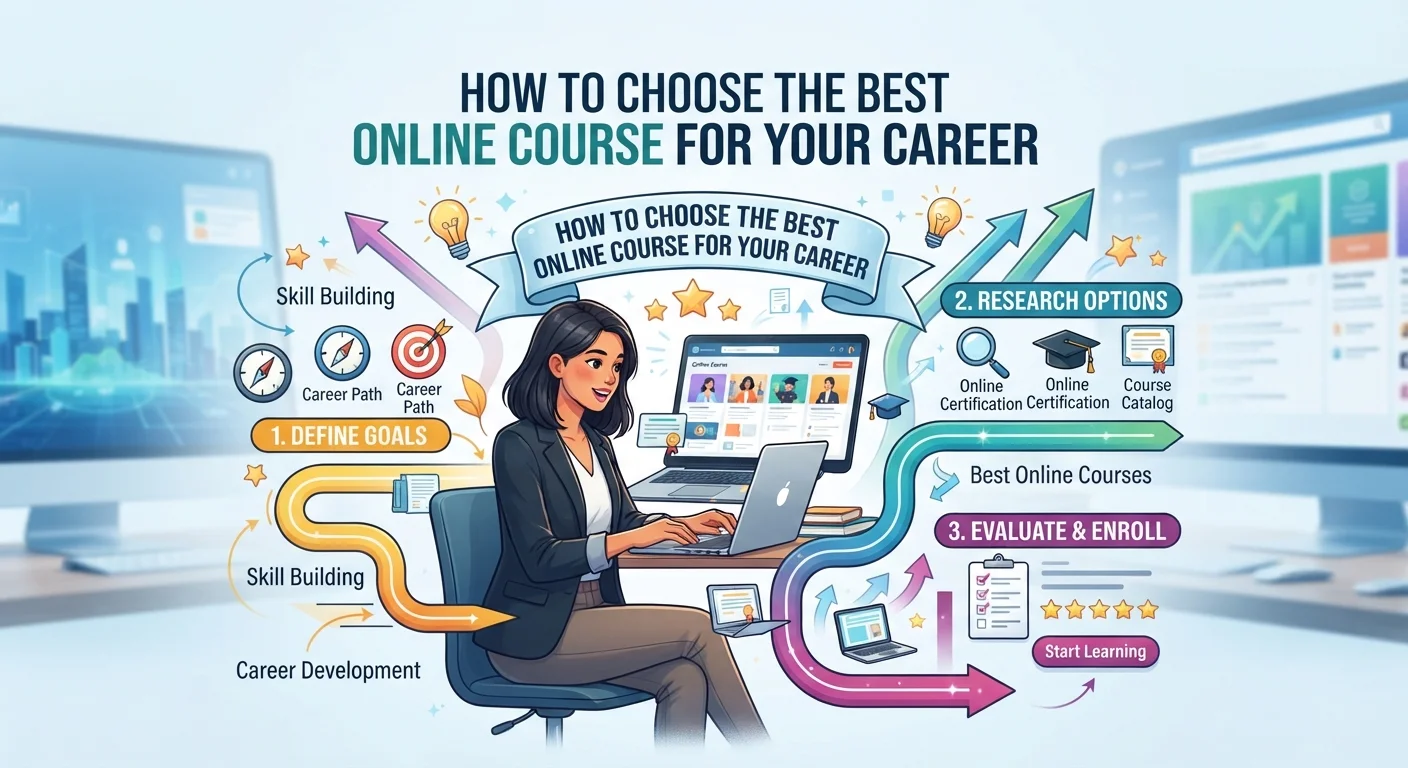
A simple search for the best online courses can produce an overwhelming number of results. Some courses are designed for beginners, while others assume professional experience. Some focus on practical skills, others emphasize theory, and some are primarily designed to prepare students for an online certification.
The challenge is not finding a course.
The challenge is finding the right course for your specific career goal.
A course that is excellent for someone changing careers may be completely unsuitable for someone trying to earn a promotion. A highly respected certification may be unnecessary for a freelancer who simply needs a practical skill. Similarly, an inexpensive introductory course may be useful for exploring a field but insufficient for someone who needs job-ready expertise.
This guide explains how to evaluate online education based on your career objectives. Instead of simply listing popular courses, it focuses on the decision-making process behind effective career development, professional education, and skill building.
read more about online learning vs traditional learning
Why Choosing the Right Online Course Matters
Online Learning Is No Longer Just an Alternative to Traditional Education
Online education has evolved from a convenient supplement to a major part of professional development.
People use online courses to:
- Learn new technical skills.
- Change careers.
- Prepare for professional certifications.
- Improve performance at work.
- Build portfolios.
- Start freelance careers.
- Develop leadership abilities.
- Learn business skills.
- Explore completely new industries.
This flexibility makes online learning powerful, but it also means that learners need to become better at evaluating educational options.
More Courses Do Not Mean Better Choices
A large course catalog can create decision fatigue.
You might find:
- Ten courses covering the same topic.
- Different instructors teaching identical skills.
- Free and paid versions.
- Beginner and advanced programs.
- Short courses and long boot camps.
- Courses with certificates and courses without them.
The best option depends on your destination, not simply the popularity of the course.
Start With Your Career Goal
Do Not Begin With the Course Catalog
One of the biggest mistakes is browsing courses before defining what you want to accomplish.
Instead of asking:
“What course should I take?”
Start with:
“What do I want this course to help me achieve?”
Your answer might be:
- Get my first job in digital marketing.
- Move from administration into data analysis.
- Become a project manager.
- Improve my English for professional communication.
- Learn graphic design.
- Qualify for a promotion.
- Start freelancing.
- Build programming skills.
- Understand artificial intelligence.
- Develop leadership skills.
Once your goal is clear, course selection becomes much easier.
Define a Specific Career Outcome
A vague objective such as “I want to improve my career” is difficult to translate into a course.
A stronger goal might be:
“I want to qualify for entry-level data analyst positions within six months.”
This immediately tells you that you need practical skills rather than a general introduction to data.
Career Development Goals and Course Selection
Courses for Career Advancement
If you already work in a field and want to advance, you may not need an entirely new qualification.
You may need to strengthen a specific skill.
For example:
A marketing specialist might study analytics.
An accountant might learn data visualization.
A sales professional might study CRM systems.
A manager might develop leadership and project management skills.
In these cases, targeted skill building can be more valuable than completing a long general program.
Courses for Career Change
Career changers usually have different requirements.
If you are moving into a new profession, employers may expect evidence that you understand the fundamentals of the field.
You may need:
- Foundational knowledge.
- Practical projects.
- Industry terminology.
- Portfolio evidence.
- Relevant tools.
- Possibly professional certification.
A single short course may not be enough.
Identify the Skills Your Target Job Requires
Study Job Descriptions
One of the best ways to choose an online course is to examine actual job listings.
Search for jobs you would realistically like to apply for.
Look at repeated requirements.
For example, data-related positions might repeatedly mention:
- Excel.
- SQL.
- Data visualization.
- Statistics.
- Python.
- Business intelligence tools.
Marketing positions might frequently require:
- SEO.
- Paid advertising.
- Analytics.
- Content strategy.
- CRM.
- Social media.
- Copywriting.
The repeated skills should influence your course selection.
Build a Skills Gap
Compare what employers want with what you already know.
Create three categories:
Already have
Skills you can confidently demonstrate.
Need to improve
Skills you understand but need to strengthen.
Need to learn
Skills you have never studied.
Your courses should primarily target the second and third categories.
Choose Courses Based on Skill Gaps
Avoid Learning What You Already Know
If you already understand the fundamentals, taking another beginner course may not be the best use of your time.
Instead, choose an intermediate or advanced course.
Do Not Skip Fundamentals Completely
However, career changers should be careful about jumping directly into advanced material.
If you lack the fundamentals, advanced courses can become frustrating.
A good learning path often looks like:
Foundation → Practical Skills → Projects → Advanced Skills → Certification
The exact sequence depends on the profession.
Online Certification: When Does It Matter?
Certificates Can Be Useful
An online certification can provide evidence that you completed a structured learning program.
It may help demonstrate:
- Commitment.
- Knowledge.
- Professional development.
- Familiarity with a specific subject.
But a certificate is not automatically valuable simply because it exists.
Certification Is Not the Same as Skill
Employers may care more about what you can actually do.
For example, a digital marketing candidate might have several certificates but struggle to:
- Analyze a campaign.
- Build a keyword strategy.
- Interpret analytics.
- Write effective advertising copy.
Another candidate might have fewer certificates but a strong portfolio showing real work.
The second candidate may be more compelling.
Research Employer Recognition
Before paying for certification, investigate whether employers in your target field actually recognize it.
Ask:
- Is it mentioned in job descriptions?
- Is it issued by a respected institution?
- Does it require an exam?
- Is there practical assessment?
- Is it recognized internationally?
- Does it need renewal?
Course Certificate vs Professional Certification
Course Completion Certificate
This usually confirms that you completed a course.
It can be useful as evidence of learning.
Professional Certification
A professional certification often involves a more formal assessment or industry-recognized standard.
These credentials may carry greater weight in certain professions.
The distinction is important when evaluating course value.
Consider Your Current Career Stage
Beginner
Beginners should prioritize:
- Clear explanations.
- Strong fundamentals.
- Practical exercises.
- Structured progression.
Intermediate Professional
Intermediate learners can focus on:
- Specialized skills.
- Advanced tools.
- Real-world projects.
- Industry applications.
Experienced Professional
Experienced professionals may benefit most from:
- Leadership.
- Strategic skills.
- Emerging technologies.
- Specialized certifications.
- Executive education.
read more about how to memorize faster
Courses for Students and Recent Graduates
Build Employable Skills
Students should think beyond academic knowledge.
Online learning can complement university education by developing practical skills employers request.
Examples include:
- Data analysis.
- Digital marketing.
- Project management.
- Programming.
- Design.
- Business communication.
Build a Portfolio
Whenever possible, choose courses that produce tangible work.
A project can become part of your portfolio.
Courses for Working Professionals
Time Is a Major Constraint
Working professionals need realistic schedules.
A course requiring twenty hours every week may not be sustainable alongside a full-time job.
Look for programs that offer:
- Flexible deadlines.
- Recorded lessons.
- Short modules.
- Downloadable resources.
- Self-paced learning.
Consider the Opportunity Cost
Your time has value.
A course that takes six months may be worthwhile if it significantly improves your career prospects.
But a long program with little practical value may not justify the investment.
Courses for Career Changers
Start With Industry Research
Before enrolling, understand the target profession.
Learn:
- Typical job titles.
- Required skills.
- Entry-level expectations.
- Common software.
- Salary ranges.
- Hiring trends.
- Portfolio requirements.
Then select courses accordingly.
Build Evidence of Ability
Career changers often face one major challenge:
They need to prove they can perform the new job despite lacking professional experience.
Projects can help bridge this gap.
The Importance of Practical Projects
Projects Turn Knowledge Into Evidence
Suppose you complete a course in data analysis.
Instead of simply listing the course on your resume, create a project that demonstrates:
- Data cleaning.
- Analysis.
- Visualization.
- Conclusions.
- Recommendations.
The project shows what you can actually do.
Choose Courses With Projects
When comparing the best online courses, examine whether students complete practical assignments.
Look for:
- Case studies.
- Capstone projects.
- Simulations.
- Real-world assignments.
- Portfolio projects.
Course Curriculum
Read the Full Syllabus
Do not choose a course based only on its title.
Read the curriculum carefully.
Check:
- Topics covered.
- Order of lessons.
- Assignments.
- Projects.
- Assessments.
- Final outcomes.
Compare Curriculum With Job Requirements
This is one of the most important steps.
If employers repeatedly require five skills and the course covers only two, the course may not be sufficient.
Instructor Quality
Experience Matters
A good instructor should ideally have meaningful expertise in the subject.
Look for:
- Professional experience.
- Teaching experience.
- Relevant credentials.
- Industry work.
- Student feedback.
Practical Experience Can Be Valuable
Someone who has actually worked in the field may provide useful context that purely theoretical instruction cannot.
Student Reviews
Look for Detailed Reviews
A rating of 4.8 stars tells you relatively little by itself.
Detailed reviews can reveal:
- Course difficulty.
- Teaching quality.
- Outdated material.
- Technical problems.
- Assignment quality.
- Workload.
- Actual career usefulness.
Look for Patterns
One negative review may not matter.
If dozens of students complain about the same problem, pay attention.
Course Recency
Technology Changes Quickly
Some subjects evolve rapidly.
This is particularly true for:
- Artificial intelligence.
- Digital marketing.
- Software development.
- Cybersecurity.
- Data analytics.
An old course may teach outdated tools or practices.
Check When Content Was Updated
A course should ideally indicate when its material was last revised.
This does not mean older courses are always bad.
Fundamental concepts can remain useful for years.
But rapidly changing fields require more frequent updates.
Course Duration
Short Courses
Short courses can be excellent for:
- Exploring a field.
- Learning one tool.
- Refreshing knowledge.
- Developing a narrow skill.
Long Programs
Longer programs may be appropriate for:
- Career changes.
- Comprehensive technical training.
- Professional preparation.
Duration should reflect the complexity of your goal.
Self-Paced vs Instructor-Led Learning
Self-Paced Courses
Advantages include:
- Flexibility.
- Lower scheduling pressure.
- Ability to repeat lessons.
- Convenient study times.
They can work well for disciplined learners.
Instructor-Led Courses
Advantages can include:
- Live feedback.
- Accountability.
- Interaction.
- Deadlines.
- Community.
They may be better for learners who struggle with self-directed study.
Cohort-Based Courses
Learning With Other Students
Cohort programs typically place learners into groups that progress through the curriculum together.
Potential benefits include:
- Networking.
- Peer support.
- Group projects.
- Accountability.
The downside may be less flexibility.
Online Course Community
Community Can Improve Learning
A course with active forums, study groups, or peer communities can make learning less isolated.
Students can:
- Ask questions.
- Share projects.
- Exchange feedback.
- Discuss challenges.
For some subjects, community is particularly valuable.
Mentorship
Personal Feedback Can Accelerate Progress
Mentorship can be especially valuable for career development.
A mentor may help you:
- Review projects.
- Identify weaknesses.
- Improve your resume.
- Understand industry expectations.
- Prepare for interviews.
If a course includes mentorship, investigate how much direct access students actually receive.
Career Services
Some Courses Include Employment Support
Certain programs offer:
- Resume reviews.
- Interview preparation.
- Career coaching.
- Networking.
- Job boards.
These services can be useful, particularly for career changers.
However, evaluate specific services rather than relying on general marketing claims.
read more about phone stand for studying
Cost of Online Courses
Cheap Does Not Always Mean Good
Price is only one factor.
A low-cost course can be excellent.
An expensive program can also provide poor value.
Evaluate:
Cost ÷ expected career value
rather than price alone.
Calculate Total Cost
Consider:
- Course tuition.
- Certification fees.
- Exam fees.
- Software.
- Equipment.
- Books.
- Optional subscriptions.
A course advertised as inexpensive may become significantly more expensive when additional costs are included.
Free Online Courses
Free Learning Can Be an Excellent Starting Point
Free courses are particularly useful when you are exploring a new field.
They allow you to determine:
- Whether you enjoy the subject.
- Whether you understand the fundamentals.
- Whether you want to invest further.
When Free Courses May Not Be Enough
For career changes, you may eventually need:
- Advanced instruction.
- Structured projects.
- Mentorship.
- Certification.
- Portfolio development.
Free resources can be the beginning rather than the entire learning path.
Return on Investment
Ask What the Course Could Change
Before enrolling, ask:
“What could this course realistically help me achieve?”
Possible outcomes include:
- Higher salary.
- Promotion.
- New job.
- Freelance income.
- Career transition.
- Increased productivity.
Then compare the expected value with the time and money required.
Learning for Promotion
Identify the Skills Your Next Role Requires
If you want to move from employee to manager, for example, technical expertise alone may not be enough.
You may need:
- Leadership.
- Communication.
- Delegation.
- Conflict management.
- Project planning.
- Decision-making.
Choose courses that correspond to the next position rather than simply strengthening your current responsibilities.
Learning for a Salary Increase
Specialized Skills Can Be Valuable
A general course may not directly increase earning potential.
Specialized skills may create stronger differentiation.
For example:
- Advanced analytics.
- Cloud technologies.
- Cybersecurity.
- Specialized design.
- Technical project management.
The value depends on the market and your specific profession.
Learning for Freelancing
Focus on Deliverable Skills
Freelancers need skills they can sell.
Depending on the field, this could include:
- Copywriting.
- Graphic design.
- Web development.
- SEO.
- Video editing.
- Social media management.
- Translation.
- Data services.
Courses should help you create work samples.
Learning for Entrepreneurship
Business Skills Matter
Entrepreneurs may benefit from courses in:
- Finance.
- Marketing.
- Sales.
- Operations.
- Negotiation.
- Customer research.
- Leadership.
But entrepreneurship also requires experimentation.
Do not spend years taking courses without actually testing your ideas in the market.
Learning for Remote Work
Develop Digital Collaboration Skills
Remote professionals may need:
- Project management.
- Communication.
- Collaboration tools.
- Time management.
- Digital presentation skills.
Technical skills remain important, but communication and self-management can be equally valuable.
Artificial Intelligence and Online Learning
AI Skills Are Becoming Increasingly Relevant
Many professionals are now exploring courses involving:
- AI literacy.
- Prompt design.
- Data analysis.
- Automation.
- Machine learning.
- AI-assisted workflows.
The right choice depends on your career.
Not everyone needs to become a machine-learning engineer.
For some professionals, learning how to use AI effectively in their existing field may be more valuable.
Avoid Following Trends Blindly
Popular Does Not Mean Relevant
A skill can be highly discussed online without being necessary for your career.
Ask:
“Does this skill appear in the jobs I want?”
If not, it may be better to prioritize another area.
Online Learning for Digital Marketing
Core Skills
Digital marketing learners may explore:
- SEO.
- Paid advertising.
- Content marketing.
- Analytics.
- Email marketing.
- Social media.
- Conversion optimization.
Build Practical Campaign Projects
A good marketing course should ideally teach you how to analyze and execute campaigns rather than simply define terminology.
Online Learning for Data Careers
Build a Strong Foundation
Data-focused learners may need:
- Excel.
- SQL.
- Statistics.
- Data visualization.
- Databases.
- Programming.
Portfolio Matters
Create projects that demonstrate the complete process:
Question → Data → Analysis → Visualization → Recommendation
This gives potential employers evidence of practical ability.
Online Learning for Technology Careers
Choose Based on the Role
Technology is a broad field.
A software developer, cybersecurity analyst, data engineer, and UX designer require different skill sets.
Identify the specific job first.
Learn the Tools Employers Use
A course should ideally teach tools relevant to the positions you want.
Online Learning for Management
Soft Skills Matter
Management courses should cover more than theory.
Useful topics include:
- Communication.
- Feedback.
- Delegation.
- Team development.
- Conflict resolution.
- Performance management.
Look for Scenarios
Case studies and simulations can make management training more practical.
Online Learning for Creative Careers
Portfolio Over Certificates
Creative fields often emphasize demonstrated work.
For designers, writers, photographers, and similar professionals, the portfolio may be more important than a certificate.
Choose courses that help you produce strong examples.
Online Learning for Healthcare and Regulated Fields
Check Professional Requirements Carefully
Some professions have formal licensing and education requirements.
An online course may supplement education but may not qualify someone to practice professionally.
Always verify the regulatory requirements in the relevant jurisdiction.
Online Learning for Finance
Distinguish General Knowledge From Professional Qualification
A personal finance course is different from professional training for accounting, financial analysis, or regulated financial services.
If your career goal involves a formal professional designation, make sure the course is aligned with that pathway.
Online Learning for Human Resources
Relevant Skills
HR professionals may benefit from:
- Recruitment.
- Employee relations.
- HR analytics.
- Compensation.
- Performance management.
- Employment law fundamentals.
- HR technology.
The right course depends on your intended HR role.
Online Learning for Sales
Focus on Practical Skills
Useful sales courses may cover:
- Prospecting.
- Qualification.
- Discovery.
- Negotiation.
- Objection handling.
- CRM.
- Pipeline management.
Look for courses that include realistic scenarios.
How to Build a Learning Roadmap
Start With One Priority
Do not attempt to learn ten unrelated skills simultaneously.
Choose one career goal.
Divide It Into Competencies
For example:
Goal: Become a data analyst.
Competency 1: Excel.
Competency 2: SQL.
Competency 3: Statistics.
Competency 4: Visualization.
Competency 5: Portfolio.
This gives you a logical learning path.
Avoid Course Collecting
More Certificates Do Not Necessarily Mean More Expertise
Some learners repeatedly enroll in courses because completing them feels productive.
But watching lessons is not the same as developing competence.
After every major course, ask:
“What can I now do that I could not do before?”
If the answer is unclear, you may need more practical application.
read more about study space at home
Use the 70-20-10 Learning Idea Carefully
Learning Through Practice
A useful professional development framework often emphasizes that people learn through a combination of:
- Practical experience.
- Interaction with others.
- Formal education.
Online courses are therefore most effective when combined with actual work and feedback.
Build a Portfolio While Learning
Do Not Wait Until the Course Ends
Start creating projects during the course.
This helps you:
- Reinforce knowledge.
- Discover weaknesses.
- Build confidence.
- Create evidence for employers.
Add Projects to Your Resume
Describe Outcomes
Instead of writing:
“Completed an online course in data analytics.”
You could emphasize a relevant project and the skills used.
The project demonstrates application rather than simply course attendance.
LinkedIn and Professional Profiles
Display Learning Strategically
You can list relevant courses and certifications on professional profiles.
But avoid creating an enormous list of every course you have ever taken.
Prioritize credentials and projects relevant to your career direction.
How Many Courses Should You Take?
There Is No Universal Number
One excellent course can be more valuable than ten mediocre courses.
Your objective should be competence.
Choose enough learning to close your skill gap and achieve your career goal.
When You Should Stop Taking Courses
When You Can Perform the Work
If you have acquired the necessary knowledge and can demonstrate it through projects or experience, move from learning to application.
The next step may be:
- Applying for jobs.
- Asking for a promotion.
- Taking freelance clients.
- Starting a project.
- Building a business.
Evaluating the Course Provider
Reputation
Research the institution or platform.
Consider:
- History.
- Instructor quality.
- Employer recognition.
- Student feedback.
Transparency
A trustworthy course provider should clearly explain:
- Curriculum.
- Price.
- Duration.
- Certification.
- Refund policy.
- Instructor credentials.
Be cautious when important details are difficult to find.
Refund Policies
Understand the Terms
Before purchasing, check:
- Refund period.
- Conditions.
- Subscription cancellation.
- Automatic renewal.
This can prevent unpleasant surprises.
Lifetime Access vs Subscription
Lifetime Access
This can be useful if you want to revisit material.
Subscription
Subscriptions can provide access to large libraries of courses.
They may be cost-effective for highly active learners.
However, calculate whether you will actually use enough content to justify the recurring fee.
Choosing Between One Course and a Learning Path
Individual Course
Best when you need one specific skill.
Learning Path
Better when you need several connected skills.
For example, a career changer might benefit from a structured path covering fundamentals, tools, projects, and career preparation.
Avoiding Information Overload
Learning Should Have a Purpose
The internet provides endless information.
Without a clear goal, you can spend months consuming content without becoming employable.
A good learning plan should answer:
- What am I learning?
- Why am I learning it?
- How will I practice it?
- How will I prove it?
- What career outcome should it support?
A Practical Course Evaluation Scorecard
Career Relevance
Does the course directly support your target job?
Score it from 1 to 5.
Skill Coverage
Does it teach the skills employers request?
Score it from 1 to 5.
Practical Experience
Does it include projects?
Score it from 1 to 5.
Instructor Quality
Does the instructor have relevant expertise?
Score it from 1 to 5.
Certification Value
Is the certificate genuinely useful?
Score it from 1 to 5.
Flexibility
Does the schedule fit your life?
Score it from 1 to 5.
Cost
Is the investment reasonable?
Score it from 1 to 5.
Student Feedback
Do reviews indicate strong learning outcomes?
Score it from 1 to 5.
Add the scores and compare shortlisted courses.
A Five-Question Test Before Enrolling
Question One: What Career Goal Does This Support?
If you cannot answer clearly, reconsider.
Question Two: What Skills Will I Gain?
The answer should be specific.
Question Three: Can I Demonstrate Those Skills?
Look for projects or assessments.
Question Four: Does the Industry Value This Credential?
Research actual job listings.
Question Five: Can I Realistically Finish It?
A course is useless if your schedule makes completion unrealistic.
A Step-by-Step Method for Choosing the Best Online Course
Step 1: Define the Career Goal
Write down the position or outcome you want.
Step 2: Research Job Requirements
Study multiple job listings.
Step 3: Identify Your Skills Gap
Determine what you lack.
Step 4: Decide Whether You Need Certification
Do not assume certification is necessary.
Step 5: Find Relevant Courses
Search based on specific skills rather than broad topics.
Step 6: Compare Curricula
Look at actual lesson content.
Step 7: Evaluate Projects
Prefer practical learning where appropriate.
Step 8: Research the Instructor
Check professional background.
Step 9: Read Student Reviews
Look for recurring patterns.
Step 10: Calculate the Full Cost
Include additional expenses.
Step 11: Check the Schedule
Make sure the workload is realistic.
Step 12: Choose and Commit
Once you have enough information, stop comparing and start learning.
read more about Quran learning app
Finding the best online courses is not about finding the course with the highest rating, the longest curriculum, or the most impressive certificate.
It is about finding the course that creates the clearest connection between where you are now and where you want your career to go.
Start with the career goal.
If you want a promotion, identify the competencies required for your next role. If you want to change careers, research the skills employers expect from entry-level candidates. If you want to freelance, prioritize practical abilities that can become paid services. If you want to strengthen your existing professional profile, choose specialized courses that address genuine skill gaps.
Then evaluate courses based on curriculum, instructor quality, practical projects, flexibility, cost, and industry relevance.
An online certification can be valuable, but it should not become the sole objective. A certificate is evidence that you completed a learning experience; it does not automatically prove mastery. In many careers, a combination of certification, practical projects, professional experience, and strong communication will create a much stronger profile.
The same principle applies to career development more broadly. Learning should be connected to action. After completing a course, use the knowledge. Apply it at work. Build a project. Improve a process. Create a portfolio. Take on a new responsibility. Apply for the position you wanted.
That is how online learning becomes more than a collection of certificates.
It becomes skill building that changes what you can actually do.
The ideal learning path is therefore rarely the one with the largest number of courses. It is the one that gives you the right knowledge at the right time, allows you to practice it, and moves you measurably closer to your professional objective.
Before enrolling in your next course, ask yourself one simple question:
“What career outcome do I want this course to help me achieve?”
If you can answer that question clearly, you are already much closer to choosing the right course.