
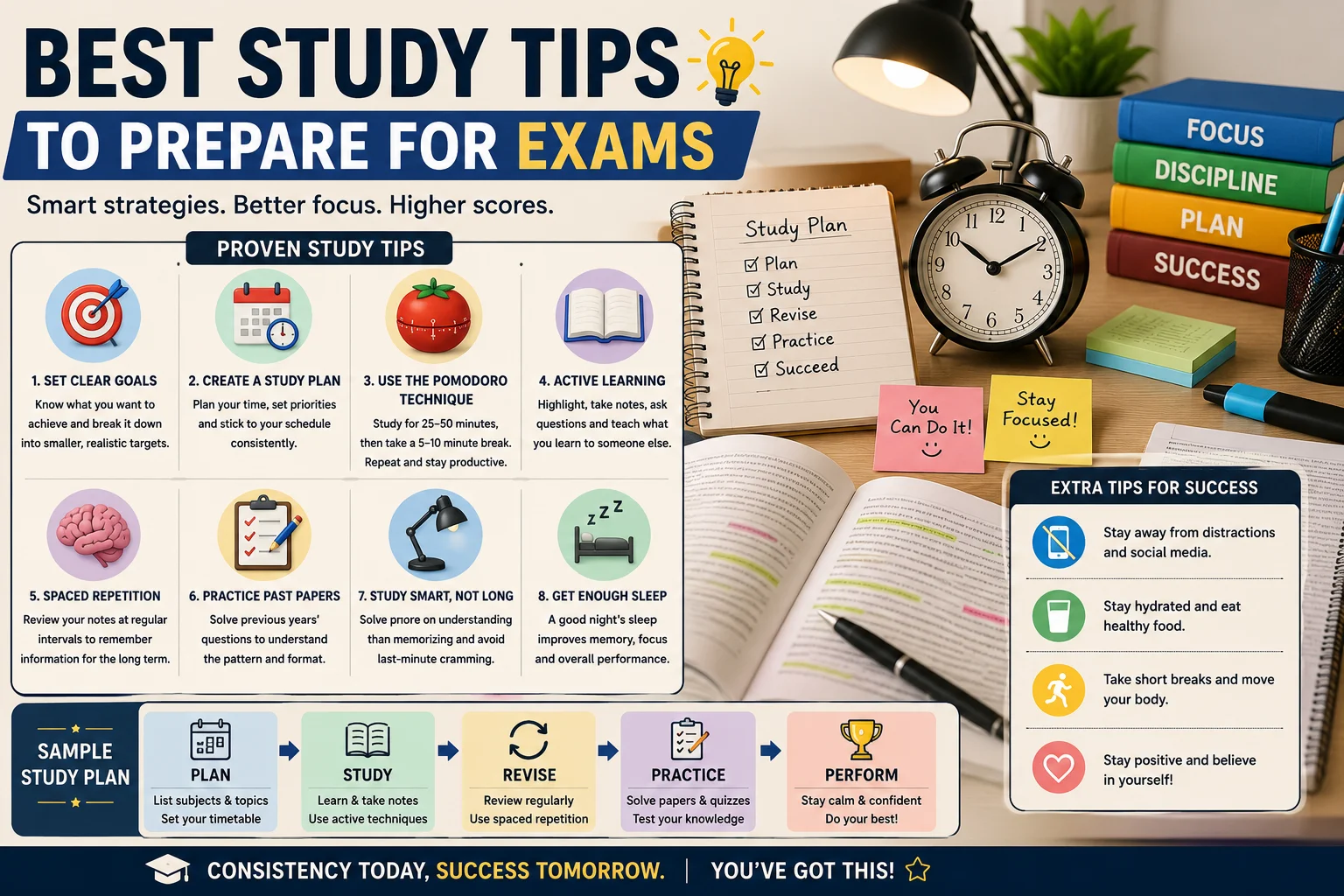
Preparing for exams is one of the most universal challenges students face worldwide. Whether you are navigating high school midterms, tackling rigorous university finals, or preparing for high-stakes professional licensing board exams, the pressure to perform can feel overwhelming.
In the face of this stress, many students default to traditional, passive learning behaviors: spending hours highlighting textbooks, rereading lecture slides, or pulling stressful all-nighters fueled by caffeine. However, cognitive psychology and educational neuroscience have proven time and again that these common behaviors are highly inefficient. They create an “illusion of competence”—the false feeling that you understand the material simply because it looks familiar—while failing to build deep, long-term memory retrieval.
To excel in modern academic environments, you must shift from passive studying to active, evidence-based learning. This comprehensive guide compiles the most effective, scientifically proven study tips (نصائح للدراسة) and techniques to revolutionize your study routine.
By restructuring your study plan, mastering advanced study techniques, and implementing a strategic approach to exam preparation and exam revision, you can dramatically increase your retention, reduce test anxiety, and achieve top grades while studying fewer hours overall.
Part 1: The Neuroscience of Learning – Why Brain-Based Studying Works
Before exploring specific methods, we must understand how the human brain processes, stores, and retrieves information. When you learn something new, your brain forms connections between neurons, creating neural pathways. To recall that information during an exam, you must strengthen those pathways so they can be accessed quickly under stress.
The Three Stages of Memory
-
Encoding: The brain processes new sensory input (such as listening to a lecture or reading a diagram) and converts it into a chemical and electrical code.
-
Consolidation: The brain stabilizes the memory trace over time, transferring it from the temporary, highly limited working memory (located in the prefrontal cortex) to the permanent, virtually limitless long-term memory (stored across the neocortex). Sleep is a critical driver of this consolidation process.
-
Retrieval: The act of searching your long-term memory files and pulling the stored information back into your conscious mind.
The golden rule of modern cognitive science is that retrieval practice is the most powerful way to strengthen memory. Every time you force your brain to retrieve a piece of information, you make that neural pathway wider, stronger, and much easier to access during a high-pressure exam.
Part 2: Top Science-Backed Study Techniques for Maximum Retention
To build deep, long-lasting memory, you must replace passive reading with active learning methods. Below are the most heavily researched and proven learning strategies utilized by top-performing students globally.
1. Active Recall: Testing Yourself to Learn
Active recall is the practice of actively stimulating your memory during the learning process, forcing your brain to retrieve answers rather than passively looking at them.
How to Implement Active Recall:
-
The Closed-Book Method: After reading a section of your textbook or notes, close the book completely. On a blank sheet of paper, write down everything you can remember without looking. Once you finish, open the book and use a colored pen to fill in the gaps or correct mistakes.
-
Flashcard Practice: Create flashcards (using physical index cards or digital apps like Anki) with a question on the front and the answer on the back. Do not flip the card over until you have explicitly said the answer out loud or written it down.
-
Formulating Practice Questions: While reading your textbook for the first time, write down practice questions in the margins. When you review your notes later, cover the main text and try to answer the questions in the margins from memory.
2. Spaced Repetition: Beating the Ebbinghaus Forgetting Curve
In 1885, German psychologist Hermann Ebbinghaus discovered the “Forgetting Curve,” which demonstrates that humans naturally lose up to 50% of new information within 24 hours of learning it, and up to 80% within a week, unless that information is reviewed periodically.
Spaced repetition is the practice of reviewing information at gradually increasing intervals (e.g., 1 day, 3 days, 7 days, 14 days, 30 days) to interrupt the forgetting curve. Each review session resets your retention back to 100%, flattening the curve over time and locking the information into your long-term memory.
How to Implement Spaced Repetition:
-
The Leitner System: A physical box-based system for physical flashcards.
-
Label five boxes (Box 1 to Box 5).
-
All flashcards start in Box 1.
-
Every time you answer a card correctly, move it up to the next box (e.g., from Box 1 to Box 2).
-
If you answer a card incorrectly, it goes all the way back to Box 1, regardless of how far it has progressed.
-
Review Box 1 every day, Box 2 every three days, Box 3 every week, Box 4 every two weeks, and Box 5 once a month.
-
-
Digital Algorithm-Based Apps: Utilize apps like Anki, Quizlet, or RemNote. These platforms use advanced spaced repetition algorithms to automatically show you difficult cards more frequently and easy cards less frequently, maximizing your study efficiency.
3. The Feynman Technique: Teaching to Understand
Named after the Nobel Prize-winning physicist Richard Feynman, this method is built on the philosophy that “if you can’t explain it simply, you don’t understand it well enough.”
The Four Steps of the Feynman Technique:
-
Choose a Concept: Write the title of the topic you want to learn at the top of a blank sheet of paper.
-
Explain it to a Child: Write out an explanation of the concept as if you were teaching it to a 10-year-old child. Avoid using any complex jargon, technical vocabulary, or complicated academic terms. Use simple analogies and clear, everyday language.
-
Identify Your Gaps: Review your explanation. Where did you struggle to explain a concept simply? Where did you default to technical jargon because you couldn’t find a simpler way to express it? Go back to your source material, textbook, or lecture slides to review those specific weak spots until you understand them completely.
-
Simplify and Analogize: Refine your explanation by using even simpler language. Create a relatable analogy to explain how the concept works (e.g., comparing a biological cell membrane to a security guard at a building gate).
4. Interleaving: Mixing Up Your Subjects
Most students study using a method called “blocking”—focusing on one specific topic or type of problem for hours before moving on to the next (e.g., solving 30 division math problems, then 30 multiplication problems).
Cognitive research has shown that interleaving—mixing up different types of topics or problems during a single study session—is far more effective for long-term learning.
-
The Benefit: Interleaving forces your brain to continually choose the correct strategy to solve a problem, rather than mindlessly applying the same formula over and over. This mirrors real exam conditions, where questions are presented in a random, unpredictable order.
-
How to Do It: If you are studying history, don’t just study World War I for five hours. Mix in topics from the Industrial Revolution and World War II. If you are studying math, mix algebra, geometry, and calculus problems together in a single practice session.
Part 3: Creating an Effective Study Plan and Schedule
An outstanding study method is only as good as the plan that supports it. To avoid the stress of last-minute cramming, you must design a structured, realistic, and highly organized schedule leading up to your exams.
1. The Retrospective Revision Timetable
Traditional study planners assign specific topics to specific days weeks in advance (e.g., “Study Chapter 3 on Tuesday”). However, these schedules are fragile; if you get sick or a topic takes longer than expected, the entire schedule falls apart, leading to stress and abandonment.
Instead, use a Retrospective Revision Timetable. This calendar focuses on tracking how well you know each topic, rather than scheduling them rigidly in advance.
How to Use It:
-
List all the topics you need to master for your exam down the left-hand column of a spreadsheet or notebook.
-
Each time you complete a study session on a topic using active recall or practice questions, write the date of the session in the next column.
-
Color-code the date based on your confidence level:
-
RED: You struggled, made major mistakes, and lacked confidence.
-
AMBER: You understood the basics but forgot key details or formulas.
-
GREEN: You answered almost all questions correctly and felt highly confident.
-
-
When you sit down to study each day, look at your spreadsheet and prioritize the topics that are colored RED or have not been reviewed in the longest time. This dynamic system ensures you spend your valuable study hours fixing your weaknesses rather than wasting time reviewing what you already know.
2. The Pomodoro Technique: Managing Your Energy and Focus
Maintaining deep, uninterrupted focus is difficult, especially with digital distractions nearby. The Pomodoro Technique is a simple, highly effective time-management method that trains your brain to focus in short, intense bursts.
-
The Session: Set a timer for 25 minutes. Put your phone on silent, close unrelated browser tabs, and work on a single task with absolute focus until the timer rings.
-
The Reward: Take a short, 5-minute break. Stand up, stretch, grab a glass of water, or walk around the room. Avoid checking social media, as this can derail your focus.
-
The Cycle: Repeat this cycle four times. After the fourth 25-minute session, take a longer, well-deserved break of 15 to 30 minutes to let your brain rest and consolidate the information.
Part 4: Advanced Exam Preparation – The Final Two Weeks
As the exam date approaches, your study strategy must transition from learning new material to practicing and refining your performance under real test conditions.
1. The Power of Past Papers and Practice Exams
There is a massive difference between knowing information in a quiet room and being able to write it down quickly under exam pressure. The best way to bridge this gap is to practice using real past papers and practice exams.
-
Replicate Real Test Conditions: Sit in a quiet room, set a timer for the exact duration of the real exam, put away your notes, and complete the paper from start to finish without interruptions.
-
Identify Question Patterns: Exam boards often repeat similar question formats and styles year after year. Doing past papers helps you become comfortable with the wording of questions and understand exactly what examiners are looking for.
-
Analyze the Rubric (Mark Scheme): After completing a practice exam, use the official grading rubric to grade your own work. Pay close attention to the specific keywords and phrasing required to earn full points.
2. Developing an Exam Day Strategy
Success on exam day requires a calm, clear mind and a strategic approach to tackling the test paper.
-
The 5-Minute Scan: When you receive the test paper, don’t start writing immediately. Spend the first 5 minutes reading through the entire paper. This alerts your subconscious mind to the questions ahead, letting your brain start retrieving relevant information in the background.
-
Secure Easy Wins First: Start by answering the questions you are most confident about. This builds your momentum, secures easy points, and reduces your anxiety, making it much easier to tackle difficult questions later.
-
Active Pacing: Calculate how much time you can spend on each question based on its point value. For example, if a 100-point exam lasts 100 minutes, you have exactly one minute per point. Never let a single difficult question eat up precious time that could be used to secure points elsewhere on the paper.
Part 5: The Holistic Pillars of High Academic Performance
Many students treat physical health as a secondary priority during exam periods, sacrificing sleep, exercise, and nutrition to squeeze in more study hours. However, cognitive performance is deeply connected to physical health. Neglecting your body directly hurts your brain’s ability to learn, retain, and recall information.
1. Sleep: The Ultimate Cognitive Enhancer
Sleep is not dead time; it is a highly active neurological process. During deep sleep, your brain consolidates memory, clears out metabolic waste, and reorganizes neural pathways to make sense of what you learned during the day.
-
The Cost of All-Nighters: Staying up all night to cram before an exam is incredibly counterproductive. Research shows that sleep deprivation impairs working memory, slows processing speed, and increases test anxiety. A well-rested brain will almost always outperform a sleep-deprived brain, even if the sleep-deprived student spent more hours studying.
-
Aim for 7 to 9 Hours: Prioritize getting consistent, high-quality sleep every night leading up to your exams, especially on the night before the test.
2. Nutrition and Hydration: Fueling the Brain
The brain makes up only 2% of your body weight but consumes over 20% of its daily energy. Feeding your brain high-quality fuel is essential for maintaining focus and preventing energy crashes during long study sessions.
-
Hydration is Critical: Dehydration of just 1% to 2% can significantly impair your attention span, memory retention, and decision-making speed. Keep a bottle of fresh water on your desk at all times while studying and during the exam.
-
Brain-Boosting Foods: Avoid sugary snacks and heavy, processed fast foods, which cause rapid spikes and crashes in blood sugar. Instead, fuel your brain with complex carbohydrates, healthy fats, and high-protein options:
-
Blueberries: Rich in antioxidants that support brain health and memory.
-
Walnuts & Pumpkin Seeds: Packed with omega-3 fatty acids and zinc, which improve cognitive function.
-
Oatmeal & Whole Grains: Provide a slow, steady release of glucose to keep your focus sharp for hours.
-
Part 6: Comparison of High-Impact vs. Low-Impact Study Methods
To help you optimize your study routine, the table below compares common study habits, explaining why some are highly inefficient and how you can replace them with high-performing, science-backed alternatives.
| Low-Impact Study Habit (Avoid) | Cognitive Reason for Failure | High-Impact Alternative (Adopt) | Why It Delivers Better Results |
|---|---|---|---|
| Passive Highlighting / Rereading | Creates an “illusion of competence”; requires minimal mental effort. | Active Recall (Self-Testing) | Forces the brain to retrieve information, strengthening neural pathways. |
| Cramming the Night Before | Information is only stored in short-term memory and is forgotten quickly. | Spaced Repetition | Distributes reviews over time to flatten the forgetting curve and build long-term memory. |
| Study Blocking (One Topic for Hours) | The brain goes on “auto-pilot,” reducing active engagement and critical thinking. | Interleaving (Mixing Subjects) | Forces the brain to dynamically choose the correct strategy, mirroring real exam environments. |
| Studying with Loud Music / TV | Splits attention and overloads working memory, slowing down processing speed. | Quiet / Instrumental Environments | Protects focus, allowing the brain to devote its full processing power to learning. |
Part 7: Managing Test Anxiety and Stress
Test anxiety is a very real challenge that can prevent even the most prepared students from performing at their best. When you feel threatened or stressed, your body releases cortisol and adrenaline, triggering a “fight-or-flight” response that temporarily shuts down the prefrontal cortex—the part of the brain responsible for logical thinking and memory recall.
Practical Strategies to Calm Your Mind
-
Box Breathing: If you feel panic rising before or during an exam, use this simple breathing technique to instantly lower your heart rate and calm your nervous system:
-
Inhale slowly through your nose for 4 seconds.
-
Hold your breath for 4 seconds.
-
Exhale slowly through your mouth for 4 seconds.
-
Hold your breath empty for 4 seconds.
-
Repeat this cycle 3 to 4 times.
-
-
Cognitive Reframing: Reframe how you view the physical symptoms of stress. Instead of thinking, “My hands are sweating and my heart is beating fast because I’m going to fail,” tell yourself, “My body is pumping adrenaline to my brain to keep me sharp, focused, and ready to perform at my absolute best.”
-
The “Brain Dump”: If your mind is racing with anxious thoughts before an exam, spend 5 minutes writing down all of your worries, fears, and doubts on a scrap sheet of paper. Research shows that transferring these anxious thoughts onto paper helps free up valuable working memory space, allowing you to focus completely on the test.
Part 8: Step-by-Step Study Plan Checklist
Ready to build your ultimate study plan? Use this comprehensive checklist to organize your schedule and lead your way to academic success:
-
[ ] Step 1: Organize Your Study Space
-
Clear your desk of clutter and remove distracting digital devices.
-
Set up comfortable, ergonomic seating and bright, natural lighting.
-
-
[ ] Step 2: Create a Retrospective Revision Timetable
-
List all exam topics on a spreadsheet or in a dedicated study notebook.
-
Set up columns for dates and color-coded confidence levels (Red, Amber, Green).
-
-
[ ] Step 3: Implement Active Study Techniques
-
Transform your reading notes into active practice questions and flashcards.
-
Set a 25-minute Pomodoro timer to build deep, uninterrupted focus blocks.
-
Use the Feynman Technique to simplify complex ideas and identify your learning gaps.
-
-
[ ] Step 4: Practice Under Real Exam Conditions
-
Locate official past papers and marking rubrics for your upcoming exams.
-
Sit in a quiet room and complete a full practice paper under strict time limits.
-
Grade your work carefully, paying close attention to required keywords and phrasing.
-
-
[ ] Step 5: Prioritize Your Physical and Mental Well-being
-
Aim for 7 to 9 hours of high-quality, consistent sleep every night leading up to the exam.
-
Keep your brain fueled with complex carbs, healthy fats, and plenty of fresh water.
-
Practice relaxation techniques like box breathing to manage test anxiety.
-
Achieving outstanding grades is not about working yourself to exhaustion or spending endless hours staring blankly at textbooks. True academic success is about studying smarter, not harder.
By replacing passive reading habits with active recall, utilizing spaced repetition to fight the forgetting curve, practicing with real past papers, and protecting your physical well-being through sleep and nutrition, you can study with confidence, reduce test anxiety, and unlock your true academic potential.
Part 9: Subject-Specific Exam Study Strategies
While cognitive science principles like Active Recall and Spaced Repetition apply universally, different academic disciplines require customized execution strategies. Trying to study for a highly abstract Mathematics exam the same way you study for a memory-heavy Anatomy exam is a recipe for inefficiency.
Here is how to adapt your study techniques to master different subject categories.
A. Quantitative Subjects (Mathematics, Physics, Engineering, Finance)
In quantitative subjects, memorizing formulas is rarely enough. Exams evaluate your ability to apply these formulas to novel, complex problems under time pressure.
-
Create a Formula Cheat Sheet (Even if Not Allowed in the Exam): The act of synthesizing all major formulas onto a single sheet of paper forces you to categorize information. Group formulas by topic, define every variable, and write down a brief note explaining when and why to use each formula.
-
The “Deconstruct the Solution” Method: When you get a practice problem wrong, do not just look at the correct answer and nod. Copy the correct step-by-step solution down by hand. Next to each step, write a sentence explaining the logical reasoning behind that specific step. Ask yourself: What clue in the question prompt indicated that this step was necessary?
-
Create a Error Log: Keep a dedicated notebook or digital spreadsheet for every mistake you make during practice sessions.
-
Structure of the log: Write down the problem, the correct answer, the specific mistake you made (e.g., arithmetic error, wrong formula choice, misread prompt), and how you will avoid making that mistake in the future.
-
Review Routine: Before starting any new practice session, review your Error Log and redo three of the problems you previously got wrong.
-
B. Natural and Life Sciences (Biology, Chemistry, Anatomy, Medicine)
These subjects are characterized by a massive volume of factual information, complex terminology, and multi-step physiological or chemical processes.
-
Image Occlusion for Anatomical and Molecular Diagrams: Standard flashcards are great for text, but terrible for visual structures. Use digital tools like Anki’s “Image Occlusion” feature to block out labels on diagrams (such as the parts of a cell, the human muscular system, or chemical pathways). Test yourself to see if you can name the blocked-out parts.
-
Concept Mapping (Visualizing Relationships): Many scientific concepts do not exist in isolation; they are deeply interconnected. Draw concept maps on a whiteboard. Start with a central theme (e.g., Cellular Respiration) and draw branch lines to related concepts (e.g., Glycolysis, The Krebs Cycle, Oxidative Phosphorylation). Write linking phrases along the arrows (such as “produces,” “requires,” or “inhibits”) to show exactly how these processes interact.
-
Process Storytelling: Turn complex biological or chemical sequences into narratives. Pretend a single oxygen molecule or blood cell is a character on a journey. Write a short story describing every barrier it encounters, every chemical change it undergoes, and its ultimate destination. This technique uses semantic encoding to anchor abstract concepts to a memorable storyline.
C. Humanities and Essay-Based Subjects (History, Literature, Sociology, Philosophy)
These subjects require you to analyze broad themes, evaluate historical evidence, construct logical arguments, and write cohesive essays under strict time limits.
-
The Essay Plan Grid: Do not waste time writing out dozens of full-length essays during your exam revision. Instead, practice writing highly structured “Essay Plans.” For every potential essay prompt, create a quick 1-page grid containing:
-
Thesis Statement: Your central argument in one or two clear sentences.
-
Paragraph Breakdowns: 3 to 4 main points, each supported by specific evidence (such as quotes, historical dates, or philosophical arguments).
-
Counter-Argument: An opposing viewpoint you will address and refute.
-
Conclusion: A brief summary explaining why your argument matters in a broader context.
-
-
Theme and Quote Flashcards: For literature or historical analysis, create flashcards with key quotes or historical events on the front. On the back, list 3 distinct thematic arguments or essays where you could successfully use that quote or event as supporting evidence.
D. Foreign Languages and Linguistics
Learning a language requires a balance of vocabulary memorization, grammar comprehension, and real-time auditory processing.
-
Audio-Recall Integration: Instead of just reading flashcards silently, record yourself speaking vocabulary words, grammar rules, or conjugation patterns. Listen to these recordings while walking, exercising, or commuting, and try to translate the words in the pause before you say the answer on the recording.
-
Active Output Generation: Do not just study vocabulary lists. Force yourself to write 3 unique, grammatically correct sentences using every new word you learn. This shifts the vocabulary from your passive recognition memory into your active output memory.
Part 10: Step-by-Step Guide to Building a Retrospective Revision Timetable in Google Sheets or Excel
As discussed in Part 3, a Retrospective Revision Timetable is a dynamic, highly adaptive tool that ensures you spend your valuable time studying your weakest topics rather than reviewing material you have already mastered.
Follow this step-by-step guide to build your own automated tracker in Google Sheets or Microsoft Excel.
Step 1: Lay Out Your Columns and Rows
-
Open a new spreadsheet in Google Sheets or Microsoft Excel.
-
In Row 1, set up your header columns:
-
Column A:
Topic / Chapter Name -
Column B:
Subject Area / Module -
Column C:
Review 1 -
Column D:
Review 2 -
Column E:
Review 3 -
Column F:
Review 4 -
Column G:
Current Confidence Level
-
-
In Column A, list every topic you need to master for your exam.
-
In Column B, categorize each topic by its broader subject area.
Step 2: Set Up Dropdown Selections for Confidence Levels
To make updating your sheet seamless, create a standardized dropdown menu for your review dates so you can instantly categorize how well you performed.
-
Select the cells in Column G (from cell
G2down to the bottom of your sheet). -
Go to the top menu and select Data > Data validation (or Data Validation in Excel).
-
Choose Add rule and set the criteria to Dropdown.
-
Click Done. You can now use this quick dropdown to track your real-time confidence for each topic.
-
Step 3: Apply Conditional Formatting Rules (Auto-Coloring)
Make your spreadsheet visually dynamic by setting up conditional formatting. This will automatically highlight cells based on how confident you feel, drawing your eyes directly to your weakest areas.
For Google Sheets:
-
Select your entire data range (e.g., columns
C2:G100). -
Click Format > Conditional formatting in the top menu.
-
Under “Format rules,” choose Text contains from the dropdown menu.
-
In the value box, type:
Red(or select the specific dropdown option for Red). -
Set the formatting style to a soft light red fill color and click Done.
-
Repeat this process to add two more rules:
-
Text containing
Amberhighlighted in soft yellow. -
Text containing
Greenhighlighted in soft green.
-
Now, whenever you update your sheet with your confidence level, the entire row or cell will instantly color-code itself, highlighting exactly where your learning gaps are.
Step 4: Automate Your Study Days with a “Days Since Last Review” Formula
To ensure you are spacing out your study sessions correctly (using Spaced Repetition), you can calculate exactly how many days have passed since your last study session.
-
Create a new column called Days Since Last Review in Column H.
-
In cell
H2, paste this formula (which automatically finds the most recent date you entered in the review columns and calculates the difference from today’s date)
Step 5: How to Use Your Tracker Daily
Every day when you sit down to study, open your spreadsheet and follow these three simple rules:
-
Priority 1: Look for any topic that is marked as
"Not Reviewed Yet"in Column H and complete your first study session on it. -
Priority 2: Look for any topic marked
Redin your confidence column. These are your absolute weakest areas and require immediate active recall practice. -
Priority 3: Look for topics with a high number in your Days Since Last Review column (e.g., more than 7 days since your last review) to prevent that information from sliding down the forgetting curve.
Part 11: The Psychology of Motivation and Overcoming Procrastination
Even the most perfect study plan is useless if you cannot find the motivation to start. Procrastination is rarely a sign of laziness; rather, it is an emotional coping mechanism. When you look at a massive, daunting study task, your brain perceives it as a source of stress, triggering a desire to avoid it in favor of short-term comfort (like scrolling social media).
Understanding how to manage this emotional barrier is a key part of effective exam preparation.
A. The 5-Minute Rule: Lowering the Friction to Start
The hardest part of studying is almost always the transition from not studying to studying. Once you actually start working, maintaining focus is much easier.
-
The Technique: Tell yourself that you are only going to study for exactly five minutes. Set a timer on your phone, open your book, and work.
-
The Psychology: Because five minutes feels incredibly easy and low-stress, your brain’s resistance to starting drops significantly. Once the five-minute timer rings, you have broken through the initial friction of starting, and over 80% of the time, you will find you want to keep working.
B. Overcoming “Task Paralysis” with Micro-Scoping
When your to-do list says broad, overwhelming things like “Study Biology Chapter 4,” your brain doesn’t know where to start, leading to task paralysis. Break your tasks down into tiny, actionable, and specific steps.
By making your daily goals highly specific and small, you eliminate the cognitive friction that leads to procrastination.
C. Identity-Based Study Habits
In his bestselling book Atomic Habits, James Clear explains that the most effective way to build long-term habits is to focus on who you wish to become, rather than what you want to achieve.
-
The Shift: Instead of telling yourself, “I am a student trying to pass this exam,” shift your identity-based language to: “I am a disciplined, curious learner who values deep understanding and academic excellence.”
-
The Action: When faced with a choice to study or procrastinate, ask yourself: What would a highly organized, successful student do in this situation? Aligning your daily choices with your desired identity creates a powerful psychological push that makes disciplined study habits feel natural.
Part 12: Group Study vs. Solo Study – Maximizing Social Learning
One of the most debated topics in exam preparation is whether it is better to study alone or with a group. Both approaches have distinct advantages, and top-performing students learn to balance both to maximize their results.
A. The Protégé Effect: Learning by Teaching Others
One of the greatest benefits of group study is the opportunity to teach your peers. This is known as the Protégé Effect.
-
The Science: When you prepare to teach a concept to someone else, your brain automatically organizes the information in a more structured, logical way.
-
The Execution: In your study group, assign different topics to each member. Spend the first 30 minutes of your session having each person “teach” their assigned topic to the group, answering questions and clarifying confusing points. This active output forces you to master the material on a much deeper level than passive reading ever could.
B. Avoid the “Socialization Trap”
Group study can easily devolve into a social hangout session where very little actual studying occurs. To prevent this, set clear boundaries:
-
Keep the Group Small: The ideal study group size is 2 to 4 people. Anything larger often leads to fragmented focus and side conversations.
-
Define a Clear Agenda: Before meeting, agree on exactly which topics or practice papers you will tackle. For example: “From 2:00 PM to 4:00 PM, we are going to solve and grade the 2025 Physics Past Paper.”
-
Use Silent Focus Blocks: Try using the “Group Pomodoro” method. Set a timer for 25 minutes where everyone works in absolute silence. Once the timer rings, take 10 minutes to discuss questions, compare answers, and explain difficult concepts to each other.
Part 13: Digital Tools and Apps to Supercharge Your Exam Prep
In 2026, students have access to an incredible array of digital tools designed to streamline note-taking, organize study plans, and automate spaced repetition. Here is a curated selection of the absolute best applications to integrate into your study techniques:
1. Anki: The King of Spaced Repetition
Anki is a highly customizable, open-source flashcard application that uses an advanced spaced repetition algorithm to optimize your review intervals.
-
Best For: Memorizing vast amounts of factual information, formulas, scientific terminology, or vocabulary.
-
Pro Tip: Use Anki’s “Image Occlusion” and “Cloze Deletion” features to create interactive fill-in-the-blank questions and diagram tests.
2. Notion: The Ultimate Study Workspace
Notion is an all-in-one workspace that allows you to organize your class notes, build databases, and track your study progress.
-
Best For: Creating a centralized hub for all your subject notes, constructing essay outlines, and managing your Retrospective Revision Timetable.
-
Pro Tip: Use Notion’s toggle lists to write active recall questions at the top of your notes, keeping the answers hidden inside the toggle until you are ready to test yourself.
3. Forest: Playful Focus and Time Tracking
Forest is a gamified productivity app that helps you stay off your phone and focus on your work.
-
Best For: Managing your Pomodoro sessions and building self-discipline.
-
How it Works: When you start a study block, you plant a virtual seed in the app. As you focus, your tree grows. If you close the app to check social media, your tree dies. Over time, you can grow an entire forest representing your dedicated study hours.
4. Cold Turkey: Absolute Distraction Blocking
If you lack the willpower to stay away from distracting websites, Cold Turkey is a powerful, system-level website and app blocker.
-
Best For: Preventing digital distractions during high-intensity study blocks.
-
Pro Tip: Set up a “Lock Out” block that prevents you from accessing social media, news, or gaming websites during your scheduled study hours. Unlike basic browser extensions, Cold Turkey cannot be easily bypassed or turned off once activated.
Part 14: Final Exam Week Checklist
When you enter the final week before your exams, your focus should shift from learning new concepts to maintaining your physical energy, managing stress, and fine-tuning your exam performance. Use this comprehensive checklist to ensure you are fully prepared:
-
[ ] 1. Complete Your Final Practice Papers
-
Run through at least two past papers under strict, timed exam conditions.
-
Grade your work using the official mark schemes to confirm you are hit every required keyword.
-
-
[ ] 2. Pack Your Exam Toolkit
-
Gather all required materials (such as approved calculators, black ink pens, pencils, erasers, geometry tools, and student ID).
-
Pack a bottle of water and a brain-boosting snack (like almonds or an energy bar).
-
-
[ ] 3. Lock in Your Sleep Schedule
-
Go to bed and wake up at the exact same times you will need to on exam day.
-
Avoid using digital screens for at least one hour before bed to protect your sleep quality.
-
-
[ ] 4. Plan Your Exam Day Logistics
-
Confirm the exact location, room number, and start time of your exam.
-
Plan your travel route, building in an extra 30 minutes of buffer time to account for unexpected traffic or delays.
-
-
[ ] 5. Review Your “Cheat Sheets” and Error Logs
-
Spend your final, low-intensity study sessions reviewing your formula sheets and Error Logs.
-
Refrain from studying new, complex topics at the last minute, which can cause unnecessary confusion and anxiety.
-
Excelling in your exams is not a matter of luck, nor does it require you to spend exhausting, stressful hours memorizing textbooks. It is about using smart, science-backed systems.
By replacing passive reading habits with active recall, using spaced repetition to flatten the forgetting curve, building a dynamic retrospective revision plan, and protecting your physical well-being through sleep and nutrition, you can approach your exams with complete confidence and achieve the outstanding grades you are fully capable of.