Education has changed dramatically over the past several years. Students today have access to learning opportunities that previous generations could hardly imagine. A learner can attend a university lecture from home, complete a professional course during a lunch break, watch a recorded lesson at midnight, or communicate with an instructor without being physically present in the same classroom.
At the same time, traditional education remains extremely important. Physical classrooms continue to provide structured schedules, face-to-face interaction, direct teacher support, group activities, and a social environment that many students find highly motivating.
This makes the question of online learning vs traditional learning more complicated than simply asking which one is better.
Neither method is automatically superior in every situation.
The right choice depends on the learner, the subject, the educational institution, the available technology, the teaching style, and the goals of the course.
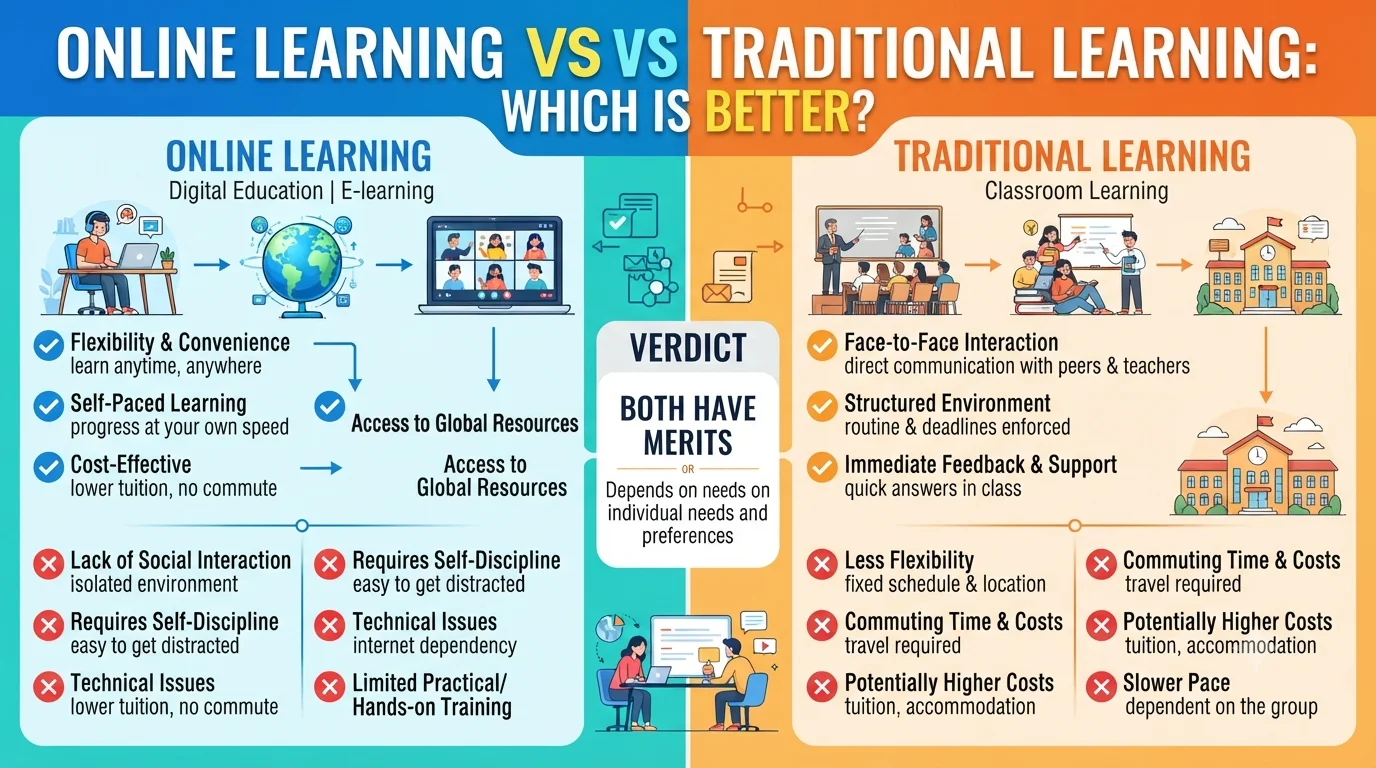
Online learning, often associated with digital education and e-learning, provides flexibility and access. Students can often learn from different locations and manage their study schedules around work, family, or other responsibilities.
Traditional classroom learning, on the other hand, offers physical presence, immediate interaction, established routines, and direct social engagement.
Understanding the strengths and weaknesses of both approaches can help students, parents, teachers, universities, and organizations make better educational decisions.
read more about academic writing books
What Is Online Learning?
Understanding Digital Education
Online learning is education delivered partly or entirely through digital technologies.
Students may access educational content using:
- Computers.
- Tablets.
- Smartphones.
- Learning management systems.
- Video conferencing platforms.
- Educational applications.
- Online discussion forums.
- Digital textbooks.
- Recorded lectures.
Online courses can be completely asynchronous, meaning students study materials at their own pace, or synchronous, meaning students and instructors meet online at scheduled times.
Many modern programs combine both approaches.
What Is E-Learning?
E-learning is a broad term covering educational experiences delivered through electronic or digital technologies.
It can include:
- Recorded video lessons.
- Interactive quizzes.
- Digital assignments.
- Online examinations.
- Virtual classrooms.
- Discussion boards.
- Interactive simulations.
- Digital libraries.
Because technology has become more sophisticated, e-learning is no longer limited to watching videos.
Modern digital education can include highly interactive learning environments.
What Is Traditional Learning?
The Classroom Learning Model
Traditional learning generally involves students and teachers meeting physically in a classroom, school, college, university, training center, or other educational environment.
Students typically follow a predetermined schedule.
The teacher delivers instruction while students:
- Listen.
- Take notes.
- Ask questions.
- Participate in discussions.
- Complete activities.
- Work with classmates.
- Take assessments.
This model has been used for generations and remains one of the most common forms of formal education.
Structure Is a Major Feature
One of the strongest characteristics of traditional learning is structure.
Students generally know:
- When classes begin.
- Where classes take place.
- What materials are required.
- When assignments are due.
- When exams occur.
For students who struggle with self-management, this structure can be extremely valuable.
Flexibility in Online Learning
Study When Your Schedule Allows
One of the biggest advantages of online education is flexibility.
A traditional class may require a student to attend at 9 a.m.
An online course may allow the student to watch the lesson later.
This can be particularly helpful for:
- Working professionals.
- Parents.
- Students with part-time jobs.
- People with irregular schedules.
- Learners living far from educational institutions.
Flexible Learning Can Improve Access
A student who cannot relocate to another city may still be able to study through an online program.
This can expand access to courses that were previously geographically limited.
Location Independence
Learn From Almost Anywhere
Online learning can eliminate the need for daily travel.
Students may study from:
- Home.
- Libraries.
- Cafes.
- Offices.
- Shared workspaces.
- Dormitories.
As long as they have the necessary technology and internet connection, physical location may become less important.
Reduced Commuting
Traditional students may spend significant amounts of time traveling to and from campus.
Online students can potentially use that time for:
- Studying.
- Working.
- Resting.
- Family responsibilities.
- Exercise.
For some learners, this is one of the strongest reasons to choose e-learning.
The Structure of Traditional Learning
Why Routine Can Be Helpful
Flexibility sounds ideal, but it is not automatically beneficial for everyone.
Some students perform better when they have a fixed routine.
Attending a physical class creates an external commitment.
Students cannot simply decide to postpone class because they do not feel motivated.
Accountability
Traditional classroom learning creates natural accountability.
A teacher can notice when a student is absent.
Classmates can remind one another about assignments.
The physical environment itself reinforces the idea that it is time to learn.
For students who struggle with procrastination, this can be a major advantage.
Self-Discipline in Online Learning
Freedom Requires Responsibility
Online education provides flexibility, but flexibility creates responsibility.
A student may have complete control over when to study.
That sounds convenient.
However, without good time-management skills, the student may repeatedly postpone coursework.
Common Online Learning Challenges
Students may struggle with:
- Procrastination.
- Distractions.
- Poor scheduling.
- Lack of motivation.
- Inconsistent study habits.
A successful online learner usually needs to develop strong self-management skills.
Creating a Study Schedule
An online student can improve consistency by creating a weekly schedule.
For example:
Monday: Watch lectures.
Tuesday: Complete reading.
Wednesday: Practice exercises.
Thursday: Review notes.
Friday: Complete assignments.
This transforms flexibility into a structured routine.
Teacher-Student Interaction
Face-to-Face Communication
Traditional classroom learning provides direct physical interaction.
Students can raise their hands and ask questions immediately.
Teachers can observe:
- Facial expressions.
- Confusion.
- Engagement.
- Body language.
This can help instructors adjust their explanations.
Spontaneous Questions
A classroom conversation can move naturally.
A student asks a question.
Another student adds a comment.
The teacher gives an example.
A discussion develops.
This spontaneity can be difficult to reproduce in some online environments.
Online Communication
Online education can still provide strong teacher interaction.
Students may communicate through:
- Video calls.
- Email.
- Discussion boards.
- Messaging systems.
- Virtual office hours.
However, the quality depends heavily on how the course is designed.
A poorly designed online course may leave students feeling isolated.
A well-designed course can create frequent interaction.
read more about study planner app
Social Interaction and Community
Classroom Learning and Social Development
Physical classrooms naturally create opportunities for students to interact.
Students may:
- Make friends.
- Join study groups.
- Work on projects.
- Participate in clubs.
- Build professional networks.
For younger students especially, social interaction is an important part of education.
Collaborative Learning
Many classroom activities involve teamwork.
Students learn not only from the teacher but also from classmates.
They may hear different perspectives and develop communication skills.
Online Communities
Online students can also develop communities.
They may participate in:
- Virtual study groups.
- Discussion forums.
- Group video calls.
- Online communities.
- Collaborative digital projects.
The challenge is making participation intentional.
Without active course design, students may simply consume content individually.
Cost Comparison
Is Online Learning Cheaper?
Online education can sometimes be less expensive than traditional education, but this is not always true.
Costs depend on:
- Institution.
- Program.
- Country.
- Course type.
- Technology requirements.
- Tuition structure.
Some online courses are inexpensive.
Others, particularly accredited degree programs, may cost as much as or even more than certain traditional programs.
Additional Savings
Online learning can reduce indirect costs such as:
- Transportation.
- Parking.
- Accommodation.
- Printed materials.
- Daily meals away from home.
These savings can be significant.
Traditional Education Costs
Traditional education can involve expenses beyond tuition.
Students may need to pay for:
- Transportation.
- Housing.
- Campus meals.
- Books.
- Printing.
- Supplies.
- Parking.
However, physical institutions may also provide facilities included in tuition, such as:
- Libraries.
- Laboratories.
- Sports facilities.
- Computer rooms.
- Student services.
Accessibility
Online Learning Can Reach More People
Digital education can make learning available to people who previously faced geographic barriers.
For example, someone living far from a major university may be able to enroll in an online program.
This can be particularly valuable for:
- Rural learners.
- Working adults.
- People with mobility challenges.
- International students.
- Learners with family responsibilities.
Accessibility Still Depends on Technology
Online education requires:
- Reliable internet.
- A compatible device.
- Electricity.
- Basic digital skills.
If any of these are unavailable, online learning can become difficult.
The Digital Divide
Not Everyone Has Equal Access
One of the biggest limitations of online education is the digital divide.
Students may have different access to:
- High-speed internet.
- Computers.
- Tablets.
- Quiet study spaces.
- Technical support.
A student with a powerful laptop and stable broadband may have a very different online experience from someone relying on a smartphone and unstable internet connection.
Technology Should Not Become a Barrier
Educational institutions offering online programs should consider accessibility carefully.
They can provide:
- Mobile-friendly platforms.
- Downloadable materials.
- Recorded sessions.
- Low-bandwidth options.
- Technical support.
Learning Environment
Studying at Home
Online students often study from home.
This can be comfortable.
There is no commute.
Students can choose their environment.
However, home can also contain distractions.
Potential distractions include:
- Family members.
- Television.
- Social media.
- Household chores.
- Notifications.
- Pets.
Creating a Dedicated Study Space
A dedicated study area can improve concentration.
It does not need to be an entire room.
Even a small desk can help create a psychological separation between studying and relaxing.
Classroom Environment
Fewer Home Distractions
A physical classroom is designed for learning.
Students are generally surrounded by others who are also studying.
This environment can encourage focus.
However, classrooms have their own distractions.
These may include:
- Noise.
- Conversations.
- Uncomfortable seating.
- Crowded rooms.
- Interruptions.
The effect depends on the student and the institution.
Learning Pace
Online Learning Can Be Self-Paced
One of the biggest advantages of e-learning is that some courses allow students to move at their own pace.
A student who understands a topic quickly may move ahead.
A student who needs additional time can replay lessons.
Rewatching Recorded Lessons
Recorded lessons can be especially useful.
Students can pause and replay explanations.
This is difficult to replicate in a traditional lecture.
Once the teacher finishes explaining something in a live classroom, the student must usually rely on notes or ask for clarification.
The Pace of Classroom Learning
Everyone Moves Through the Curriculum Together
Traditional classes usually follow a common pace.
This creates structure but can also create challenges.
If the teacher moves too quickly, some students may fall behind.
If the teacher moves too slowly, advanced students may become bored.
Teachers therefore need to balance different learning levels.
Practical and Hands-On Education
Where Traditional Learning Has a Major Advantage
Some subjects benefit greatly from physical environments.
Examples include:
- Laboratory sciences.
- Medicine.
- Nursing.
- Engineering workshops.
- Certain technical trades.
- Performing arts.
- Physical education.
Students may need access to:
- Equipment.
- Laboratories.
- Machines.
- Clinical environments.
- Physical materials.
Online simulations can supplement these experiences, but they may not fully replace real-world practice.
Can Online Learning Teach Practical Skills?
Yes, but the answer depends on the skill.
Digital platforms can effectively teach:
- Software.
- Programming.
- Writing.
- Marketing.
- Business.
- Languages.
- Theory.
- Many professional skills.
However, skills requiring physical interaction may require in-person training.
read more about brain foods for studying
Technology and Learning
Digital Tools Can Enhance Education
Online learning gives students access to numerous digital resources.
These may include:
- Interactive simulations.
- Digital flashcards.
- Online dictionaries.
- Educational videos.
- Automated quizzes.
- AI-assisted learning tools.
- Digital libraries.
Technology can make learning more interactive and personalized.
But More Technology Does Not Automatically Mean Better Education
Technology is a tool.
A poorly designed digital course can still be ineffective.
The quality of:
- Curriculum.
- Teaching.
- Feedback.
- Assessments.
- Student support
often matters more than the platform itself.
Traditional Learning and Educational Technology
Classrooms Are Also Becoming Digital
It is important not to treat traditional education as technology-free.
Modern classrooms may use:
- Interactive displays.
- Learning management systems.
- Digital textbooks.
- Tablets.
- Educational applications.
- Online assignments.
This means the difference between online and traditional education is becoming less absolute.
Many institutions now use blended learning.
Blended Learning
Combining Online and Classroom Education
Blended learning combines physical instruction with digital learning.
For example, students may:
- Attend a weekly classroom session.
- Watch online lectures.
- Complete digital quizzes.
- Participate in group discussions.
- Submit assignments through an online platform.
This approach attempts to combine the strengths of both models.
Why Blended Learning Can Be Effective
Students can benefit from:
- Face-to-face interaction.
- Flexible digital resources.
- Structured schedules.
- Online revision.
- Physical collaboration.
For many educational settings, this hybrid approach may offer a useful compromise.
Personalized Learning
Online Platforms Can Adapt to Students
Some digital learning systems can track student performance.
They may identify:
- Weak topics.
- Quiz mistakes.
- Learning progress.
- Completion rates.
This information can support more personalized instruction.
Adaptive Learning
Adaptive platforms may change the difficulty or sequence of content according to performance.
This can help students focus on areas where they need additional practice.
However, technology cannot replace the professional judgment of a skilled teacher.
Traditional Teachers and Personal Support
Human Guidance Remains Important
A teacher can provide more than information.
Teachers can:
- Encourage students.
- Identify emotional barriers.
- Explain concepts differently.
- Give personalized feedback.
- Recognize changes in performance.
This human relationship can be particularly important for students who need additional support.
Motivation
What Motivates Online Learners?
Online students may be motivated by:
- Flexibility.
- Career goals.
- Personal interests.
- Convenience.
- Independence.
However, motivation must often come from within.
External Motivation in Classrooms
Traditional education provides external motivators.
These may include:
- Attendance requirements.
- Exams.
- Teacher expectations.
- Peer pressure.
- Fixed deadlines.
These structures can help some students stay on track.
Assessment Differences
Online Assessments
Online courses may use:
- Automated quizzes.
- Online exams.
- Digital assignments.
- Discussion participation.
- Projects.
These methods can provide fast feedback.
Potential Challenges
Online assessment can raise concerns about:
- Academic integrity.
- Identity verification.
- Technical failures.
- Internet interruptions.
Educational institutions therefore need appropriate assessment strategies.
Traditional Assessment
Physical Exams
Traditional classrooms can conduct supervised exams.
This can simplify identity verification and reduce certain forms of academic misconduct.
However, traditional exams also have limitations.
Students may experience:
- Test anxiety.
- Travel requirements.
- Fixed scheduling.
- Limited flexibility.
Academic Integrity
Online Education and Cheating Concerns
One common criticism of online education is that students may have easier access to unauthorized resources during unsupervised assessments.
Technology can reduce some risks through:
- Secure browsers.
- Identity verification.
- Proctoring.
- Question randomization.
However, assessment design is often more important than surveillance.
Projects, presentations, open-book assignments, and applied tasks can test understanding differently from traditional memorization-based exams.
Concentration and Attention
Digital Distractions
Online learners face a unique problem: the learning device is also a source of distraction.
The same laptop used for class may provide access to:
- Social media.
- Entertainment.
- Messaging.
- Games.
- Shopping.
Students must actively manage these distractions.
Classroom Distractions
Traditional students also face distractions, but they are generally different.
They may include:
- Classmates.
- Noise.
- Movement.
- Conversations.
Communication Skills
Traditional Learning Encourages Live Communication
Students regularly practice:
- Speaking.
- Presenting.
- Listening.
- Negotiating.
- Group discussion.
These skills can be developed naturally through classroom activities.
Online Communication Is Still Valuable
Digital education develops different skills.
Students may become comfortable with:
- Video meetings.
- Written communication.
- Digital collaboration.
- Online presentations.
- Remote teamwork.
These skills are increasingly relevant to modern workplaces.
Networking Opportunities
Physical Campuses Offer Natural Networking
Traditional students can meet:
- Professors.
- Classmates.
- Alumni.
- Employers.
- Industry professionals.
Informal interactions can sometimes lead to:
- Internships.
- Jobs.
- Collaborations.
- Mentorship.
Online Networking Can Also Be Powerful
Online students may connect with people across countries and industries.
They can participate in:
- Professional communities.
- Online conferences.
- Virtual events.
- Industry forums.
- Global study groups.
The advantage is geographical diversity.
International Learning
Online Education Removes Some Borders
A student in one country may be able to study a course created by an institution in another country without relocating.
This can provide exposure to:
- Different cultures.
- International perspectives.
- Global teaching methods.
- Diverse classmates.
This is one of the most powerful possibilities created by digital education.
Language Learning
Online vs Traditional for Languages
Language learning is an interesting example because both approaches have strengths.
Online learning provides:
- Language apps.
- Video lessons.
- Native-speaker content.
- Digital flashcards.
- Online conversation partners.
Traditional classrooms provide:
- Live conversation.
- Immediate correction.
- Group interaction.
- Structured practice.
The strongest approach may combine both.
Convenience
Online Learning Wins on Convenience
There is no question that online learning can be extremely convenient.
Students can avoid:
- Commuting.
- Relocation.
- Fixed physical classrooms.
They can access materials from many locations.
But Convenience Is Not the Same as Effectiveness
A convenient course is not necessarily a good course.
Students should evaluate:
- Instructor quality.
- Curriculum.
- Accreditation.
- Student support.
- Assessment methods.
- Course outcomes.
Traditional Learning and Routine
Physical Attendance Creates Commitment
For some students, physically going to class creates a clear boundary between education and personal life.
They enter a learning environment.
They interact with teachers.
They leave.
This routine can make it easier to maintain consistency.
Which Method Is Better for Different Students?
Online Learning May Suit You If:
You may prefer online education if you:
- Have a busy schedule.
- Work while studying.
- Need geographic flexibility.
- Are self-disciplined.
- Prefer independent study.
- Learn well through digital resources.
- Need to replay lessons.
- Live far from educational institutions.
Traditional Learning May Suit You If:
Classroom learning may be better if you:
- Prefer structured schedules.
- Need direct teacher interaction.
- Learn well through discussion.
- Enjoy social interaction.
- Need physical facilities.
- Struggle with procrastination.
- Benefit from supervised learning.
read more about stay focused while studying
Which Method Is Better for Parents?
Family Responsibilities Can Change the Decision
Parents may find online education more convenient because it can fit around family responsibilities.
However, traditional programs may offer stronger structure.
The best option depends on:
- Class schedules.
- Childcare.
- Commute.
- Course flexibility.
Which Method Is Better for Working Adults?
Online Education Often Offers Greater Flexibility
Working professionals may benefit from online courses because they can study outside normal working hours.
A recorded course can be particularly useful.
However, some professionals may prefer traditional evening or weekend classes because they provide stronger accountability.
Which Method Is Better for Younger Students?
Age Matters
Younger students often benefit from direct teacher supervision and social interaction.
Traditional classrooms can support:
- Social development.
- Routine.
- Communication.
- Behavioral guidance.
Online learning can still supplement education, but completely independent digital learning may not suit every young learner.
Which Method Is Better for Higher Education?
It Depends on the Program
Universities can successfully deliver many subjects online.
Programs focused on:
- Business.
- Marketing.
- Writing.
- Computer science.
- Some social sciences
may adapt relatively well to online formats.
Programs requiring extensive laboratory or clinical experience may require more physical instruction.
Main Advantages
Advantages of Online Learning
Online education offers:
- Flexibility.
- Geographic freedom.
- Convenient access.
- Self-paced learning.
- Recorded materials.
- Digital resources.
- Potentially lower indirect costs.
- Global access.
Advantages of Traditional Learning
Traditional education offers:
- Structure.
- Face-to-face interaction.
- Immediate communication.
- Social development.
- Physical facilities.
- Hands-on learning.
- Natural accountability.
- Networking opportunities.
Disadvantages of Online Learning
Potential challenges include:
- Isolation.
- Technology problems.
- Distractions.
- Procrastination.
- Screen fatigue.
- Unequal internet access.
- Reduced face-to-face interaction.
Disadvantages of Traditional Learning
Potential disadvantages include:
- Fixed schedules.
- Commuting.
- Higher indirect costs.
- Geographic limitations.
- Less flexibility.
- Large class sizes.
- Limited opportunities to replay live lessons.
How to Choose the Right Learning Method
Evaluate Your Learning Style
Ask yourself:
Do I learn better independently?
Do I need a teacher physically present?
Do I enjoy group discussion?
Do I need flexible scheduling?
Am I disciplined enough to study independently?
The answers can point toward the right model.
Evaluate the Course
Do not choose based only on whether it is online or offline.
Research:
- Curriculum.
- Instructor experience.
- Accreditation.
- Assessment methods.
- Student support.
- Learning resources.
- Practical components.
Consider the Subject
A programming course may work very well online.
A laboratory-based course may require physical facilities.
The subject itself should influence your decision.
Consider Your Technology
Before choosing online education, make sure you have:
- Reliable internet.
- Suitable hardware.
- Necessary software.
- A quiet study environment.
If you constantly struggle with connectivity, online education may become frustrating.
Consider Your Time
If you have a predictable schedule, traditional learning may work well.
If your schedule changes frequently, online learning may provide more flexibility.
Consider Your Personality
Some people thrive independently.
Others perform better when surrounded by classmates.
Neither preference is wrong.
The goal is to understand what helps you learn effectively.
The Future of Education
Education Is Becoming More Flexible
The future is unlikely to be purely online or purely traditional.
Instead, education is increasingly combining:
- Physical classrooms.
- Digital platforms.
- Recorded lessons.
- Virtual meetings.
- Interactive applications.
- AI-powered tools.
- Online collaboration.
This creates more choices for learners.
Artificial Intelligence and Digital Education
AI tools are increasingly being integrated into educational experiences.
They may help students:
- Practice concepts.
- Generate questions.
- Receive explanations.
- Organize notes.
- Translate materials.
- Identify areas requiring additional study.
However, AI should complement education rather than replace teachers.
The Teacher’s Role Is Changing
As information becomes easier to access, teachers can focus more heavily on:
- Guidance.
- Critical thinking.
- Feedback.
- Discussion.
- Mentorship.
- Application.
This may make the teacher’s role more valuable rather than less important.
Online Learning vs Traditional Learning
The debate over online learning vs traditional learning should not be treated as a competition with one universal winner.
Online learning is powerful because it provides flexibility, accessibility, and digital resources. It can allow students to study around work and family responsibilities and connect learners with educational opportunities beyond their geographic location.
Traditional learning remains valuable because it provides structure, human interaction, social development, practical experiences, and direct access to teachers and facilities.
For some students, online education will be the better choice.
For others, classroom learning will produce stronger results.
And for many learners, the most effective solution may be a combination of both.
read more about study tools
The question “Which is better?” has no universal answer.
The better learning method is the one that matches the student’s needs, the subject being studied, the quality of instruction, and the learner’s ability to stay engaged.
Online learning is particularly attractive for people who need flexibility, geographic freedom, and independent study. Traditional learning can be more effective for learners who value routine, direct interaction, physical resources, and structured accountability.
Rather than choosing a format simply because it is modern or familiar, students should examine the complete educational experience.
Ask:
- Will I receive high-quality instruction?
- Can I communicate with my teacher?
- Will I have enough opportunities to practice?
- Can I maintain motivation?
- Does the schedule fit my life?
- Do I have the technology I need?
- Does the course require physical experience?
- Will I benefit from interaction with other students?
Once these questions are answered, the decision becomes much clearer.
The future of education is unlikely to belong exclusively to online or traditional classrooms. Instead, successful education will increasingly combine the strengths of both.
The most important goal is not choosing between a screen and a classroom.
It is creating a learning experience that helps students understand, practice, remember, and apply what they learn.