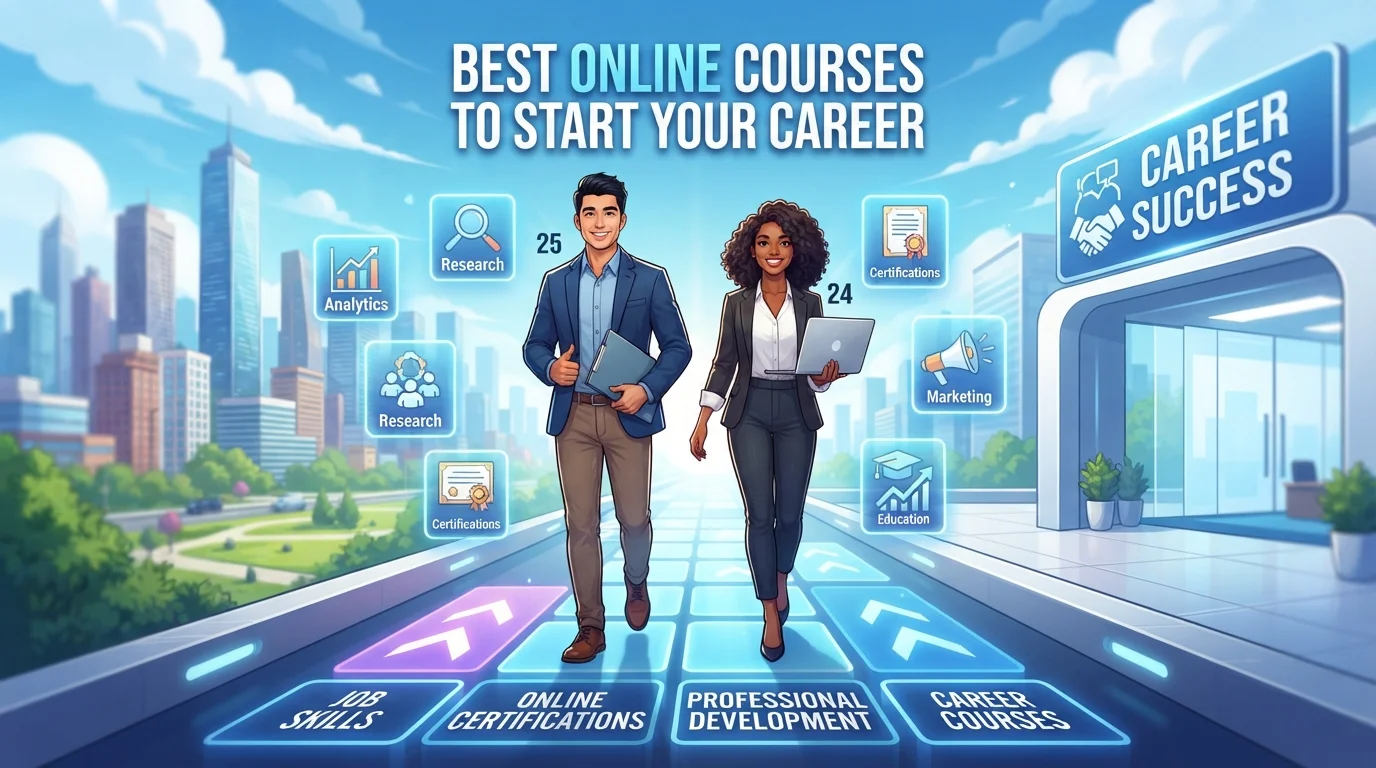
Choosing the right career path can feel overwhelming, especially for students and recent graduates who are preparing to enter a competitive job market. A degree can provide valuable academic knowledge, but employers often look for practical abilities that can be applied immediately in the workplace. This is where career courses can make a significant difference.
Online learning has made it easier than ever to develop job skills, explore professional fields, and earn online certifications without committing to another full-time degree. Whether you are interested in marketing, technology, business, finance, design, communication, or project management, there are career-focused courses that can help you build a stronger professional foundation.
The best courses are not necessarily the longest or most expensive. A valuable course should teach practical skills, include relevant projects or exercises, and help learners demonstrate what they can do. The goal should be to move beyond simply collecting certificates and instead develop capabilities that employers actually value.
This guide explores the best career courses for students and beginners, explains which skills are worth learning, and provides a practical approach to choosing online certifications that can support long-term career development.
read more about best online courses
Why Career Courses Matter for Students
Academic Knowledge Is Only Part of Career Preparation
University education can provide theoretical knowledge and a strong foundation in a particular subject. However, many workplace responsibilities require practical skills that may not be covered deeply in a traditional academic program.
For example, a business student may understand marketing concepts but still need to learn how to create a marketing campaign, analyze customer data, prepare a digital advertising strategy, or use professional analytics tools.
Similarly, a computer science student may understand programming principles but need additional experience with version control, cloud platforms, databases, software development workflows, or real-world projects.
Career courses help bridge this gap.
They allow students to take what they learn academically and develop practical abilities that are easier to demonstrate during internships, interviews, freelance projects, and entry-level jobs.
Career Courses Can Help You Discover Your Direction
Not every student knows exactly what career they want to pursue. Online learning provides a relatively flexible way to experiment with different professional fields.
A student interested in business could take introductory courses in:
- Digital marketing
- Project management
- Business analytics
- Sales
- Entrepreneurship
- Human resources
- Financial analysis
After completing introductory courses, students can identify which subjects they enjoy and which skills they want to develop further.
This approach can reduce the risk of spending years pursuing a career path without understanding what the actual work involves.
Practical Skills Can Strengthen a Resume
A resume becomes more convincing when it demonstrates what a candidate can actually do.
Simply writing that you are “interested in marketing” is less powerful than showing that you have completed a marketing project, created a sample campaign, analyzed customer behavior, or built a portfolio.
Career courses can provide opportunities to develop these examples.
The strongest approach is to combine education with evidence. A certification may show that you completed a structured learning program, while a portfolio project demonstrates how you applied the knowledge.
How to Choose the Best Career Courses
Start With the Career You Want
Before enrolling in several random courses, identify the type of work you are interested in.
Ask yourself:
- What industries interest me?
- What entry-level positions exist in those industries?
- What skills are commonly required?
- Which skills do job descriptions mention repeatedly?
- Do I prefer analytical, creative, technical, or interpersonal work?
- What type of work environment would suit me?
You do not need to have your entire career planned. Even choosing a broad direction can help.
For example, “technology” is broad, but choosing between software development, data analysis, cybersecurity, and digital product management creates a much clearer learning path.
Prioritize Practical Job Skills
A course should ideally teach skills that can be applied to real workplace situations.
For example, a digital marketing course is more valuable when students learn how to:
- Research audiences
- Develop content strategies
- Understand search engine optimization
- Analyze campaign performance
- Build marketing reports
- Understand conversion rates
- Work with customer data
- Develop measurable marketing objectives
The same principle applies to other fields.
Look for courses that emphasize application rather than memorization.
Check the Course Curriculum
Before enrolling, examine the syllabus carefully.
A good career course should have clear learning outcomes and a logical progression from basic concepts to practical applications.
Avoid choosing a course simply because its title sounds impressive.
A course called “Professional Business Mastery” may be less useful than a straightforward course focused on spreadsheet analysis, project management, or sales communication if those are the skills employers require.
Consider Projects and Assignments
Projects are particularly valuable because they give you something concrete to discuss during interviews.
For example, a beginner in data analytics could create a project analyzing sales data and presenting business recommendations.
A marketing student could develop a complete campaign plan for a fictional company.
A web development learner could create a simple website.
A project management student could build a sample project schedule and risk-management plan.
These experiences turn theoretical learning into evidence of ability.
Best Career Courses for Digital Marketing
Digital Marketing Fundamentals
Digital marketing is one of the most accessible career fields for students because it combines creativity, communication, technology, and analytics.
A strong introductory course should cover major areas such as:
- Search engine optimization
- Content marketing
- Social media marketing
- Email marketing
- Paid advertising
- Customer journeys
- Conversion optimization
- Marketing analytics
- Branding
- Digital strategy
Students should ideally finish the course with a basic understanding of how different marketing channels work together.
Search Engine Optimization
SEO is another valuable skill for students interested in marketing, publishing, e-commerce, and content.
An SEO course can teach learners how search engines discover and evaluate content, how keyword research works, how to optimize webpages, and how to evaluate organic search performance.
More advanced courses may introduce:
- Technical SEO
- On-page optimization
- Off-page strategies
- Search intent
- Content clusters
- Internal linking
- Competitor analysis
- SEO reporting
SEO is particularly useful because it can be applied to personal websites, business projects, e-commerce stores, blogs, and professional portfolios.
Social Media Marketing
Social media skills are relevant to many modern businesses.
A good course should teach more than how to publish posts. Students should learn how to create a social media strategy, understand target audiences, develop content calendars, analyze engagement, and measure performance.
Practical assignments can include creating a monthly content calendar or developing a social media campaign for a hypothetical business.
Digital Advertising
Students interested in paid media can explore courses covering online advertising concepts.
Important subjects include:
- Audience targeting
- Campaign objectives
- Ad creative
- Budget allocation
- Conversion tracking
- Performance analysis
- Return on advertising spend
- A/B testing
Learning how to interpret advertising results is particularly valuable because businesses want marketers who can connect spending with measurable outcomes.
read more about best earbuds for online classes
Best Career Courses for Business Students
Business Analytics
Business analytics is increasingly important because organizations rely on data to make decisions.
An introductory business analytics course can teach students how to transform raw information into useful insights.
Important topics include:
- Data collection
- Data cleaning
- Descriptive statistics
- Data visualization
- Business reporting
- Trend analysis
- Performance indicators
- Decision-making
Students who develop these abilities can explore roles in business analysis, operations, marketing analytics, sales analytics, and related areas.
Excel and Spreadsheet Skills
Advanced spreadsheet skills remain valuable across many industries.
Students should consider learning:
- Formulas
- Functions
- Pivot tables
- Charts
- Data cleaning
- Conditional formatting
- Lookup functions
- Basic dashboards
- Spreadsheet automation
These skills can improve productivity in finance, administration, sales, marketing, operations, human resources, and management.
For many entry-level positions, strong spreadsheet ability can be more immediately useful than a collection of unrelated certificates.
Project Management
Project management courses are useful for students who want careers involving coordination, planning, operations, consulting, technology, construction, marketing, or business.
A beginner course should introduce:
- Project planning
- Scope management
- Scheduling
- Resource allocation
- Risk management
- Team communication
- Budgeting
- Project documentation
- Performance tracking
Learning project management can also improve personal organization and teamwork.
Best Career Courses for Technology Careers
Programming Fundamentals
Students interested in technology can begin with programming fundamentals.
The specific programming language matters less at the very beginning than understanding core concepts such as:
- Variables
- Conditions
- Loops
- Functions
- Data structures
- Debugging
- Algorithms
- Basic software design
Once these concepts are understood, learners can specialize in languages relevant to their target careers.
Web Development
Web development remains an attractive area for people interested in building digital products.
Beginner courses may introduce:
- HTML
- CSS
- JavaScript
- Responsive design
- Web accessibility
- Basic version control
- Front-end development
Students should focus on creating projects rather than only completing lessons.
A portfolio containing several functional websites can provide stronger evidence of ability than a long list of introductory certificates.
Data Analytics
Data analytics combines technology, statistics, and business decision-making.
A beginner learning path can include:
- Spreadsheet analysis
- SQL
- Data visualization
- Basic statistics
- Dashboard creation
- Data storytelling
Students can strengthen their portfolios by working with realistic datasets and presenting conclusions clearly.
Cybersecurity Fundamentals
Cybersecurity is another technology field worth exploring.
Introductory courses can teach basic concepts such as:
- Network security
- Authentication
- Access control
- Security threats
- Data protection
- Risk management
- Security awareness
Students should understand that cybersecurity is a broad field. Later specialization can include areas such as security analysis, network security, cloud security, or governance and compliance.
Best Career Courses for Communication Skills
Business Communication
Strong communication is valuable in almost every profession.
A business communication course can help students learn how to:
- Write professional emails
- Prepare reports
- Present information
- Communicate with colleagues
- Explain complex ideas
- Participate in meetings
- Adapt communication to different audiences
Communication skills can significantly influence career progression because employees frequently need to explain their work to managers, customers, or team members.
Public Speaking and Presentation Skills
Many graduates struggle with interviews and presentations not because they lack knowledge but because they have difficulty communicating confidently.
A public speaking course can help learners develop:
- Presentation structure
- Voice control
- Body language
- Audience engagement
- Storytelling
- Visual presentation skills
- Question-handling techniques
These abilities are useful in interviews, meetings, sales roles, management positions, and academic settings.
Professional Writing
Professional writing courses can be especially useful for students entering corporate environments.
They can teach learners how to write concise emails, reports, proposals, business documents, and professional messages.
Good workplace writing should generally be clear, organized, direct, and appropriate for the audience.
Best Career Courses for Finance and Accounting
Financial Literacy
Students do not need to become accountants to benefit from financial knowledge.
A financial literacy course can introduce:
- Budgeting
- Financial statements
- Revenue
- Expenses
- Profit
- Cash flow
- Financial ratios
- Basic investment concepts
Understanding financial terminology can help professionals make better business decisions.
Accounting Fundamentals
Accounting courses can be particularly useful for students considering careers in finance, administration, business operations, or entrepreneurship.
An introductory course may cover bookkeeping, financial statements, accounts payable, accounts receivable, and basic financial reporting.
Financial Modeling
Students pursuing finance-related careers can eventually explore financial modeling.
Financial modeling involves using structured spreadsheets to represent business performance, forecasts, scenarios, and financial assumptions.
It requires more advanced spreadsheet knowledge and should generally come after learners understand basic accounting and finance.
Best Career Courses for Sales and Customer Service
Sales Fundamentals
Sales is a valuable career path for people who enjoy communication, negotiation, and relationship building.
A good sales course should cover:
- Prospecting
- Lead qualification
- Customer needs analysis
- Sales presentations
- Objection handling
- Negotiation
- Follow-up
- Closing
- Customer relationship management
Sales skills are transferable across industries.
Customer Relationship Management
CRM knowledge can be useful for students entering sales, customer success, marketing, and business development.
Students can learn how businesses organize customer information, track leads, manage follow-ups, and monitor sales pipelines.
Learning the concepts behind CRM systems is useful even before gaining experience with a specific platform.
Career Courses for Artificial Intelligence and Emerging Technology
AI Literacy
Artificial intelligence is becoming relevant across many professions, not only technology jobs.
Students can benefit from introductory AI courses that explain:
- How AI systems work at a high level
- Generative AI
- Machine learning fundamentals
- AI limitations
- Responsible AI use
- Data privacy
- Workplace applications
The goal for most beginners should not be to become AI researchers immediately. Instead, they should understand how AI can be used responsibly to improve productivity and solve business problems.
AI Tools for Productivity
Professionals increasingly use AI tools for research, brainstorming, drafting, analysis, automation, and workflow support.
Students can learn how to use AI responsibly for tasks such as:
- Organizing information
- Generating ideas
- Summarizing material
- Creating initial drafts
- Analyzing structured information
- Automating repetitive workflows
However, students should avoid depending entirely on AI. Employers still value judgment, creativity, critical thinking, communication, and subject-matter knowledge.
read more about fast charger for students
Why Online Certifications Can Help Your Career
Certifications Provide Structured Learning
One of the main benefits of online certifications is structure.
Instead of randomly watching videos about a subject, students can follow a curriculum designed around specific learning objectives.
This can make the learning process more organized and measurable.
Certifications Can Support a Resume
Online certifications can strengthen a resume when they are relevant to the position.
For example, someone applying for a junior marketing position may benefit from certifications related to SEO, digital advertising, analytics, or content marketing.
However, certificates should support the story of the resume rather than dominate it.
A resume with twenty unrelated certificates may appear less focused than one showing three relevant certifications plus practical projects.
Certifications Are Not a Replacement for Experience
A certificate alone does not guarantee employment.
Employers often evaluate candidates based on a combination of education, practical experience, communication, problem-solving ability, technical skills, and cultural fit.
Therefore, students should use courses as a foundation for creating experience.
How to Turn Career Courses Into Real Experience
Build a Portfolio
A portfolio can be one of the most effective ways to demonstrate practical skills.
Depending on your field, a portfolio might include:
- Marketing campaigns
- Websites
- Data dashboards
- Business reports
- Design projects
- Financial models
- Writing samples
- Social media strategies
- Project plans
- Sales presentations
The projects do not have to come from paid employment.
You can create realistic projects for fictional businesses or analyze publicly available datasets.
Work on Personal Projects
Personal projects allow students to practice without waiting for an employer to give them an opportunity.
For example, a student interested in digital marketing could create a complete marketing strategy for a fictional restaurant.
A data analytics student could analyze a public dataset.
A programming student could build a simple application.
A design student could create a branding project.
The important thing is to document the process and explain the decisions behind the final result.
Look for Internships
Courses can make students more prepared for internships.
Internships provide an opportunity to see how professional environments actually operate.
Even short-term experience can teach valuable lessons about deadlines, teamwork, communication, meetings, customers, managers, and workplace expectations.
Students should therefore combine online learning with real-world opportunities whenever possible.
How to Create a Career Course Learning Path
Step One: Choose One Career Direction
Start with one primary goal.
For example:
“I want to become a junior digital marketer.”
This goal is specific enough to guide your learning.
Step Two: Identify Required Skills
Study entry-level job descriptions and identify recurring requirements.
For a digital marketing role, you might find requirements related to:
- SEO
- Social media
- Content
- Analytics
- Advertising
- Communication
- Reporting
These requirements become your learning roadmap.
Step Three: Choose Two or Three High-Value Courses
Do not enroll in ten courses at once.
Choose a small number of courses that directly support your goal.
Complete them properly before adding more.
Step Four: Build Projects Alongside Learning
After learning each major skill, create something with it.
This converts passive learning into practical experience.
Step Five: Update Your Resume and Portfolio
Document your completed courses, projects, tools, and measurable achievements.
Instead of writing:
“Completed a digital marketing course.”
You can write:
“Developed a complete digital marketing campaign plan including audience research, content strategy, SEO recommendations, and performance metrics.”
The second description demonstrates application.
Common Mistakes When Choosing Career Courses
Collecting Certificates Without Learning
One of the most common mistakes is focusing on certificates rather than skills.
Completing a course quickly just to receive a certificate does not necessarily create career value.
The real objective is competence.
Choosing Courses Because They Are Popular
Popularity does not always mean relevance.
A course may have millions of learners but still be unsuitable for your career goals.
Always compare the curriculum with the skills required for your target role.
Taking Too Many Courses at Once
Learning can become overwhelming when students enroll in multiple programs simultaneously.
A better strategy is sequential learning.
Choose one subject, practice it, complete a project, and then move to the next skill.
Ignoring Soft Skills
Technical skills are important, but employers also value communication, teamwork, adaptability, organization, critical thinking, and problem-solving.
A strong career development plan should include both technical and interpersonal abilities.
Not Practicing
Watching lessons creates familiarity, but practice creates competence.
If a course teaches Excel, use Excel.
If it teaches programming, code.
If it teaches marketing, create a campaign.
If it teaches presentation skills, present.
The more actively you practice, the more useful the course becomes.
How Much Time Should You Spend on Career Courses?
Focus on Consistency
Students do not necessarily need to study for several hours every day.
A consistent schedule can be more sustainable.
For example, a learner might dedicate one hour each weekday to professional development and several hours on weekends to projects.
The exact schedule should depend on academic responsibilities and personal circumstances.
Balance Learning With Application
A useful approach is to divide learning time between education and practice.
For example, if you spend two hours studying a concept, consider spending additional time applying it.
This prevents the learning process from becoming purely theoretical.
How Career Courses Support Long-Term Career Development
Skills Need Continuous Updating
The workplace changes continuously.
Technology evolves, industries adopt new tools, and employers modify their expectations.
Career development therefore should not end after graduation.
Professionals can continue learning throughout their careers.
Specialization Can Increase Your Value
Once you understand the basics of a field, specialization can help differentiate you.
For example, a marketer might specialize in:
- SEO
- Paid advertising
- E-commerce
- Content strategy
- Email marketing
- Marketing analytics
- B2B marketing
A data professional might specialize in:
- Business intelligence
- Financial analytics
- Marketing analytics
- Product analytics
Specialization should generally come after establishing a strong foundation.
Combine Complementary Skills
One of the most effective strategies is to combine related skills.
For example, someone with marketing knowledge and data analytics skills may be able to evaluate campaigns more effectively.
A business professional with project management and communication skills may become more effective at coordinating teams.
A designer who understands marketing may create work that is better aligned with business objectives.
Combining skills can create a professional profile that is difficult to replace.
read more about learn English at home
Career Courses for Different Student Goals
For Students Who Want a Corporate Career
Focus on:
- Business communication
- Excel
- Project management
- Business analytics
- Presentation skills
- Industry-specific knowledge
For Students Who Want a Freelance Career
Focus on:
- A marketable technical skill
- Client communication
- Sales
- Personal branding
- Portfolio development
- Project management
- Pricing and negotiation
For Students Who Want a Technology Career
Focus on:
- Programming
- Data structures
- Databases
- Cloud fundamentals
- Cybersecurity or data analytics
- Technical projects
For Students Who Want a Marketing Career
Focus on:
- Digital marketing
- SEO
- Social media
- Content
- Advertising
- Analytics
- Copywriting
For Students Who Want to Start a Business
Focus on:
- Business fundamentals
- Financial literacy
- Marketing
- Sales
- Customer research
- Project management
- Entrepreneurship
- Digital tools
How to Make Your Online Learning More Effective
Set Specific Learning Objectives
Instead of saying, “I want to learn marketing,” create a measurable objective.
For example:
“I want to be able to create a basic digital marketing strategy for a small business.”
This makes it easier to determine whether you have actually learned the subject.
Take Notes Strategically
Do not try to write down every sentence from a course.
Focus on concepts, processes, examples, definitions, and practical instructions that you expect to use later.
Create concise reference notes that you can review when working on projects.
Teach What You Learn
Explaining a concept to another person is an effective way to test your understanding.
If you cannot explain a topic clearly, you may need to review it.
Create a Final Project
Whenever possible, finish a course with a practical project.
This gives you an opportunity to combine multiple concepts and creates something that can potentially be included in your portfolio.
What Employers Look for Beyond Certificates
Evidence of Skills
Employers want to know whether you can perform the work.
Projects, internships, freelance work, volunteer experience, and practical assignments can help demonstrate this.
Problem-Solving
Employees regularly encounter problems that are not explained in a textbook.
Career courses should therefore encourage learners to analyze situations and make decisions rather than simply memorize information.
Adaptability
Modern workplaces change quickly.
Employers value people who can learn new tools, adjust to changing priorities, and continue improving.
Communication
Being able to explain your ideas clearly is useful in almost every role.
Even highly technical professionals need to communicate with colleagues, managers, customers, and other stakeholders.
A Practical 90-Day Career Learning Strategy
Days 1–30: Build the Foundation
During the first month, focus on understanding the fundamentals of your chosen field.
Choose one or two introductory career courses and establish a regular learning schedule.
Take notes and complete all exercises.
Do not rush through lessons simply to finish them.
Days 31–60: Develop Practical Skills
During the second month, start applying what you learned.
Complete projects and practice using relevant professional tools.
If possible, create a small portfolio.
This stage should focus heavily on doing rather than watching.
Days 61–90: Prepare for the Job Market
During the final month, focus on professional presentation.
Update your resume.
Improve your professional profile.
Organize your portfolio.
Practice interviews.
Research entry-level job descriptions.
Identify remaining skill gaps and address the most important ones.
By the end of 90 days, you may not be an expert, but you can have a much clearer professional direction and a stronger foundation for your first opportunity.
Frequently Asked Questions About Career Courses
Are Online Career Courses Worth It?
Yes, when they are chosen carefully and combined with practical experience.
The value of an online course depends on its relevance, quality, curriculum, and how effectively you apply what you learn.
Can Online Certifications Help Me Get My First Job?
They can strengthen your application, particularly when the certification is relevant to the role.
However, employers may also look for projects, internships, communication skills, and demonstrated competence.
How Many Career Courses Should I Take?
There is no ideal number.
It is generally better to complete a small number of highly relevant courses thoroughly than to collect dozens of certificates without developing practical skills.
Should I Choose Free or Paid Courses?
Both can be useful.
Free courses can provide excellent introductions to many subjects, while paid programs may offer more structured curricula, projects, instructor support, or specialized content.
Evaluate the learning outcomes rather than assuming price determines quality.
Can I Start Career Courses Without Experience?
Absolutely.
Many online courses are designed for beginners.
Start with foundational material and gradually move toward more advanced subjects as your knowledge improves.
Should Students Take Career Courses Before Graduation?
Yes, if the courses fit their academic workload and career goals.
Starting early can give students time to build projects, explore different professions, and develop job skills before graduation.
Are Certificates More Important Than Skills?
No.
Skills and the ability to demonstrate those skills are usually more valuable than simply possessing certificates.
A certificate can support your professional profile, but practical competence should be the priority.
read more about benefits of reading
Choosing the Best Career Courses
The best career courses are not necessarily the ones with the most impressive titles or the largest number of certificates. They are the courses that help you develop useful abilities, apply those abilities to realistic problems, and move closer to a specific professional goal.
For students preparing to enter the workforce, a smart learning strategy combines technical knowledge, practical projects, communication skills, and continuous career development. Courses in digital marketing, business analytics, project management, programming, data analysis, communication, finance, sales, and emerging technologies can all provide valuable foundations when they match the learner’s objectives.
The most important step is to avoid treating online learning as a race to collect credentials. Instead, think of each course as one building block in your professional development.
Choose a career direction, identify the skills employers expect, select relevant career courses, practice what you learn, create projects, and gradually build evidence of your abilities.
When online certifications are combined with real-world practice, a strong portfolio, effective communication, and a willingness to keep learning, they can become much more than additions to a resume. They can provide a practical pathway from student life toward a confident and sustainable career.