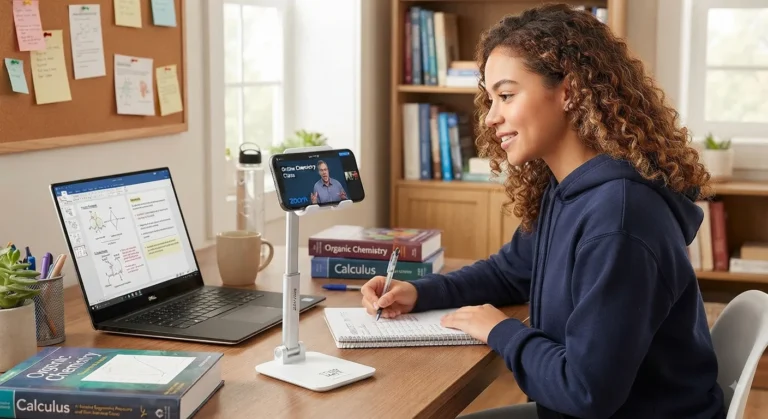

A typical day may involve early mornings, classes, lectures, commuting, study sessions, group projects, part-time work, extracurricular activities, social communication, and late-night studying. Throughout the day, a smartphone or laptop may be used for notes, research, communication, transportation, calendars, learning platforms, authentication codes, entertainment, and emergency contact.
That makes battery life more important than it may initially seem.
When a student’s phone reaches 10% battery just before an important lecture, having access to a reliable fast charger for students can make a significant difference. Instead of waiting hours for a battery to recover, a compatible fast-charging system can restore useful battery capacity in a relatively short period.
But does every student actually need fast charging?
Not necessarily.
The best charger depends on the student’s devices, schedule, budget, charging standards, and daily habits. Someone who spends most of the day near an electrical outlet may be perfectly comfortable with a conventional charger. Another student who spends hours commuting between campus, home, libraries, and work may benefit enormously from a compact USB-C fast charger.
This guide explains what students should know before buying a USB-C charger, how fast charging works, when it is genuinely useful, how to choose a phone charger, and which features matter most for student life.
The focus is not simply on buying the charger with the highest wattage.
Instead, the goal is to choose a charger that is fast, compatible, portable, safe, practical, and appropriate for the devices you actually use.
read more about phone stand for studying
What Is a Fast Charger?
Understanding Fast Charging
A fast charger is a charger designed to deliver power at a higher rate than basic charging systems.
Charging speed is generally discussed in terms of watts.
A charger might be rated at:
- 10W
- 18W
- 20W
- 25W
- 30W
- 45W
- 65W
- 100W
- Higher ratings for certain specialized devices
However, a higher wattage number does not automatically mean that your phone will charge at that wattage.
The device itself determines how much power it can accept.
Charger Wattage Is Only One Part of the Equation
Charging speed depends on the interaction between:
Charger + cable + device + charging protocol + battery conditions.
For example, buying a 100W charger does not mean that a smartphone designed to accept 25W will suddenly charge at 100W.
The phone will generally regulate the power it receives according to its charging design.
This is one of the most important concepts for students shopping for a charger.
Why Fast Charging Matters During Student Life
Students Are Often Short on Time
A student may have only 20 minutes between classes.
That could be enough time to:
- Grab food
- Respond to messages
- Walk across campus
- Prepare for the next lecture
- Charge a phone
If the phone is nearly empty, charging efficiency becomes important.
A fast charger can turn a short break into a useful charging opportunity.
Smartphones Have Become Academic Tools
Students increasingly depend on smartphones for more than communication.
A phone may be used for:
- Digital textbooks
- Class schedules
- Learning platforms
- Group chats
- Research
- Note-taking
- Document scanning
- Authentication
- Maps
- Ride-hailing
- Mobile payments
A dead battery can therefore create more than an entertainment inconvenience.
It can interfere with everyday student tasks.
A Fast Charger for Students Is About Convenience
The Value of Short Charging Sessions
Imagine two students.
Student A charges their phone overnight and rarely uses it heavily during the day.
Student B uses their phone continuously and often arrives home with very little battery.
Student B is likely to benefit more from fast charging.
The advantage is not necessarily that the phone reaches 100% dramatically faster every time.
The bigger advantage is that short charging sessions become more useful.
A student might plug in for 15 or 20 minutes before leaving for class and recover enough battery to get through several additional hours.
read more about study space at home
How Fast Charging Works
Power Is Measured in Watts
Electrical power can be simplified as:
Watts = Volts × Amps
A charger can deliver different combinations of voltage and current depending on the charging standard and connected device.
Modern fast-charging systems are more sophisticated than simply pushing maximum power continuously.
The phone communicates with the charger and determines an appropriate charging level.
Charging Is Not Constant
A smartphone typically does not charge at its maximum rate from zero to 100%.
Charging behavior changes as the battery fills.
Fast charging is often most noticeable when the battery is relatively low.
As the battery approaches a high state of charge, the charging rate generally decreases.
This helps manage heat and battery stress.
USB-C Chargers and Why They Matter
USB-C Has Become a Major Standard
USB-C has become widely adopted across modern electronics.
It can be used for:
- Smartphones
- Tablets
- Laptops
- Headphones
- Power banks
- Gaming devices
- Cameras
- Accessories
For students with several devices, USB-C can simplify charging.
Instead of carrying multiple types of chargers, one USB-C power adapter may support several devices.
USB-C Does Not Automatically Mean Fast Charging
This is a common misconception.
A USB-C connector describes the physical connector type.
It does not automatically tell you:
- Maximum wattage
- Charging protocol
- Cable capability
- Data speed
- Device compatibility
Two USB-C chargers can provide very different charging performance.
Why the Cable Matters
A Good Charger Needs a Suitable Cable
Students sometimes buy a powerful charger but continue using an unsuitable or low-quality cable.
That can limit charging performance.
The cable must be capable of handling the power level required by the device.
USB-C Cable Differences
Not every USB-C cable has identical capabilities.
Some are designed primarily for basic charging and data.
Others support higher power delivery and faster data transfer.
When buying a high-wattage charger, check whether the cable supports the required power level.
Do Students Need 20W, 30W, 45W, or 65W?
20W Chargers
A 20W charger can be a practical choice for many smartphones that support fast charging around that range.
It can provide a significant improvement over basic low-power charging.
For a student who only needs a phone charger, this can be a simple solution.
30W Chargers
A 30W charger provides more flexibility.
It may work well for:
- Smartphones
- Tablets
- Small USB-C devices
It can also provide additional headroom for compatible devices.
45W Chargers
A 45W charger can be useful for devices that support higher charging rates.
Students using certain tablets or compatible smartphones may appreciate the extra capacity.
65W Chargers
A 65W charger becomes particularly useful when students want one charger for several devices.
For example, it may be suitable for:
- Phone
- Tablet
- Certain laptops
- Accessories
This can reduce the number of chargers carried in a backpack.
One Charger for Multiple Student Devices
The Universal Charger Concept
Students often carry several electronics.
A typical setup might include:
- Smartphone
- Tablet
- Laptop
- Wireless earbuds
- Smartwatch
Carrying a separate charger for every device is inconvenient.
A higher-powered multi-port USB-C charger can simplify the setup.
Multi-Port Chargers
Multi-port chargers can provide several outputs.
For example:
- USB-C port
- Second USB-C port
- USB-A port
This can allow multiple devices to charge simultaneously.
However, pay attention to how total power is distributed between ports.
A charger advertised as 65W does not necessarily provide 65W to every port at the same time.
Why Students Should Care About Portability
Backpack Space Matters
Students already carry:
- Books
- Laptop
- Notebook
- Water bottle
- Headphones
- Pens
- Personal items
A large charging brick adds unnecessary weight.
A compact charger can be much more practical.
GaN Chargers
Gallium nitride, commonly called GaN, is a semiconductor technology used in many modern compact chargers.
GaN chargers can provide relatively high power in smaller designs.
This can be particularly useful for students who want:
High power + small size + low backpack weight.
Fast Charging and Battery Health
Does Fast Charging Damage Batteries?
Fast charging itself is not automatically harmful when it is properly implemented by the device and charger.
Modern smartphones manage charging intelligently.
However, heat is an important factor in battery aging.
Heat Is the Bigger Concern
Charging can generate heat.
High temperatures can accelerate battery degradation over time.
Students should therefore avoid unnecessary heat while charging.
For example:
- Don’t cover a phone with thick materials while charging.
- Avoid leaving it in direct sunlight.
- Avoid charging in extremely hot environments.
- Use reputable chargers and cables.
More Power Does Not Always Mean Better
If your phone only supports a certain charging level, buying an enormously powerful charger may not provide a meaningful speed advantage.
The best charger is the one that matches the device.
How to Choose the Right Fast Charger for Students
Step 1: Identify Your Devices
Make a list of everything you need to charge.
For example:
Phone + earbuds
or:
Phone + tablet + laptop + smartwatch
Your answer changes the charger you need.
Step 2: Check the Phone’s Charging Requirements
Look at the manufacturer’s specifications.
Check:
- Maximum charging power
- Supported charging protocol
- Connector type
Step 3: Check Your Laptop
If you want one charger for both your phone and laptop, laptop power requirements become important.
A 20W charger may be excellent for a phone but insufficient for many laptops.
Step 4: Choose the Appropriate Wattage
Think about the highest-power device you need to charge.
Then choose a charger that can support it while considering multi-port power distribution.
Step 5: Choose the Right Number of Ports
One port may be enough for a simple setup.
Two or more ports may be better for students carrying multiple devices.
read more about Quran learning app
What Is a Good Phone Charger for Students?
Compact
A student charger should ideally fit easily into a backpack.
Reliable
It should come from a reputable manufacturer and include appropriate safety protections.
Compatible
It should support the charging standards required by the student’s devices.
Powerful Enough
It should provide the necessary charging speed without unnecessary excess.
Durable
A charger carried around campus should withstand daily use.
Important Safety Features
Overcurrent Protection
A quality charger should include mechanisms designed to prevent excessive current.
Overvoltage Protection
Protection against excessive voltage is another important feature.
Overtemperature Protection
Managing heat is essential for safe charging.
Short-Circuit Protection
A reputable charger should provide protection against electrical short circuits.
Certified Products
Students should be cautious about extremely cheap chargers from unknown sources.
A charger is an electrical device connected to expensive electronics.
Saving a small amount of money is not worth compromising safety.
Cheap Chargers vs. Reliable Chargers
Why the Cheapest Option Isn’t Always Best
Online marketplaces contain many inexpensive charging products.
Some may perform adequately.
Others may have:
- Poor construction
- Inconsistent power delivery
- Low-quality components
- Limited safety protections
- Unclear specifications
The problem is that it can be difficult to evaluate a charger simply by looking at its advertised wattage.
Focus on Reputation
When buying a charger, consider:
- Manufacturer reputation
- Safety certifications relevant to your market
- Warranty
- Reviews from reliable sources
- Clear technical specifications
Fast Charging for College Students
Campus Life Is Unpredictable
College students often move between multiple locations.
A student may start the day at home, attend lectures, study in the library, meet friends, go to work, and return home late.
A fast charger becomes valuable because charging opportunities are unpredictable.
Libraries
A library may provide outlets, but they can be limited.
A fast charger means you can take advantage of a short period near an outlet.
Lecture Halls
Not every lecture hall has convenient power outlets.
Starting class with a low battery can be stressful.
Fast Charging for High School Students
Phones Are Still Important
High school students may use phones for:
- Communication
- School applications
- Transportation
- Research
- Homework
- Family communication
Parents may also value reliable charging because students need to remain reachable.
Simplicity Matters
For younger students, a simple charger that is easy to use and compatible with their phone may be preferable to an overly complicated multi-device system.
Fast Charging for Commuting Students
Long Commutes Create Battery Problems
Students who travel long distances may use their phones heavily for:
- Music
- Navigation
- Messaging
- Video
- Reading
- Podcasts
This can consume significant battery power.
Charging at Multiple Points
A student may benefit from having:
- A home charger
- A backpack charger
- A power bank
This creates redundancy.
Fast Charger vs. Power Bank
When a Charger Is Better
A wall charger is usually the better option when an electrical outlet is available.
It can provide consistent power without relying on a power bank’s stored energy.
When a Power Bank Is Better
A power bank is useful when:
- You are traveling
- You have no outlet
- You are outdoors
- You are commuting
- You are attending a long event
The Best Student Setup May Include Both
For students with long days, carrying a compact power bank alongside a fast wall charger can provide additional flexibility.
Choosing a Fast-Charging Power Bank
Capacity
Power banks are commonly described using mAh.
Higher capacity generally means more stored energy, but actual usable output depends on conversion efficiency and other factors.
Output Power
A power bank with a large capacity is not automatically a fast charger.
Check its output wattage and supported charging standards.
USB-C Input and Output
A USB-C power bank can simplify charging because the same connector may be used for both recharging the power bank and charging the phone.
Fast Charging During Exam Season
Why Battery Anxiety Increases
During exams, students may rely heavily on their devices.
They may use:
- Online lectures
- Study apps
- Digital notes
- PDFs
- Communication platforms
- Video calls
Running out of battery at an inconvenient moment becomes more disruptive.
Build a Charging Routine
Instead of waiting until the battery reaches 1%, charge strategically.
For example:
Morning: Start with a high battery level.
Midday: Use a fast charger during a break.
Evening: Charge while studying.
Night: Use your normal charging routine.
This reduces dependence on emergency charging.
How Fast Charging Can Save Time
Consider the Value of a 15-Minute Break
A student may have only a short break before leaving.
A conventional charger might provide limited recovery during that time.
A compatible fast charger can make those minutes more valuable.
The exact percentage gained depends on:
- Phone model
- Battery size
- Starting battery level
- Charger
- Cable
- Temperature
- Charging protocol
So it is better to think in terms of useful battery recovery, not a guaranteed percentage.
Why Charging Speed Varies
Battery Level
Charging is generally faster at lower battery levels.
Temperature
High temperatures can cause charging systems to reduce power.
Device Usage
Using demanding applications while charging can affect charging speed and heat generation.
Cable Quality
The cable can limit power delivery.
Charger Compatibility
The phone and charger must support compatible charging standards.
read more about best online courses
The Importance of Charging Protocols
USB Power Delivery
USB Power Delivery, commonly abbreviated USB PD, is a widely used charging standard.
It allows compatible devices and chargers to negotiate power levels.
Proprietary Fast Charging
Some manufacturers use proprietary technologies.
These may offer the fastest possible charging speeds only when paired with compatible chargers and cables.
Why Students Should Check Compatibility
Buying a generic high-wattage charger does not necessarily guarantee the maximum charging speed advertised for your phone.
Always check the manufacturer’s requirements.
Common Fast-Charging Mistakes Students Make
Buying the Highest Wattage Available
More watts do not automatically mean faster charging.
Ignoring the Cable
A powerful charger paired with an inappropriate cable can reduce performance.
Buying Based Only on Price
The cheapest option may not offer the quality or safety you need.
Carrying Too Many Chargers
Students sometimes carry separate chargers for every device when a capable multi-port charger could simplify the setup.
Ignoring Port Distribution
A multi-port charger may reduce power to individual ports when several devices are connected.
A Student Charger Buying Checklist
Before Buying
Ask:
- What devices do I need to charge?
- What charging standards do they support?
- What is the maximum power each device accepts?
- Do I need one port or several?
- Do I need laptop charging?
- Is portability important?
- Does the charger have appropriate safety protections?
- Is the manufacturer reputable?
- Does it include a suitable cable?
- What warranty is offered?
Answering these questions can prevent most purchasing mistakes.
Best Charger Setup for Different Students
The Minimalist Student
If you only need to charge a smartphone:
Compact 20–30W USB-C charger + appropriate cable
may be enough, depending on the phone.
The Multi-Device Student
For:
- Phone
- Tablet
- Earbuds
consider a compact multi-port charger.
The Laptop Student
If you need to charge:
- Phone
- Tablet
- Laptop
consider a higher-power charger, potentially around 65W or another appropriate rating depending on the laptop.
The Traveling Student
A compact GaN charger combined with a power bank can provide flexibility.
Is Fast Charging Worth the Extra Money?
For Some Students, Absolutely
If you regularly find yourself saying:
“I don’t have time to charge my phone.”
then fast charging can be a worthwhile investment.
For Others, Maybe Not
If your phone spends most of the night connected to a charger and you rarely run low during the day, you may not need an expensive high-powered charger.
The Real Question Students Should Ask
Instead of:
“Do students need a fast charger?”
ask:
“Does my daily routine create situations where faster charging would solve a real problem?”
If the answer is yes, fast charging can be extremely useful.
How to Maintain a Charger
Protect the Cable
Avoid sharply bending the cable near the connector.
Keep It Dry
Do not use chargers around water.
Avoid Excessive Heat
Store charging equipment away from direct sunlight and high temperatures.
Inspect for Damage
Replace cables or chargers that show:
- Exposed wires
- Cracked housing
- Burn marks
- Loose connectors
- Unusual overheating
How Students Can Extend Daily Battery Life
Reduce Screen Brightness
A bright screen can consume significant battery power.
Use Battery Saver Modes
When battery levels become low, battery-saving features can extend remaining usage.
Limit Background Activity
Apps running in the background can contribute to battery consumption.
Download Content When Possible
Students can download music, podcasts, or documents ahead of time rather than relying continuously on mobile data.
Manage Location Services
Navigation and location-based services can consume additional energy.
These strategies complement fast charging.
Fast Charging and Sustainability
Longer Device Lifespan
A charger that supports your devices properly can help you avoid unnecessary accessory replacements.
Avoid Disposable Accessories
Buying a reliable charger that lasts for years can be more sustainable than repeatedly replacing cheap chargers.
One Charger, Multiple Devices
A capable multi-port charger can reduce the number of adapters you need to own.
Fast Charger for Students: What Matters Most?
When comparing student chargers, prioritize:
Compatibility
The charger must work properly with your devices.
Reliability
It should provide consistent power.
Safety
It should include appropriate protection features.
Portability
It should be easy to carry.
Power
It should meet your actual charging needs.
Ports
Choose enough ports for your devices.
Cable compatibility
Make sure your cables can support the required power.
Price
Choose based on value, not simply the lowest number.
read more about best earbuds for online classes
Do Students Need a Fast Charger?
A fast charger for students is not an absolute necessity, but for many students it is one of the most useful everyday gadgets they can own.
Modern students depend heavily on smartphones, tablets, and laptops. When these devices become essential tools for communication, education, navigation, productivity, and organization, battery management becomes part of daily life.
Fast charging is especially valuable when time is limited.
A student may not have an hour to sit beside an outlet, but they may have 15 minutes between classes.
They may not be able to charge at home before leaving, but they may find an outlet at the library.
They may spend the entire day moving between campus, transportation, work, and home.
In these situations, fast charging provides something extremely valuable:
flexibility.
The best choice, however, is not necessarily the most powerful charger available.
A student with a smartphone may be perfectly happy with a compact 20W or 30W charger, depending on the phone’s capabilities.
A student carrying a laptop, tablet, phone, and earbuds may benefit from a more powerful multi-port USB-C charger.
A commuter may benefit from combining a wall charger with a fast-charging power bank.
The most important lesson is to choose based on the devices and routine you actually have.
Before buying, check your phone’s charging specifications, choose a reputable charger, use a suitable cable, and pay attention to safety features.
And remember that charging speed is only one part of good battery management.
Reducing unnecessary battery consumption, charging strategically, and carrying the right accessories can make your devices much more dependable throughout the day.
For students with busy schedules, that reliability can make a surprisingly big difference.
So, do students need a fast charger?
Not every student does.
But if your phone regularly reaches low battery during school, college, commuting, studying, or work, a reliable fast charger can be one of the smartest and most practical student gadgets to add to your everyday bag.