Arabic Courses for Kids: Helping Children Learn the Language of the Quran
Learning the language of the Quran can give children a deeper connection with Quranic reading, vocabulary, pronunciation, and meaning. For families raising children in environments where Arabic is not the primary everyday language, structured Arabic education can be especially valuable. Children may learn how to recite Quran correctly while also developing an understanding of the Arabic words and expressions they encounter during their studies.
The process does not have to begin with advanced grammar or difficult vocabulary. A well-designed program can introduce children to Arabic gradually, beginning with letters and sounds and then progressing toward words, sentences, Quranic vocabulary, reading comprehension, and more advanced language skills.
learning Arabic language of the Quran is therefore different from simply learning conversational Arabic. Quranic Arabic has its own vocabulary, linguistic structures, and classical characteristics. Children can benefit from an age-appropriate approach that connects language learning with Quran reading and recitation while keeping lessons understandable and engaging.
An effective Arabic course for kids can help children develop foundational language skills while making their Quran learning experience more meaningful. When Arabic instruction is combined with regular Quran reading and an appropriate Tajweed course, children can develop several complementary skills: they can learn to recognize Arabic letters and words, improve pronunciation, understand commonly repeated Quranic vocabulary, and gradually become more confident readers.
This article explores how children can learn Quranic Arabic, why early exposure can be useful, what an effective children’s Arabic course may include, how Tajweed relates to Arabic learning, and how parents can support their children throughout the learning process.
read more about Quran apps
What Does Learning the Arabic Language of the Quran Mean?
Understanding Quranic Arabic
The phrase learning Arabic language of the Quran refers to developing an understanding of the Arabic language used in the Quran. This includes learning vocabulary, sentence structures, grammatical concepts, word patterns, and expressions that help students understand what they read.
It is important to distinguish between learning Quranic Arabic and learning modern spoken Arabic.
Modern Arabic has many varieties and is used in different countries and contexts. Quranic Arabic refers to the classical Arabic in which the Quran was revealed. While there are connections between classical and modern Arabic, students who want to understand the Quran may benefit from studying vocabulary and structures specifically relevant to Quranic texts.
For children, this learning process should be simplified according to their age. They do not need to begin by studying complex grammatical terminology. Instead, they can first become familiar with frequently encountered words and expressions and gradually develop a broader understanding.
Connecting Language With Quran Reading
One advantage of learning Quranic Arabic alongside Quran reading is that children can see the practical application of what they are studying.
For example, a child may learn the meaning of a frequently repeated Arabic word and then encounter that same word while reading a Quranic verse. Repeated exposure can make the vocabulary more familiar over time.
This approach can help transform Arabic from an abstract school subject into a language connected to a meaningful text.
Building Understanding Gradually
Children should not be expected to understand the entire Quran immediately after beginning Arabic lessons.
Language learning takes time. Students gradually develop vocabulary, recognize patterns, understand grammatical relationships, and become more comfortable with the language.
A structured learning plan can divide these goals into manageable stages.
Why Should Children Learn the Language of the Quran?
Developing a Deeper Connection With Quran Reading
A child who learns to recognize the meanings of common Quranic words may begin to understand parts of what they recite.
Even a small vocabulary can make a difference. As children learn more words and expressions, they may gradually recognize familiar concepts across different verses and chapters.
This can make Quran reading a more meaningful educational experience.
Supporting Independent Learning
As children’s Arabic skills develop, they may become increasingly capable of recognizing words and understanding basic meanings without relying entirely on translation.
This does not mean that young students will immediately be able to interpret complex verses independently. Rather, they can develop foundational language skills that support future study.
Early learning can therefore provide a foundation for more advanced Quranic education later.
Introducing Arabic at an Appropriate Age
Children often have a natural ability to learn sounds and language patterns through repetition and exposure.
Starting Arabic education at a suitable age can allow children to become familiar with the Arabic alphabet, pronunciation, vocabulary, and sentence structures gradually.
The key is not simply starting as early as possible. The teaching approach must also be suitable for the child’s developmental stage.
read more about power bank for students
What Should an Arabic Course for Kids Include?
Arabic Alphabet and Letter Recognition
For beginners, learning the Arabic alphabet is a fundamental step.
Children need to recognize individual letters and understand how they sound before they can read Arabic words confidently.
Lessons can introduce letters progressively rather than presenting the entire alphabet as one large task.
Visual examples, repetition, pronunciation practice, and interactive exercises can make this stage easier for young learners.
Correct Letter Pronunciation
Recognizing a letter is not the same as pronouncing it correctly.
Arabic contains sounds that may not exist in a child’s first language. Some letters can therefore require additional practice.
Children can benefit from listening carefully to the teacher and repeating sounds several times.
Correct pronunciation is particularly important when Quran reading is the ultimate goal.
Connecting Letters Into Words
Once children recognize individual letters, they can begin learning how letters connect to form Arabic words.
This stage helps students transition from alphabet recognition to actual reading.
The teacher can introduce simple words and gradually increase their complexity as the child becomes more confident.
Quranic Vocabulary
A children’s Arabic course focused on Quran learning can introduce vocabulary that frequently appears in Quranic texts.
Students can learn the meanings of selected words through simple examples and repetition.
Rather than memorizing long lists of vocabulary without context, children can benefit from encountering words within short phrases or familiar Quranic passages.
Basic Grammar
Grammar can eventually become an important part of Quranic Arabic education.
However, children generally benefit from age-appropriate explanations rather than complicated terminology.
Teachers can introduce basic concepts gradually, such as recognizing nouns and verbs, understanding simple sentence structures, and noticing how words change according to their grammatical role.
As students become more advanced, they can move toward more detailed grammatical study.
How Does Tajweed Support Arabic Learning?
Understanding the Role of Tajweed
A tajweed course focuses primarily on the correct recitation of the Quran.
Tajweed teaches students how to pronounce Quranic letters and sounds accurately and how to apply recognized recitation rules.
Arabic language learning and Tajweed are related, but they are not the same subject.
Arabic learning focuses on language understanding, vocabulary, grammar, and reading. Tajweed focuses on correct Quranic pronunciation and recitation.
A child can benefit from studying both because they develop different but complementary abilities.
Pronunciation and Language Learning
Correct pronunciation is important in both Quran recitation and Arabic language learning.
Children who receive consistent pronunciation correction can develop greater awareness of Arabic sounds.
Tajweed instruction can reinforce this awareness by helping students understand how Quranic letters and sounds should be articulated during recitation.
Combining Arabic and Tajweed
A balanced learning program can include Arabic language lessons alongside Quran reading and Tajweed practice.
For example, a child might learn a group of Quranic words in an Arabic lesson and then practice reading verses containing those words during Quran lessons.
This creates a connection between language understanding and recitation.
How Should Arabic Be Taught to Young Children?
Use Age-Appropriate Lessons
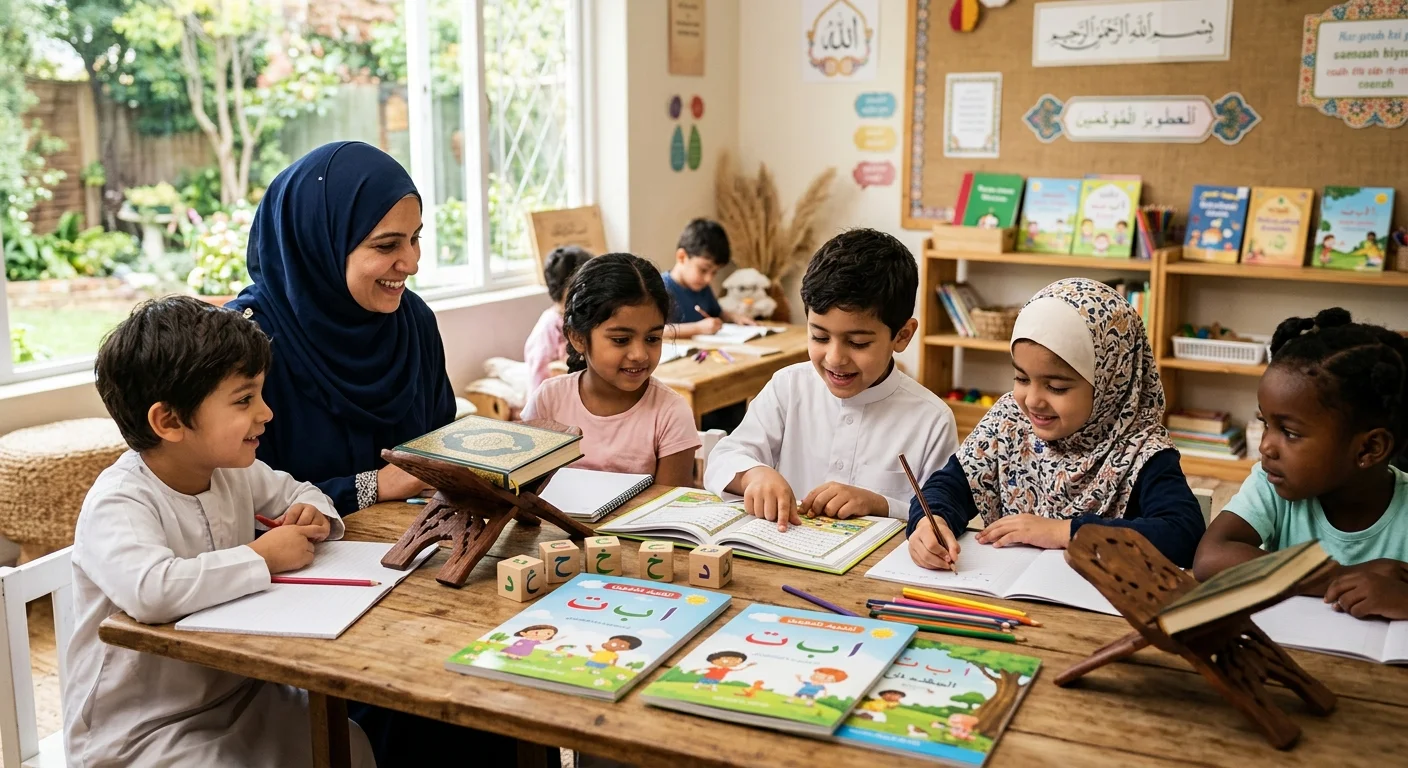
Teaching methods should reflect the child’s age and attention span.
Younger children may benefit from shorter activities, repetition, visual materials, games, and simple examples.
Older children may be ready for more structured reading, vocabulary exercises, grammar explanations, and comprehension activities.
The same curriculum should not necessarily be delivered in exactly the same way to every child.
Make Learning Interactive
Children generally engage more effectively when they participate actively rather than simply listening to a long explanation.
Interactive activities can include:
- Identifying Arabic letters
- Matching words with meanings
- Repeating sounds
- Reading short words
- Recognizing familiar Quranic vocabulary
- Completing simple exercises
- Reviewing previously learned words
- Practicing short Quranic passages
Interactive learning can make repetition feel less monotonous.
Use Repetition Strategically
Repetition is essential for language learning, especially for young students.
However, repeating exactly the same activity over and over can become boring.
Teachers can revisit the same vocabulary through different exercises. A word might first be introduced visually, then pronounced, then used in a short phrase, and later recognized in a Quranic passage.
This allows repetition while maintaining variety.
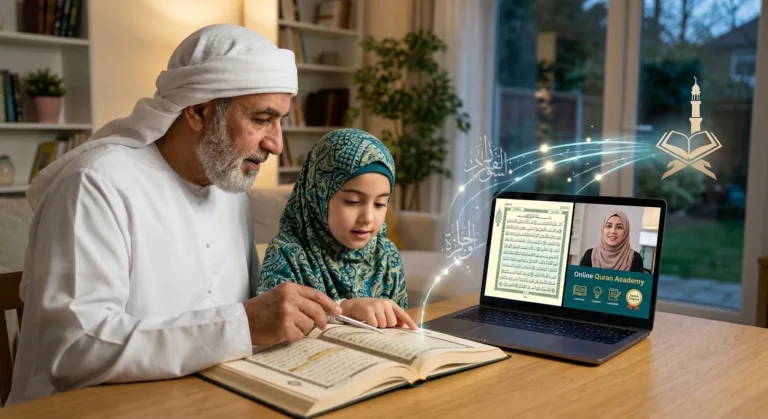
How Can Online Arabic Courses Help Children?
Learning From Home
Online Arabic education allows children to attend lessons from a familiar environment.
For families with busy schedules, this can reduce the need for regular travel to a learning center.
A suitable learning space can help children focus during lessons.
Access to Qualified Teachers
One of the main advantages of online learning is that families are not necessarily limited to teachers who live nearby.
Students can potentially connect with teachers in different locations, giving families more options when choosing an instructor.
Teacher quality remains essential. Parents should evaluate qualifications, teaching experience, curriculum structure, and the instructor’s ability to work with children.
Flexible Scheduling
Online classes can often be arranged around school, homework, extracurricular activities, and family responsibilities.
Flexibility can be especially useful for families with changing schedules.
However, flexibility should not eliminate consistency. Children still benefit from regular lessons and predictable learning routines.
Individual Attention
Some online programs offer individual or small-group instruction.
Individual attention can allow the teacher to hear the child’s pronunciation, identify reading difficulties, and adjust the pace according to the child’s progress.
This can be especially useful for beginners who need frequent correction and encouragement.
read more about improve English writing
What Are the Main Stages of Learning Quranic Arabic for Children?
Stage One: Recognizing Arabic Letters
The first stage is becoming familiar with Arabic letters and their sounds.
Children learn to recognize letters visually and connect them with their pronunciation.
This foundation supports all later reading skills.
Stage Two: Reading Simple Words
After learning the letters, children can begin combining them into words.
They gradually become more comfortable recognizing connected letters and reading simple Arabic forms.
Stage Three: Building Quranic Vocabulary
Once basic reading develops, students can begin learning frequently used Quranic words.
The focus should remain manageable. Children do not need to memorize hundreds of words at once.
A smaller vocabulary learned thoroughly can provide a stronger foundation than a large list quickly forgotten.
Stage Four: Understanding Simple Phrases
Children can begin recognizing how words work together in short Quranic expressions.
At this stage, teachers can introduce basic grammar naturally through examples.
Stage Five: Developing Reading Comprehension
As vocabulary and grammar improve, children can begin understanding simple meanings from the text.
This stage can gradually become more sophisticated as the student’s Arabic skills develop.
Stage Six: More Advanced Quranic Arabic
Older or more advanced students can study deeper grammatical concepts, word patterns, vocabulary relationships, and linguistic features.
The progression should be based on the student’s ability rather than age alone.
How Long Does It Take for a Child to Learn Quranic Arabic?
Progress Varies Between Students
There is no universal timeline for learning Quranic Arabic.
Children progress at different rates depending on their age, previous exposure to Arabic, home environment, learning frequency, memory, motivation, and instructional approach.
A child who hears Arabic regularly may have a different starting point from a child who has never encountered the language.
Consistency Matters More Than Speed
Parents may sometimes focus on how quickly their child is progressing.
However, sustainable learning is often more valuable than rushing through a curriculum.
Regular lessons combined with short periods of practice can help children retain what they learn.
Learning Is a Long-Term Process
Arabic language development can continue for years.
Early childhood education should therefore be viewed as building a foundation rather than completing the entire learning journey.
The goal is to develop confidence, familiarity, and positive learning habits that can support more advanced study in the future.
What Challenges Can Children Face When Learning Quranic Arabic?
Arabic May Be Completely New to Them
Children who do not speak Arabic at home may initially find the alphabet and pronunciation unfamiliar.
This is normal.
Teachers can make the transition easier by introducing concepts gradually and using repetition.
Some Sounds May Be Difficult
Arabic contains sounds that may be challenging for children whose first language does not contain similar sounds.
Consistent listening and pronunciation practice can help.
Children should receive corrections patiently rather than being made to feel discouraged by mistakes.
Vocabulary Can Feel Difficult
Quranic Arabic includes vocabulary that children may not encounter in everyday English or other languages.
Teachers can make vocabulary more accessible by using repetition, examples, visual associations, and familiar contexts.
Maintaining Motivation
Children can lose interest if lessons feel too difficult or repetitive.
A supportive teacher can make a significant difference by setting realistic goals and recognizing progress.
Parents can also encourage children by celebrating improvements rather than focusing only on mistakes.
How Can Parents Support Arabic Learning at Home?
Create a Regular Routine
Parents can help by establishing a consistent study schedule.
Even short periods of review can reinforce what the child learns during formal lessons.
Review Vocabulary Together
Parents can ask children to recall a few words they learned.
Simple questions can turn vocabulary review into a natural family activity.
Encourage Reading Practice
Children should have opportunities to practice reading outside their scheduled lessons.
The amount of practice should be appropriate for their age and ability.
Celebrate Progress
Recognizing achievements can help children develop positive associations with learning.
Parents can celebrate milestones such as completing the alphabet, reading their first Arabic words, learning new Quranic vocabulary, or improving recitation.
Avoid Excessive Pressure
Learning should be challenging enough to encourage growth but not so stressful that children associate Arabic with fear or frustration.
Parents can provide support while allowing the teacher to handle technical correction and instruction.
read more about digital marketing skills
How Can Parents Choose the Right Arabic Course for Kids?
Consider the Child’s Starting Level
Before choosing a course, parents should determine whether the child is a complete beginner, already knows the Arabic alphabet, can read basic Arabic, or has previous Quran learning experience.
A course that is too advanced can discourage a beginner, while a course that is too basic may fail to challenge an experienced student.
Ask About the Curriculum
Parents should understand what the course teaches.
A strong curriculum may include Arabic reading, vocabulary, Quranic language, basic grammar, pronunciation, and age-appropriate comprehension.
If Quran reading is also included, parents should determine how Tajweed is integrated into the learning plan.
Evaluate the Teacher
The teacher’s ability to work with children is just as important as subject knowledge.
A teacher should be patient, clear, encouraging, and capable of correcting mistakes without discouraging the student.
Consider Class Size
One-to-one classes can provide intensive individual attention, while small groups can offer interaction with other students.
Both approaches can work depending on the child’s personality and learning needs.
Look at Scheduling Options
Parents should choose a schedule that the child can realistically maintain.
An ideal lesson time is one when the child is alert rather than tired after a long school day.
Check How Progress Is Measured
Parents should ask how teachers monitor progress.
Clear milestones can help families understand whether the child is developing the expected reading, vocabulary, pronunciation, and comprehension skills.
Arabic Language Learning and Quran Memorization
Language Can Support Memorization
Understanding vocabulary can complement memorization.
When children recognize the words they are memorizing, they may develop a stronger connection between the sound and meaning of the passage.
This does not mean that understanding alone guarantees memorization. Repetition remains essential.
Combine New Memorization With Revision
Students who memorize Quran need regular revision.
Parents and teachers can encourage a balanced routine in which new passages are introduced while previously memorized material is reviewed.
Avoid Turning Every Lesson Into Memorization
Not every Arabic lesson needs to focus on memorization.
Children also need opportunities to understand language, practice reading, learn vocabulary, and develop pronunciation.
A balanced program can make the overall learning experience more comprehensive.
Arabic Reading and Quran Recitation Are Different Skills
Reading Focuses on Language Recognition
Arabic reading involves recognizing letters, words, and sentence structures.
As children progress, they can also develop comprehension.
Recitation Focuses on Correct Delivery
Quran recitation requires attention to pronunciation, articulation, Tajweed rules, rhythm, and other aspects of proper recitation.
A child may be able to read Arabic words but still need additional Tajweed training to recite Quran accurately.
This is why Arabic language education and Quran recitation education can complement each other without being treated as identical subjects.
Making Arabic Learning Enjoyable for Children
Connect Lessons With Familiar Topics
Children can learn more comfortably when examples relate to concepts they already understand.
Teachers can introduce simple Arabic vocabulary through everyday ideas before connecting it to more advanced Quranic language.
Use Short Learning Activities
Breaking a lesson into smaller activities can help children maintain concentration.
For example, a lesson could include pronunciation practice, vocabulary review, reading, a short explanation, and a final review.
Recognize Small Achievements
Children benefit from encouragement.
Recognizing small improvements can help build confidence and motivate them to continue.
Keep Expectations Realistic
Every child develops at a different pace.
Comparing one child with another can create unnecessary pressure. A better approach is to compare the child’s current ability with their previous performance.
The Role of Teachers in Children’s Quranic Arabic Education
Teachers Provide Structured Guidance
Parents may support learning at home, but qualified teachers provide specialized instruction.
They can identify pronunciation issues, explain unfamiliar vocabulary, introduce grammar, and adapt lessons to the student’s level.
Teachers Correct Mistakes
Children may repeat mistakes without realizing them.
A teacher’s feedback can help identify these issues before they become habits.
This is particularly important for Quran recitation, where pronunciation accuracy matters.
Teachers Build Learning Confidence
A supportive teacher can make a child feel comfortable asking questions and making mistakes.
This is an important part of language learning because students need opportunities to practice without being afraid of every error.
read more about healthy study snacks
Learning Arabic language of the Quran can give children an important foundation for understanding and engaging more deeply with Quranic texts. The process begins with simple skills such as recognizing Arabic letters and sounds and can gradually develop into reading, vocabulary, grammar, comprehension, and a greater awareness of the language used in the Quran.
A well-designed Arabic course for kids should recognize that children learn differently from adults. Lessons should be age-appropriate, interactive, structured, and based on realistic expectations. Regular repetition, positive feedback, and gradual progression can help children build confidence while developing their Arabic skills.
Online education can make these opportunities more accessible by connecting children with teachers regardless of where they live. Flexible schedules, individualized instruction, live feedback, and structured curricula can make online learning a practical option for many families.
At the same time, Arabic language learning should not be confused with Quran recitation. A child may learn to read Arabic without mastering Quranic recitation, just as a child may memorize Quranic passages without fully understanding their linguistic meaning. Combining Arabic education with a suitable tajweed course can help develop both sides of the learning experience.
Parents also have an important supporting role. They can create a consistent routine, encourage practice, celebrate progress, and provide an environment where mistakes are treated as a normal part of learning.
Most importantly, children should be given time to develop. Learning the language of the Quran is a long-term educational journey rather than a short-term task. When children receive patient instruction, appropriate materials, regular practice, and encouragement, they can gradually develop the language skills needed to read, recognize, and understand more of the Arabic they encounter in the Quran.
The ultimate goal is not simply for children to memorize vocabulary or complete a particular course. It is to establish a lasting foundation that can support their Quran reading, recitation, understanding, and continued Arabic learning as they grow.