
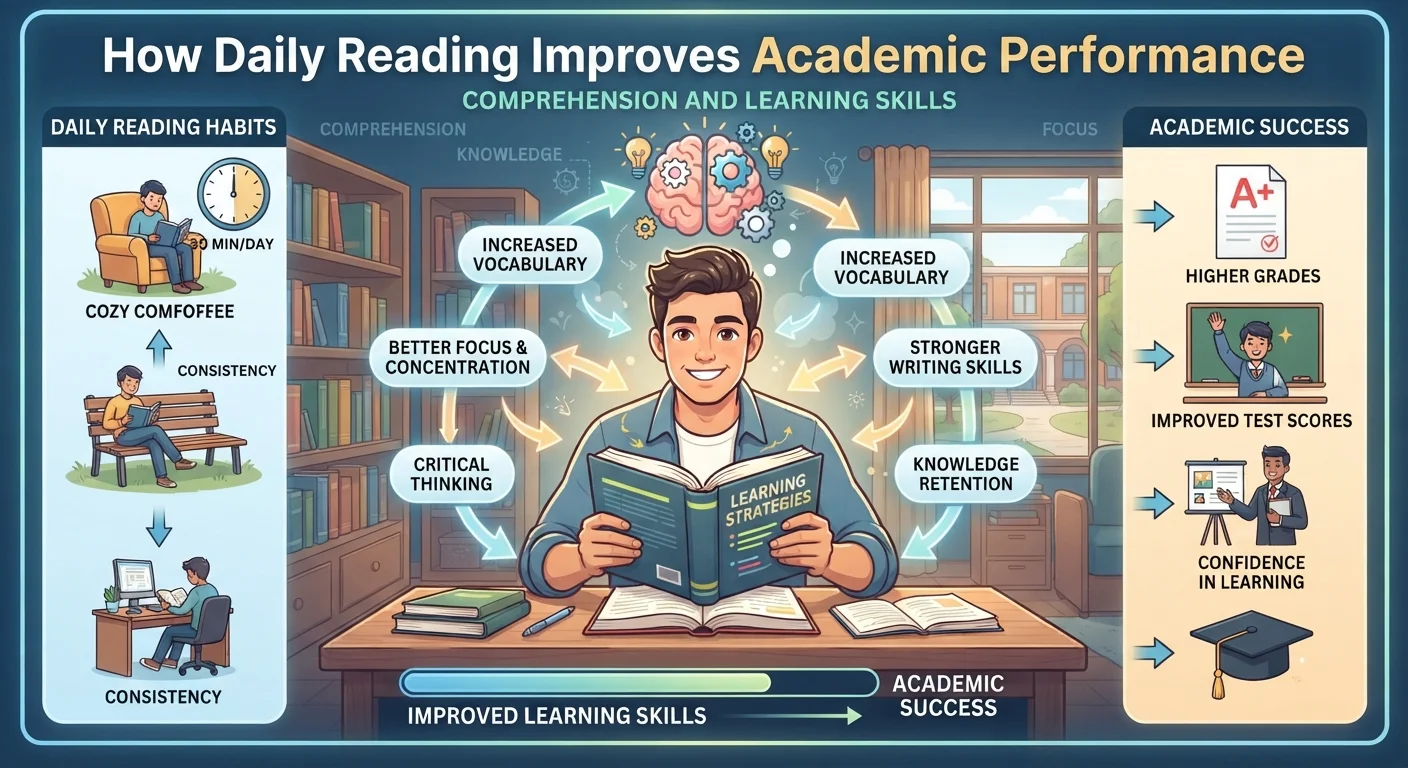
Reading is one of the most powerful habits students can develop for improving their academic performance. Although students often associate academic success with long hours of studying, completing assignments, or memorizing information before examinations, consistent reading can strengthen many of the underlying skills that make learning easier. From understanding complex ideas to expanding vocabulary, improving concentration, developing critical thinking, and remembering information more effectively, reading influences almost every part of the learning process.
The benefits of reading become particularly noticeable when reading becomes a regular daily habit rather than an occasional activity. A student who reads for a reasonable amount of time every day gradually becomes more comfortable with language, more familiar with different styles of writing, and better at extracting meaning from complicated texts. These improvements can translate into stronger performance across subjects, including languages, science, history, social studies, business, and many other academic fields.
Daily reading does not necessarily mean reading textbooks for several hours. Fiction, nonfiction, biographies, essays, magazines, educational articles, and age-appropriate books can all contribute to the development of useful literacy skills. What matters most is consistency, active engagement, and choosing material that provides an appropriate level of challenge.
This article explains how regular reading supports comprehension and learning, how it can contribute to study improvement and academic success, and how students can develop sustainable reading habits that fit naturally into their daily routines.
read more about Quran learning app
What Are the Benefits of Reading for Students?
Reading provides students with much more than entertainment or information. It is a complex mental activity that requires attention, interpretation, memory, vocabulary knowledge, and the ability to connect ideas.
Reading Strengthens Comprehension
Comprehension is the ability to understand and interpret what you read. It is one of the foundations of academic learning because students encounter written information in almost every subject.
A student may know how to pronounce every word in a paragraph without actually understanding its meaning. Strong comprehension requires the reader to identify the main idea, recognize supporting details, understand relationships between concepts, interpret unfamiliar information, and connect new knowledge with what they already know.
Regular reading gives students repeated opportunities to practice these skills.
The more students encounter different types of writing, the more comfortable they can become with identifying the purpose and structure of a text. Over time, they may become faster at recognizing important information and separating major ideas from less important details.
Reading Expands Vocabulary
Vocabulary development is another major benefit of consistent reading.
Students encounter words in context when they read. Instead of simply memorizing a dictionary definition, they can observe how a word is used in a sentence, how it relates to other words, and how its meaning changes depending on context.
For example, a student who frequently reads science material may encounter specialized terms that rarely appear in everyday conversation. A student who reads novels may encounter descriptive language, expressions, and words associated with emotions and human relationships.
A broader vocabulary can make future reading easier because students are less likely to become confused by unfamiliar terminology.
Reading Improves Language Skills
Frequent exposure to well-written material can help students become more familiar with sentence structure, grammar, punctuation, organization, and style.
This can influence writing as well as reading.
Students who regularly encounter different forms of effective writing may gradually develop a better sense of how ideas can be organized into introductions, explanations, examples, arguments, and conclusions.
Reading therefore supports a cycle in which stronger reading skills contribute to stronger writing skills, while stronger writing skills can make it easier to express what a student has learned.
read more about best online courses
How Daily Reading Improves Academic Performance
Academic performance depends on many skills working together. Reading can strengthen several of these skills simultaneously.
Better Understanding of Textbooks
Textbooks often contain dense information, specialized vocabulary, diagrams, examples, and explanations.
Students who are accustomed to reading regularly may find it easier to work through complicated chapters because they have more experience processing written information.
Instead of becoming discouraged after reading a difficult paragraph, they may be more willing to reread it, identify unfamiliar terms, and connect it with surrounding information.
This ability becomes increasingly important as students progress into more advanced levels of education.
Improved Ability to Follow Instructions
Academic assignments frequently contain written instructions.
A student may lose marks not because they lack the knowledge required to complete an assignment, but because they misunderstand what the question is asking.
Regular reading can strengthen attention to wording and context. Students become more familiar with recognizing details, conditions, comparisons, explanations, and specific requirements.
This can be especially useful for examination questions, where a single word can significantly change what the student is expected to do.
Stronger Written Responses
Many academic assessments require students to explain their answers in writing.
Reading exposes students to different ways of presenting information and constructing arguments. This exposure can help them develop more effective written responses.
A student who reads regularly may become more comfortable with organizing an answer logically, selecting appropriate vocabulary, and explaining ideas clearly.
Reading does not automatically make someone an excellent writer, but it provides a large amount of language input that can support writing development.
Reading and Study Improvement
Effective studying is not simply about spending more time with a book. It is about understanding and retaining information.
Reading Helps Students Process Information
When students read consistently, they practice processing information from beginning to end.
They learn to recognize the relationship between individual facts and larger concepts. This is particularly valuable in subjects where understanding is more important than memorization.
For example, when studying history, a student needs to understand not only individual dates but also causes, consequences, relationships, and changes over time.
Reading can help students become more comfortable with this kind of connected information.
Reading Supports Active Learning
Active reading requires the student to interact with the material instead of passively looking at words.
Students can ask questions, underline important ideas, summarize paragraphs, predict what will happen next, compare concepts, and explain information in their own words.
These techniques encourage deeper processing.
A student who finishes a chapter and can explain its central ideas without looking at the page has engaged with the material more actively than someone who simply read the same number of pages without thinking about them.
Reading Makes Revision More Efficient
Strong comprehension can make revision easier.
When students understand information during their initial study session, they may need less time later to reconstruct what the material means.
They can focus their revision on important concepts, difficult topics, and information that they have not yet mastered.
This does not mean reading replaces revision. Instead, effective reading can make revision more productive.
Reading Habits That Support Learning
Developing a reading habit is often more useful than setting an unrealistic goal that cannot be maintained.
Start With a Manageable Amount
Students do not need to begin by reading for several hours every day.
Starting with 15 or 20 minutes can be enough to establish consistency. Once reading becomes part of the daily routine, the amount can gradually increase.
A small habit repeated consistently can produce better results than an ambitious routine that lasts only a few days.
Choose Appropriate Material
Students are more likely to continue reading when the material is interesting and suitable for their current level.
Reading should sometimes be challenging, but material that is consistently far beyond the reader’s ability can become frustrating.
A balanced reading routine can include easier books for enjoyment and more challenging texts for intellectual development.
Create a Regular Reading Time
Attaching reading to an existing routine can make the habit easier to maintain.
For example, a student might read after breakfast, during a scheduled study period, after completing homework, or before bedtime.
The goal is to reduce the number of decisions involved in starting.
When reading becomes a predictable part of the day, it is less likely to be forgotten.
The Relationship Between Reading and Concentration
Modern students often divide their attention between textbooks, notifications, social media, messages, videos, and other digital distractions.
Regular reading provides an opportunity to practice sustained attention.
Reading Requires Continuous Attention
Following a long chapter requires the reader to remain mentally connected to the information.
If attention repeatedly shifts away from the text, comprehension becomes more difficult.
By practicing focused reading regularly, students can become more comfortable with spending longer periods engaged with one task.
This skill can transfer to studying, writing assignments, lectures, and examination preparation.
Reading Can Reduce the Habit of Constant Switching
Frequent task switching can make sustained academic work feel difficult.
A student who spends every free moment moving between short pieces of digital content may initially struggle to read a long chapter.
Developing a daily reading routine creates an alternative pattern: stay with one text, follow its ideas, and continue until reaching a natural stopping point.
The ability to remain engaged with a single task is valuable in almost every academic environment.
read more about best earbuds for online classes
Reading and Critical Thinking
One of the deeper benefits of reading is its potential to encourage critical thinking.
Readers Learn to Evaluate Ideas
Not everything written in a book or article should automatically be accepted as true.
Students can learn to ask questions such as:
- What is the author’s main argument?
- What evidence supports the claim?
- Are there alternative explanations?
- Is the information based on facts, opinions, or assumptions?
- Does the conclusion logically follow from the evidence?
These questions transform reading from a passive activity into an analytical process.
Different Books Present Different Perspectives
Reading multiple authors can expose students to different interpretations of the same subject.
For example, historical events can be discussed from different perspectives. Scientific topics can be explained at different levels of complexity. Social issues can involve competing arguments.
Exposure to multiple perspectives encourages students to compare ideas rather than relying on a single explanation.
Reading Encourages Questioning
Strong readers often become better questioners.
When students encounter unfamiliar ideas, they learn to identify what they understand and what remains unclear.
Questions such as “Why did this happen?”, “How does this work?”, and “What evidence supports this?” encourage deeper learning.
Questioning is particularly useful during study sessions because it helps students identify gaps in their knowledge.
Reading and Memory
Learning requires information to be retained long enough to be used later.
Comprehension Supports Retention
Understanding information generally provides a stronger foundation for remembering it than simply repeating words.
When students understand how ideas relate to each other, they create meaningful connections that can make information easier to recall.
Reading helps students build these connections by presenting concepts within a broader context.
Summarizing Improves Engagement
One useful reading habit is summarizing a section after completing it.
A student can close the book and explain the main idea in a few sentences.
This simple process forces the brain to identify what was important and distinguish it from secondary information.
For academic study, summarization can be particularly effective after completing a chapter or major section.
Connecting New Information With Existing Knowledge
Students learn more effectively when new information is connected to something they already understand.
Reading naturally creates opportunities for these connections.
A student studying economics may connect a new concept with a previous lesson. A biology student may relate a new process to a concept learned earlier. A literature student may compare a character with one encountered in another novel.
These connections can make knowledge more organized and meaningful.
Reading Across Different Academic Subjects
Reading is not limited to language and literature classes.
Reading in Science
Science students regularly encounter complex terminology and explanations.
Reading scientific material helps students become comfortable with technical vocabulary, cause-and-effect relationships, processes, evidence, and structured explanations.
The ability to carefully read a scientific question is also essential because many examination problems contain information that must be interpreted before an answer can be calculated.
Reading in Mathematics
Although mathematics is strongly associated with numbers, reading remains important.
Students must understand word problems, instructions, definitions, explanations, and mathematical terminology.
A student can know how to perform a calculation but still arrive at the wrong answer if the question itself is misunderstood.
Strong reading comprehension can therefore support mathematical problem-solving.
Reading in History
History requires students to understand sequences of events, causes, consequences, perspectives, and changes over time.
Regular reading can make it easier to follow detailed narratives and compare different interpretations.
It also exposes students to a broader vocabulary that can be useful when writing historical explanations.
Reading in Business and Social Sciences
Students studying business, economics, psychology, sociology, or related subjects often encounter abstract concepts and specialized terminology.
Reading widely can help them become more comfortable with conceptual language and arguments.
This is especially valuable when students must compare theories, analyze cases, or write structured essays.
Reading and Academic Confidence
Academic success is influenced not only by knowledge but also by how confidently students approach learning.
Familiarity Reduces Intimidation
Long academic texts can seem intimidating when students rarely read.
With practice, the same type of text may become easier to approach.
Students learn that difficult paragraphs can be reread, unfamiliar words can be investigated, and complicated arguments can be broken into smaller parts.
This can make challenging academic material feel more manageable.
Progress Creates Motivation
Reading improvement is often gradual.
A student may not notice a major difference after one week, but after several months, the change can become obvious. Books that once seemed difficult may become easier, vocabulary may expand, and reading speed may improve.
Seeing this progress can encourage students to continue.
read more about fast charger for students
Reading Speed Versus Reading Comprehension
Students sometimes believe that the fastest reader is automatically the best reader.
That is not necessarily true.
Speed Is Not the Main Goal
Reading quickly has advantages, especially when students face large amounts of material.
However, speed without comprehension provides limited academic value.
A student who reads 50 pages without understanding them has not necessarily learned more than someone who carefully understands 20 pages.
The appropriate reading speed depends on the complexity and purpose of the material.
Slow Reading Can Be Valuable
Difficult academic texts often require slower reading.
Students may need to stop, reread a sentence, define a term, make a note, or connect the idea with previous material.
This is not inefficient. It is part of deep comprehension.
The goal should be to adjust reading speed according to the material rather than trying to maintain the same speed for every type of text.
How Parents and Teachers Can Encourage Reading
Students often develop reading habits more easily when the people around them support the behavior.
Make Reading Accessible
Books should be easy for students to access.
A home or classroom reading environment can include materials covering different interests, levels, and subjects.
When students have choices, they are more likely to find something they genuinely want to read.
Avoid Turning Every Reading Session Into a Test
Reading can support academic development without always becoming an assignment.
If every book is followed by a quiz, students may begin to associate reading only with evaluation.
Allowing some reading to be purely enjoyable can help maintain motivation.
Discuss What Students Read
Simple conversations about books can deepen comprehension.
Parents and teachers can ask students what they found interesting, which character they liked, what they learned, or whether they agreed with an author’s argument.
These discussions encourage students to think beyond the words on the page.
Digital Reading and Traditional Books
Reading today takes many forms.
Reading on Screens
Students frequently read articles, digital textbooks, research material, educational platforms, and electronic books.
Digital reading can be extremely useful because it provides convenient access to large amounts of information.
However, distractions can make focused reading more difficult when students are reading on devices that also display notifications and entertainment.
Printed Books
Printed books provide a physical reading environment with fewer digital interruptions.
Some students find it easier to concentrate on paper, while others prefer electronic formats.
There is no universal requirement to choose one format.
The most important factor is whether the student can read attentively, understand the material, and retain what they learn.
Building a Long-Term Reading Habit
The greatest benefits usually come from consistency.
Set a Realistic Daily Goal
A student might begin with a goal such as 10 to 20 minutes per day.
The purpose is to make the habit easy enough to maintain even on busy days.
Once the routine becomes established, students can gradually increase the amount of reading.
Keep a Reading Record
Tracking reading can provide motivation.
Students can record the title of the book, number of pages, reading time, or important ideas they learned.
The purpose is not to create pressure. It is simply to make progress visible.
Alternate Between Genres
Reading different types of material can keep the habit interesting.
A student might alternate between fiction, nonfiction, biographies, science topics, history, essays, and educational books.
Different genres challenge the brain in different ways and expose readers to varied vocabulary and writing structures.
read more about learn English at home
The benefits of reading extend far beyond improving the ability to recognize words on a page. Daily reading can strengthen comprehension, vocabulary, concentration, memory, critical thinking, writing ability, and the confidence needed to approach difficult academic material.
For students, these skills form the foundation of effective learning. Better comprehension can make textbooks easier to understand. Stronger vocabulary can improve written and spoken communication. Better concentration can support longer study sessions, while stronger critical thinking can help students evaluate arguments and solve problems.
The most effective approach is not necessarily to read as much as possible. It is to read consistently and actively.
A student who spends a manageable amount of time reading every day can gradually build stronger reading habits. By asking questions, summarizing information, connecting new ideas with existing knowledge, and reflecting on what they read, students can turn reading into a powerful learning strategy.
Daily reading also supports study improvement because it strengthens the skills students rely on when preparing for exams, completing assignments, understanding lectures, and working through complicated academic material.
Ultimately, academic success is rarely the result of one habit alone. It develops through a combination of effective study strategies, persistence, organization, healthy routines, and continuous learning. Reading can become one of the simplest and most sustainable parts of that process.
The pages a student reads today can build the vocabulary, knowledge, concentration, and comprehension skills that make tomorrow’s learning easier.