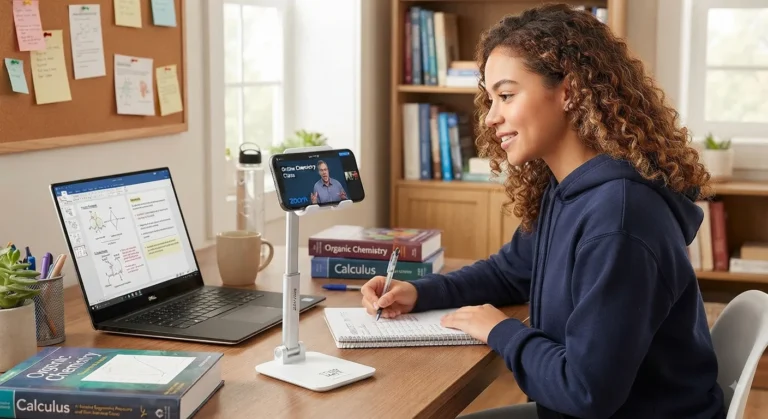
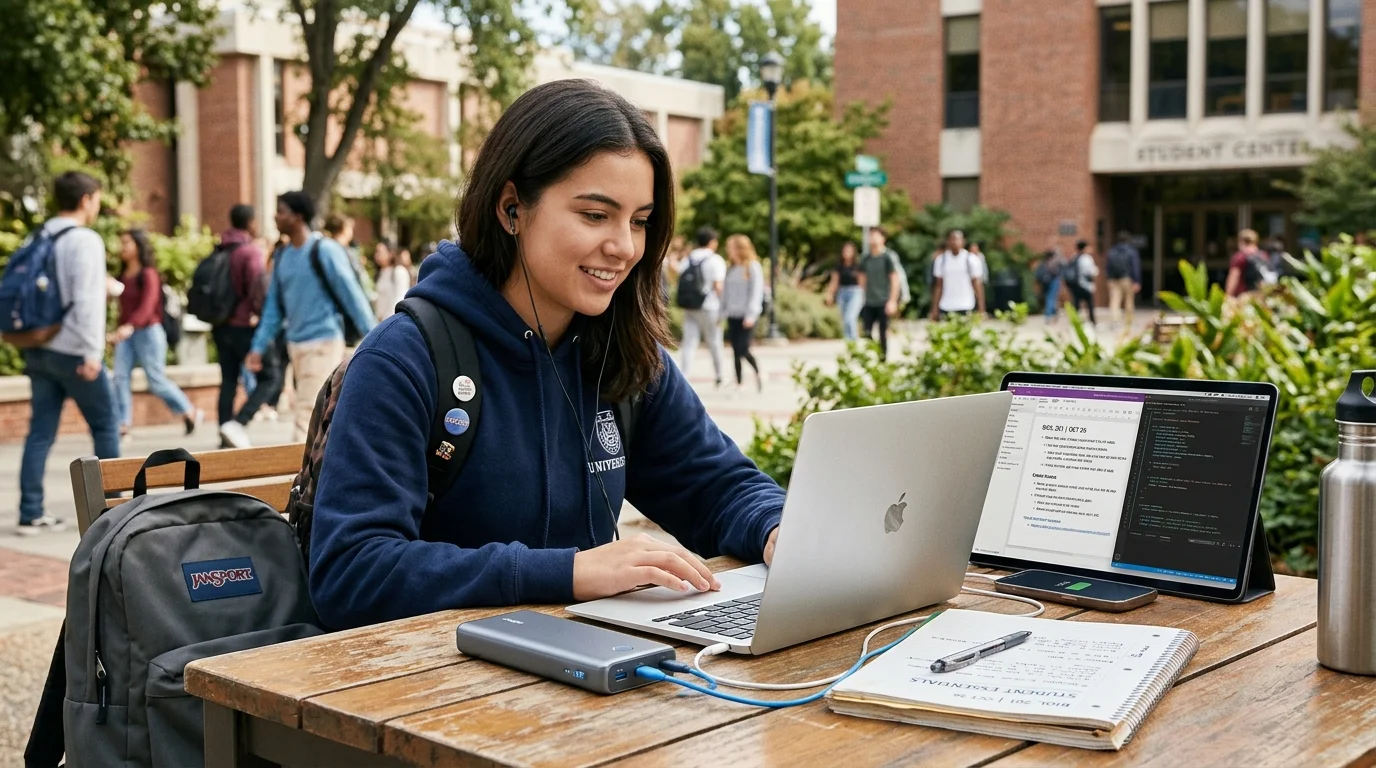
For many students, a smartphone is no longer just a device for calls and messages. It can be a study tool, communication channel, navigation device, entertainment platform, payment method, camera, calendar, alarm clock, and sometimes even a digital student ID. Laptops and tablets are equally dependent on battery power, especially when students spend long hours away from home.
This is why a power bank for students can become much more than a convenient gadget. In the right circumstances, it can be an important part of a student’s everyday essentials. A reliable portable charger can provide extra battery capacity when there is no convenient electrical outlet nearby, helping students stay connected and productive throughout the day.
However, not every student needs to carry a power bank every day. Someone who spends most of the day at home or has easy access to charging stations may find one unnecessary. Another student who attends long lectures, commutes for hours, studies in libraries, participates in campus activities, or travels frequently may consider a portable charger essential.
The decision therefore depends on lifestyle, device usage, daily schedule, and access to power.
This guide explains when a power bank for students becomes an essential accessory, what features matter most, how to choose the appropriate capacity, how to use one safely, and why portable power can be particularly useful during a busy academic schedule.
read more about learn English at home
Why Battery Life Matters to Students
Smartphones Are Part of Everyday Student Life
Students often depend on their phones throughout the day. A smartphone may be used to check lecture schedules, communicate with classmates, access educational platforms, receive university notifications, take notes, scan documents, use authentication apps, and search for information.
This constant use can drain a battery much faster than expected.
A student might begin the morning with a fully charged phone and assume it will last until evening. But navigation, video calls, social media, streaming, photography, mobile data, Bluetooth, and educational applications can consume considerable power.
When the battery reaches a critically low level at the wrong time, the consequences can be more significant than simply being unable to browse social media.
A Dead Phone Can Create Practical Problems
Imagine a student leaving campus after a long day with only a few percent of battery remaining.
They may need navigation to find transportation, contact a family member, order a ride, access a digital ticket, receive an important message, or make an emergency call.
In such situations, a portable charger can provide an extra layer of security.
The value of a mobile battery is therefore not necessarily measured by how often it is used. Sometimes its importance comes from knowing that backup power is available when something unexpected happens.
When Does a Power Bank Become an Essential Student Accessory?
When You Spend Long Hours on Campus
Students who remain on campus from early morning until late afternoon or evening are among the people most likely to benefit from carrying a portable charger.
A typical day might include lectures, breaks, library sessions, group projects, meals, and extracurricular activities.
If there is no convenient charging point during those hours, a power bank can help keep essential devices running.
When You Commute Long Distances
Long commutes are another strong reason to consider a power bank.
Students who spend one or two hours traveling to university may use their phones for music, videos, reading, navigation, messaging, or coursework.
Over several hours, this usage can significantly reduce battery capacity.
A portable charger can be particularly useful when buses, trains, or other forms of public transportation do not provide reliable charging facilities.
When Your Phone Battery Is Aging
Smartphone batteries gradually lose their original capacity through normal use.
A phone that once comfortably lasted an entire day may eventually require charging before the day ends.
Replacing the phone simply because its battery no longer lasts as long may be unnecessary for some students.
A power bank can provide a practical temporary solution, especially when the device still performs well in other areas.
When You Use Your Phone for Academic Work
Students who use smartphones heavily for education can benefit from backup power.
Educational applications, PDF readers, online lectures, research tools, cloud services, note-taking applications, and video conferencing can all contribute to battery consumption.
If your phone is part of your study system, keeping it operational becomes more important than simply having access to entertainment.
When You Travel Frequently
Students who travel between cities, visit family, attend conferences, participate in competitions, or take educational trips may find a portable charger particularly valuable.
Travel often creates situations where access to electrical outlets is unpredictable.
A compact power bank can provide independence from the nearest wall socket.
Power Bank for Students: What Makes It Useful?
Portability
The first characteristic of a student-friendly power bank is portability.
Students already carry notebooks, books, laptops, chargers, headphones, water bottles, and other belongings. A power bank that is unnecessarily large or heavy can become annoying to carry.
For everyday use, compact designs are often more practical than extremely large models.
Sufficient Capacity
Capacity determines how much energy the power bank can store.
Power banks are commonly described using milliampere-hours, or mAh. A higher number generally means more stored energy, although the actual amount of charge delivered to a device depends on efficiency, voltage conversion, cable quality, charging protocols, and other factors.
Students should therefore avoid choosing solely based on the biggest advertised capacity.
Charging Speed
Charging speed can be just as important as capacity.
A power bank that provides sufficient power can restore useful battery percentage during a short break between classes.
For example, a student might have only 20 or 30 minutes before the next lecture. A fast-charging portable charger can make that short window much more useful.
Number of Ports
A student may carry more than one device.
They could have a smartphone, wireless earbuds, tablet, smartwatch, or another accessory.
A power bank with multiple outputs can be convenient when charging several compatible devices.
However, multiple ports do not automatically mean that every connected device will receive the maximum charging speed simultaneously. Students should check the manufacturer’s specifications.
read more about benefits of reading
Choosing the Right Power Bank Capacity
Small Capacity Power Banks
Lower-capacity models are usually compact and easy to carry.
They may be appropriate for students who simply want emergency backup power rather than multiple full charges.
A small model can fit easily into a backpack pocket or even some larger clothing pockets.
Its main advantage is convenience.
Medium Capacity Power Banks
A medium-capacity power bank can offer a useful balance between portability and battery backup.
For many students, this category is attractive because it can provide enough additional energy for a long campus day without becoming excessively heavy.
It is particularly useful for students who regularly need to recharge a smartphone once during the day.
High Capacity Power Banks
Higher-capacity models can provide considerably more backup power.
They may be appropriate for students who spend very long periods away from electrical outlets or who need to charge multiple devices.
However, greater capacity generally means greater size and weight.
For someone who already carries a heavy backpack, a huge power bank may be unnecessary.
Capacity Should Match Your Routine
The ideal capacity is not necessarily the largest capacity available.
A student should ask:
- How long am I usually away from a wall charger?
- How much battery does my phone consume during an average day?
- Do I need to charge more than one device?
- Do I travel frequently?
- How much extra weight am I comfortable carrying?
The answers will help determine whether a small, medium, or larger portable charger makes sense.
Portable Charger vs. Wall Charger
Why Students May Need Both
A portable charger should not necessarily replace a conventional wall charger.
A wall charger is generally the fastest and most convenient option when electrical power is available.
A portable charger becomes valuable when access to an outlet is limited.
Think of the two as serving different purposes.
The wall charger is your primary charging method, while the power bank is your backup or mobile charging solution.
The Best Strategy
Charge your devices fully before leaving home when possible.
Carry the power bank only when your schedule makes it useful.
This approach prevents unnecessary battery anxiety while avoiding the need to carry a heavy accessory every day.
Power Banks for Students Who Use Laptops
Smartphones Are Not the Only Consideration
Many students now depend on laptops for coursework.
Engineering students, design students, business students, computer science students, and other university students may spend several hours working on laptops outside the home.
A traditional small power bank designed only for smartphones may not be capable of charging a laptop.
USB-C Power Delivery
Students who need laptop charging should pay attention to USB-C Power Delivery, commonly known as USB-C PD.
Compatible laptops can sometimes be charged through USB-C using sufficient power output.
However, compatibility varies significantly between laptops and power banks.
Before purchasing, check the laptop’s required charging power and the power bank’s supported output specifications.
Higher Power Means Different Requirements
Charging a laptop generally requires more power than charging a smartphone.
A power bank capable of comfortably charging a phone may not provide enough wattage for a laptop.
Students should therefore distinguish between a basic smartphone power bank and a higher-output power station or laptop-compatible power bank.
Power Banks for Tablets and Other Devices
Tablets
Students who use tablets for reading textbooks, handwritten notes, digital drawing, or lectures can also benefit from portable power.
Tablet batteries are often larger than smartphone batteries, so students should consider capacity and output carefully.
Wireless Earbuds
Earbuds generally require much less power than smartphones or tablets.
Even a compact power bank can provide enough energy for repeated earbud charging, provided the appropriate cable or charging setup is available.
Smartwatches
Smartwatches also have small batteries but may require specialized charging accessories.
A power bank with a suitable USB output can sometimes power the watch’s charging cable, although compatibility should be confirmed.
Why Students Should Care About Charging Speed
Fast Charging During Short Breaks
University schedules can leave students with only brief periods between classes.
A slow charger may not provide much additional battery during a 15-minute break.
A compatible fast-charging system can restore significantly more usable energy during that same period.
Power Bank Output Matters
Students should look at the power bank’s output specifications rather than simply assuming that every portable charger is fast.
The device, cable, and power bank must support compatible charging standards for the intended speed.
Using a high-capacity power bank with a low-output port may still result in slow charging.
Don’t Confuse Capacity With Speed
A power bank with a huge mAh rating is not necessarily a fast charger.
Capacity describes stored energy, while output power relates to how quickly energy can be delivered.
Both characteristics matter, but they answer different questions.
Safety Considerations for Student Power Banks
Choose Reliable Products
A power bank contains rechargeable lithium-based battery cells and should be manufactured with appropriate safety protections.
Students should avoid suspiciously cheap products from unknown sources, particularly when specifications appear unrealistic.
A reputable manufacturer and reliable seller can reduce the risk of receiving a poorly constructed battery product.
Look for Safety Protections
Depending on the product, safety systems may include protection against overcharging, overheating, short circuits, overcurrent, and excessive discharge.
Students should check the manufacturer’s documented safety features.
Avoid Damaged Power Banks
Do not continue using a power bank that is swollen, cracked, leaking, unusually hot, or physically damaged.
Battery damage can create serious safety risks.
A damaged unit should be removed from service rather than kept in a backpack.
Keep It Away From Extreme Heat
High temperatures can be harmful to rechargeable batteries.
Do not leave a power bank exposed to intense heat for extended periods, such as inside a parked car under direct sunlight.
Students should also avoid covering a charging power bank with heavy clothing or other materials that could interfere with heat dissipation.
How to Carry a Power Bank Safely
Use a Protective Pocket
Keep the power bank in a separate compartment of your backpack when possible.
This reduces the chance of it being scratched or damaged by keys, pens, or other hard objects.
Protect the Ports
Dust and debris can accumulate around charging ports.
Keeping the power bank in a clean compartment can help maintain reliable connections.
Avoid Loose Metal Objects
A portable battery should not be thrown into a bag with loose metal objects that could potentially contact exposed connectors or ports.
Organizing your backpack is a simple safety habit.
read more about career courses
Power Banks and Student Essentials
What Belongs in a Student Backpack?
A student’s everyday essentials may include:
- Smartphone
- Laptop or tablet
- Notebook
- Pens
- Water bottle
- Headphones
- Identification card
- Charging cable
- Wall charger
- Power bank
- Personal items
Not everyone needs every item every day.
The purpose of a student essentials checklist is to identify what supports your specific schedule rather than encouraging students to carry unnecessary equipment.
When the Power Bank Moves From Optional to Essential
A power bank becomes more important when several conditions occur at once.
For example, a student may:
- Spend 10 hours outside the home
- Use their phone heavily
- Commute long distances
- Have an aging smartphone battery
- Depend on mobile navigation
- Need digital university services
- Have limited access to wall outlets
In that situation, carrying backup power is highly practical.
The Role of Cables
A Power Bank Is Useless Without Compatibility
One of the easiest mistakes is carrying a power bank while forgetting the charging cable.
Students should make sure the cable is compatible with both the power bank and the device.
Depending on the devices involved, this could mean USB-C to USB-C, USB-A to USB-C, Lightning-compatible cables for certain older devices, or another appropriate connection.
Carry a Short Cable
A short charging cable can be easier to manage while walking around campus.
It can reduce tangled wires and take up less space.
Some power banks also have integrated cables, which can be convenient for students who frequently forget separate accessories.
Should Students Carry a Power Bank Every Day?
Not Necessarily
A power bank is not automatically essential for every student.
If your phone lasts comfortably all day, your campus has accessible charging stations, and you spend most of your time near electrical outlets, you may not need one daily.
Carrying unnecessary weight can make a backpack less comfortable.
Consider Your Worst-Case Day
A better approach is to think about the days when battery life becomes a problem.
If you frequently experience low-battery situations, a power bank may be worth carrying.
If your battery rarely drops below 40 or 50 percent before you return home, you may only need it on specific days.
Carry It Strategically
Students can keep the power bank at home when their schedule is short and pack it on long campus days.
This creates a flexible approach rather than treating the accessory as mandatory every morning.
Power Banks for Students During Exams
Why Exams Increase the Importance of Backup Power
Exam periods can create unusually long days.
Students may travel to unfamiliar locations, spend hours studying in libraries, communicate with classmates, access schedules, and rely heavily on their phones.
A low battery during an exam day can create unnecessary stress.
Keep Your Phone Available for Emergencies
Even if you try to minimize phone use while studying, keeping enough battery for communication can be important.
A compact power bank can provide peace of mind without requiring access to a wall outlet.
Power Banks for Group Projects
Collaboration Requires Connectivity
Group assignments often involve messaging, file sharing, video calls, online documents, and project management applications.
Students working together outside the classroom may spend several hours using their phones and laptops.
A portable charger can help prevent battery problems from interrupting collaboration.
One Power Bank Can Help a Group
Some higher-capacity models offer multiple outputs.
This can be useful when several students need emergency charging.
However, sharing one power bank can also reduce charging speed or drain the unit quickly, depending on its capacity and output capabilities.
Power Banks for Commuting Students
Long Travel Changes the Equation
Students who live far from campus have different charging requirements from students who live nearby.
A two-hour commute each way can result in several hours of daily phone use before the student even arrives home.
A power bank can provide valuable backup during these long periods.
Navigation Makes Battery More Important
Navigation apps can consume substantial battery because they may use GPS, mobile data, screen brightness, and continuous processing.
A student who relies on their phone for transportation directions should consider backup power more seriously.
read more about mobile learning
Power Banks for International Students and Travelers
Travel Creates More Uncertainty
Students traveling internationally may spend long periods in airports, stations, buses, or unfamiliar cities.
Access to electrical outlets is not always guaranteed.
A portable charger can make it easier to keep phones operational for maps, translation tools, boarding information, communication, and digital tickets.
Check Travel Rules
Before flying, students should check the current airline and airport rules concerning lithium-ion battery capacity and transportation.
Power banks are generally subject to specific aviation safety requirements, and rules can vary by airline and jurisdiction.
Do not assume that every high-capacity battery can be packed in checked baggage.
How to Extend Your Phone Battery Before Using a Power Bank
Reduce Screen Brightness
The display can be a major source of battery consumption.
Reducing brightness when practical can help extend battery life.
Turn Off Unnecessary Connections
Bluetooth, location services, mobile data, and other connections can consume energy depending on how they are used.
Turn off features you do not need.
Use Battery Saver Mode
Most modern smartphones include battery-saving features that can reduce background activity and extend remaining battery life.
Using these features can delay the moment when you need your portable charger.
Close Unnecessary High-Consumption Activities
Video streaming, gaming, navigation, and high-resolution photography can drain batteries quickly.
When battery life becomes critical, reduce demanding activities until you have access to charging.
How to Maintain a Power Bank
Charge It Periodically
Do not assume that a power bank will remain fully charged forever.
Recharge it periodically, particularly if it has been stored for an extended period.
Don’t Leave It Permanently Connected
Although modern charging systems have protections, there is generally little reason to keep a portable battery connected to a charger continuously after it has completed charging.
Follow the manufacturer’s recommendations.
Store It Properly
Keep the power bank in a dry environment away from extreme temperatures.
If you will not use it for a long time, follow the manufacturer’s storage guidance regarding charge level.
Common Mistakes Students Make With Power Banks
Buying Based Only on Capacity
A huge capacity number may look impressive, but it does not tell you everything about charging speed, size, weight, efficiency, or compatibility.
Ignoring Weight
Students often carry their belongings for hours.
A power bank that is technically excellent but unnecessarily heavy may end up staying at home.
Forgetting the Cable
The portable charger cannot help if the appropriate cable is missing.
Keep a compatible cable with the power bank.
Using Damaged Accessories
Damaged cables and power banks should not be ignored.
Replace faulty accessories rather than continuing to use them.
Choosing an Unknown Product Solely Because It Is Cheap
Price matters to students, but battery products are not an area where unrealistic specifications should be trusted blindly.
A reliable product with documented specifications is generally a better choice.
How Much Should Students Spend?
Focus on Value Rather Than the Lowest Price
Students often have limited budgets, so price is understandably important.
However, the cheapest option is not always the most economical if it fails quickly or provides unreliable charging.
Consider durability, capacity, output, safety features, warranty coverage, and portability together.
Match the Purchase to Your Needs
A student who needs only emergency smartphone charging does not necessarily need a premium high-capacity model designed for laptops.
On the other hand, a student who spends all day on campus and needs to charge several devices may benefit from investing in a more capable option.
read more about Quran apps
Should Students Carry a Power Bank?
A power bank for students is not an absolute necessity for everyone, but it can be one of the most practical accessories for students with demanding schedules.
The real value of a portable charger comes from flexibility. It gives students the ability to recharge their devices without depending entirely on electrical outlets. This can be especially helpful during long university days, extended commutes, library sessions, exams, group projects, travel, and unexpected delays.
The right power bank should match the student’s actual needs. A compact model may be ideal for someone who wants emergency smartphone backup, while a larger and higher-output option may be more appropriate for students who need to support multiple devices or compatible laptops.
Capacity, charging speed, portability, output compatibility, safety features, number of ports, and reliability should all be considered before choosing one. Students should also remember that a power bank is only useful when it is charged and paired with the appropriate cable.
Ultimately, the best approach is not to ask whether every student must carry a power bank. Instead, ask whether your daily routine regularly places you in situations where battery power becomes a problem.
If you regularly leave home in the morning and return at night with a nearly empty phone, depend heavily on your mobile device for university activities, commute long distances, or spend hours in places without convenient charging, a portable charger can move from a nice-to-have gadget to a genuine everyday essential.
For students whose devices already last comfortably through the day and who have easy access to wall outlets, carrying one every day may not be necessary.
In short, a portable charger is best viewed as a backup power solution that becomes increasingly valuable as your schedule becomes longer, your devices become more important, and your access to traditional charging becomes less predictable. Choosing the right size and capacity for your routine can give you the convenience of reliable mobile power without adding unnecessary weight to your student backpack.